

Quick Answer: What Do You and Wu Mean?
You (有, yǒu) can mean having, presence or being. Wu (无, wú), written 無 in traditional Chinese, can mean lacking, absence or nonbeing. In the Daodejing (道德经, Dàodéjīng), the pair helps describe how things work and how they come to be. The English translation changes with the kind of question a passage asks.[1][2][3][4]
- Use: A vessel has a material form and an open space that helps make it useful.
- Emergence: The received text puts the pair into a statement about the origin of things.
- Explanation: Commentators ask what a thing with definite form depends on.[1][2][3]
“Presence and absence” can make a practical example clear. “Being and nonbeing” is often more helpful for discussions of what gives things their ground.

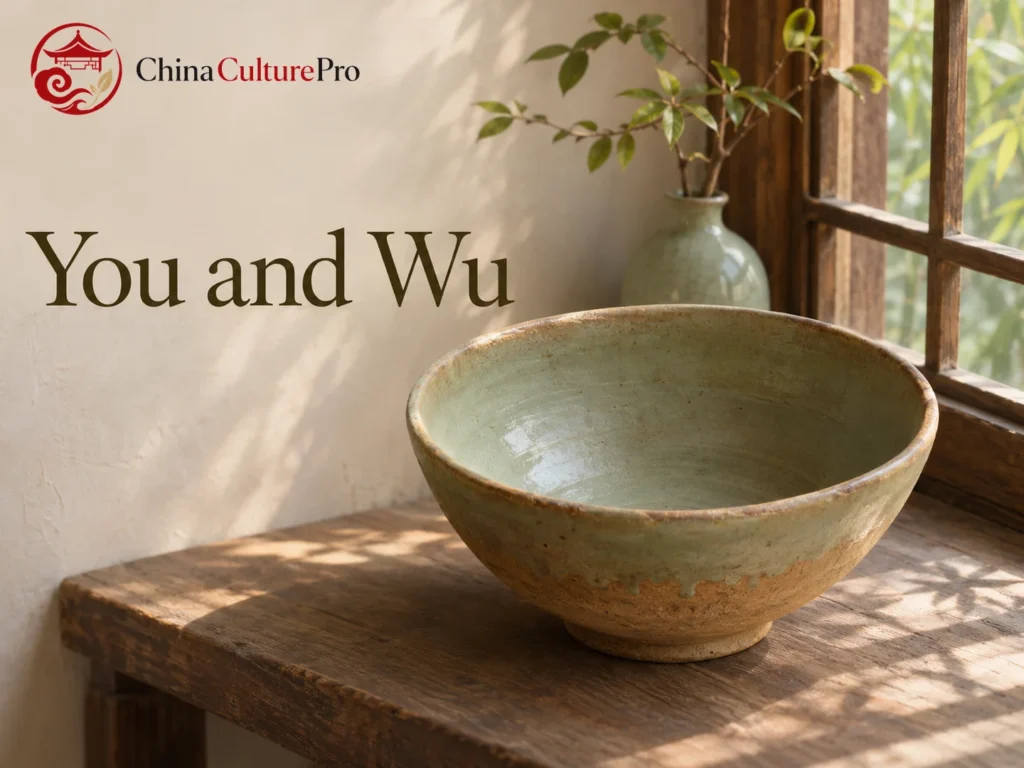
A bowl can be described by the clay that forms it and by what its shape makes available. A passage that asks why such an object works has a different aim from one that asks how formed things arise at all. The same Chinese words can help pose both questions.
How an Empty Space Makes an Object Useful
Chapter 11 uses three examples: the hub of a wheel, the inside of a vessel and the openings of a room. Each has formed material. In each, an opening or an unfilled space is important to what the thing can do. The vessel gives an immediate case because its clay provides a boundary within which it can hold something.[1][2]
An empty space in a vessel depends on how the clay is arranged. The clay also gains a particular use through the space it encloses. The pair directs attention to the relation between the visible form and what the form leaves open. This is a useful point of comparison with the uncarved block, which gives shaping a different role in another chapter.[1][2]
What Chapter 40 Asks About Emergence
In the received wording of Chapter 40, the many things arise from being, which arises from nonbeing. A reader now has to consider what it could mean for what is formed or present to depend on what has no definite form. Chapter 11 helps a reader hear the distinction, while Chapter 40 gives it a different explanatory job.[2][3][4]
A translation such as “something arises from nothing” makes the wording striking. It can also make nothing sound like a thing that produces something else. The reading depends on how the passage understands arising or dependence. That interpretive problem gives a reason to keep the two Chinese words in view.[2][3][4]
How Wang Bi Reads the Pair
Wang Bi (王弼, Wáng Bì) uses the relation between being and nonbeing to ask how many different forms can have a common ground. What lacks a definite form can have an explanatory role without adding a new object to the list of objects it explains. The relation belongs to his interpretation of the Way and its expression. For a related reading of how the Way’s influence is expressed, see de as virtue and potency.[3][4]
Other writers associated with Xuanxue disputed how that explanation should work. Guo Xiang, for example, gives emphasis to things arising and transforming of themselves. The difference shows that a common vocabulary leaves open more than one account of the origin and order of things.[3][4]
FAQs About You and Wu
Is wu always best translated as nothingness?
Absence or lack can be clearer where a text describes a useful opening. In a philosophical account of what things depend on, nonbeing may make the explanatory question easier to see.[1][3][4]
Does Chapter 11 value absence by itself?
Its examples place what is absent within a formed object. The use of the vessel depends on the space and on the clay that gives the space its shape.[1][2]
Are wu and wu wei the same idea?
Wu is the word for absence or nonbeing in the passages discussed here. Wu wei is a related expression for nonaction or nonforcing and asks a different question about conduct.[2][3][4]
出典
[1] Book of Changes Academy. Daodejing 11 and Wang Bi’s Commentary
[2] The Chinese Literature Translation Trust. Daode Jing: Chinese Text and English Translation
[3] Stanford Encyclopedia of Philosophy. Neo-Daoism
[4] Stanford Encyclopedia of Philosophy. Metaphysics in Chinese Philosophy