

Quick Answer: What Are Red Bean Buns?
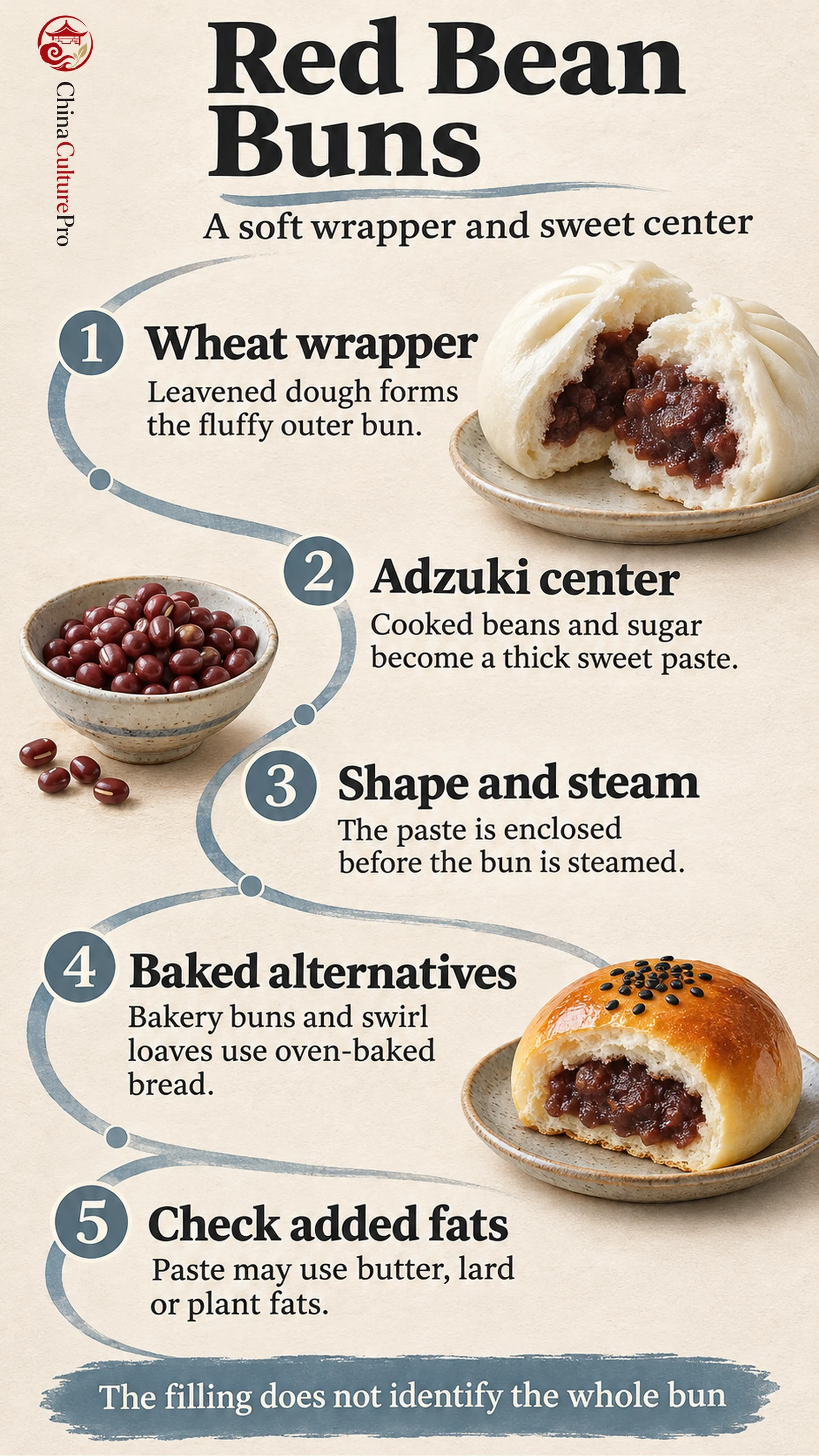
Red bean buns(豆沙包,dòushābāo)are Chinese sweet buns enclosing adzuki bean paste. The familiar steamed version combines a soft, leavened wheat wrapper with a denser, sweet center.[1][3]
- Wrapper: A flour-based dough rises into a fluffy bun.
- Filling: Cooked adzuki beans are sweetened and made into paste.
- Method: Steaming cooks the enclosed bun without a baked brown crust.
- Setting: Breakfast, snacks and some family celebrations all feature them.
Baked red bean buns also exist, so an English menu name does not always identify the outer bread.
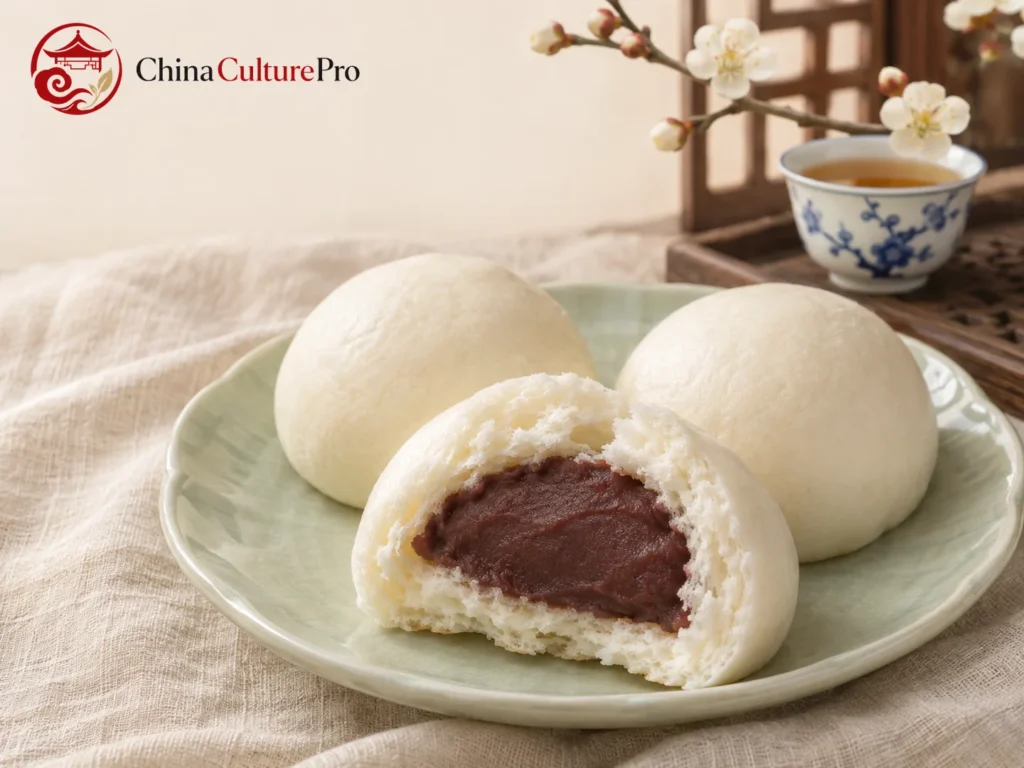
Pulling a bun apart reveals the essential contrast: a light wrapper surrounding a smooth or slightly textured bean center.
The Wheat Wrapper and Sweet Red Bean Paste
The shell is a dough, not a rice sheet. Flour, yeast and liquid form the basic leavened wrapper; individual recipes may add sugar, oil, milk or another leavener. A published milk-based version shows why a pale steamed bun is not automatically dairy-free.[1]
The filling starts with adzuki beans rather than ordinary red kidney beans. Cooking softens them so they can be mashed or blended with sugar. The paste is thick enough to remain enclosed, rather than flowing like a sweet soup.[1][2]
Smoothness varies. Blended paste gives a more even center, while a less processed version can retain bean texture. The appearance of a dark filling does not reveal which preparation or added fat was used.[5]
Fat is a separate question from the beans themselves. Documented paste recipes include butter, coconut oil, lard or vegetable shortening, while another uses beans and sugar without added fat. “Red bean” therefore identifies the main ingredient, not the complete dietary profile.[1][2][4]
How Steamed Red Bean Buns Are Made
A common preparation keeps the bean paste and dough separate until assembly:[1]
- Cook the adzuki beans until soft.
- Sweeten and work them into a paste, then let it firm for filling.
- Prepare and portion the leavened dough.
- Flatten each portion, enclose the paste and seal the opening.
- Allow the shaped buns to rise and steam them.
The seal can sit underneath a smooth round bun; visible pleats are not compulsory. A small red dot may be added as a marker, but it is optional rather than an ingredient that defines the dish.[2]
Steamed Bao and Baked Red Bean Bread
| スタイル | 外側 | Filling arrangement |
|---|---|---|
| Steamed red bean bun | Pale, soft leavened wheat dough | A center enclosed before steaming |
| Baked red bean bun | Oven-baked bread with a colored surface | Enclosed paste or decorative exposed layers |
| Red bean swirl loaf | A larger baked bread loaf | Paste distributed in visible swirls |
A Chinese bakery-style preparation uses milk, cream and egg in its bread dough and finishes the risen pieces in an oven. It can produce individual buns or a swirl loaf. The shared bean filling does not make that enriched bread identical to steamed bao.[5]
Breakfast and Family Food Traditions
Red bean buns belong to the wider Chinese breakfast repertoire. A Shanghai childhood account recalls buying them from specialist vendors alongside other morning foods. That memory documents one urban eating setting, not a claim that every household prepared them in the same way.[3]
Home preparation offers another setting. A northern Chinese family account describes making batches of plain steamed buns and red bean buns for Lunar New Year, using optional markings to distinguish them. The same account also describes eating them outside the festival.[2]
Choosing and Eating Red Bean Buns
First ask whether the bun is steamed or baked. Then check whether the filling is smooth or more textured and whether it includes added fats. For vegetarian food choices, lard in the paste matters even when no meat is visible.[4][5]
If avoiding dairy or egg, check the outer bread as well as the center. An enriched baked dough and a milk-based steamed wrapper can contain ingredients absent from a simpler water-based version.[1][5]
Compare custard buns or sweet potato buns by their filling and shell, rather than assuming that all white steamed buns taste alike.
FAQs About Red Bean Buns
Are Red Bean Buns Always Steamed?
No. Steamed bao and baked bakery buns both exist. Ask which outer bread the menu describes.[3][5]
Does Red Bean Paste Contain Meat?
The main ingredient is bean, but some pastes use lard. Others use plant fats or no added fat; check the recipe.[1][2][4]
Are Red Bean Buns Gluten-Free?
The familiar steamed and baked versions use wheat flour. The bean filling alone does not make the whole bun gluten-free.[1][5]
出典
[1] Catherine Zhang. Red Bean Buns
[2] Wei Guo. Red Bean Buns: Dou Sha Bao
[3] Judy Leung. Steamed Red Bean Buns
[4] Everybunny Eats. Chinese-Style Red Bean Paste
[5] Kaitlin and Judy Leung. Red Bean Bread