

Quick Answer: What Is Beijing Ai Wo Wo?
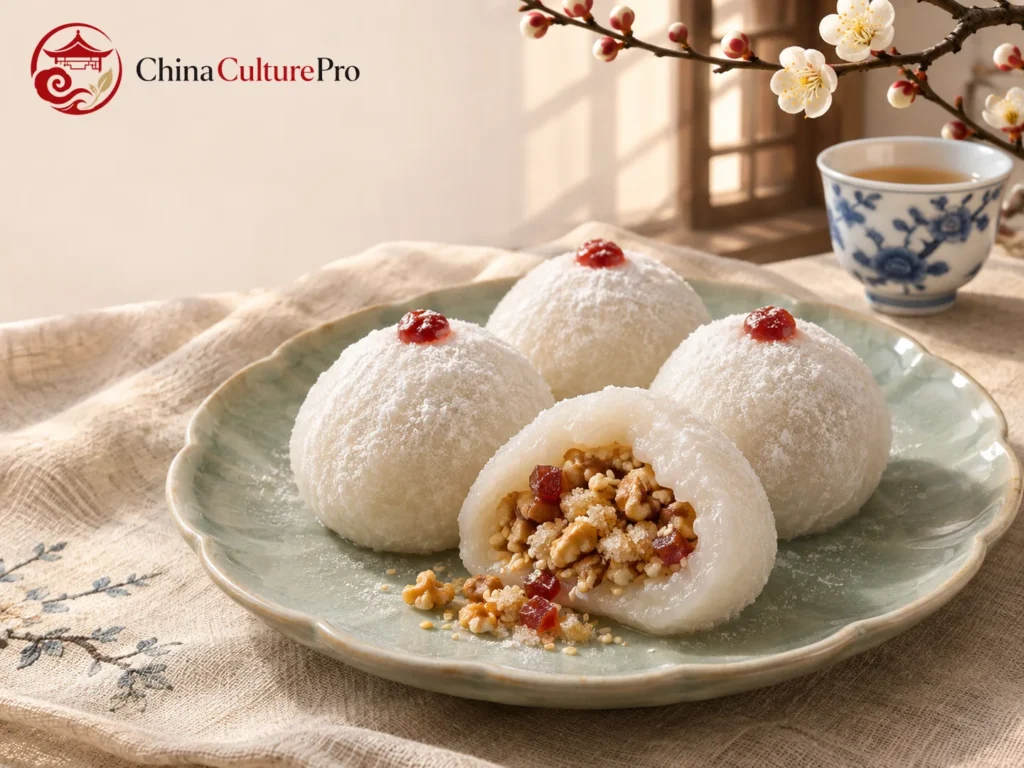
Ai Wo Wo(艾窝窝,àiwōwo)is a Beijing sweet snack made by enclosing a filling in a soft, cooked glutinous-rice shell. The familiar result is a small white ball with a dusted surface.[1][2]
- Shell: Cooked sticky rice is worked into a cohesive outer layer.
- Filling: Sugar, nuts, seeds and preserved fruit form familiar combinations.
- Surface: A light powder helps reduce sticking.
- Serving: It is commonly assembled as a cool, ready-to-eat snack.
The rice shell, filling and dusting are separate components; a rice-based shell does not make every ingredient rice.
A bite moves from a soft white outside to a sweet center that may be crumbly and fruity or smooth and paste-like.
The Cooked Rice Shell, Filling and Dusting
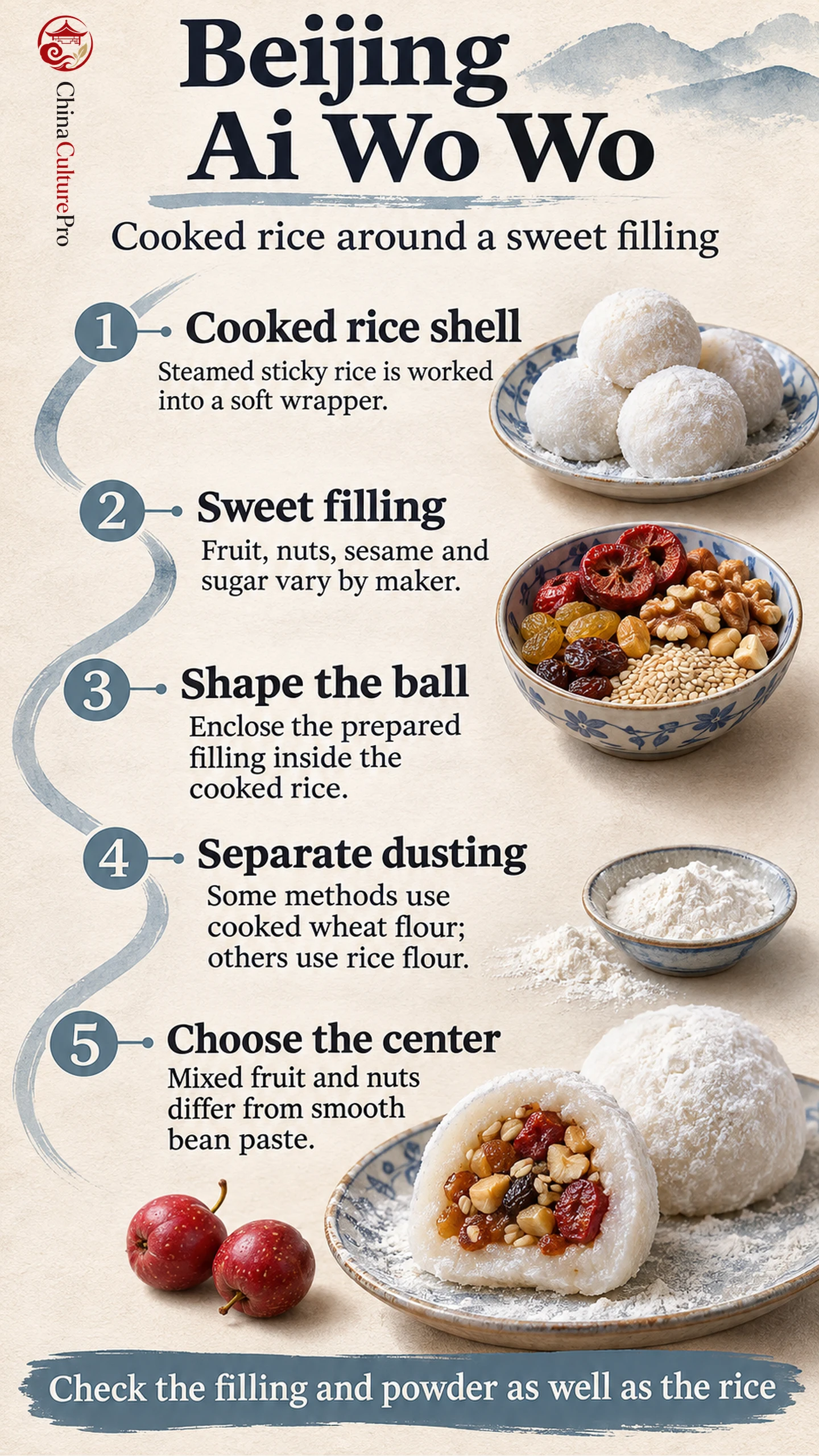
The shell begins with glutinous rice cooked before wrapping. In one pastry chef’s method, the cooked rice is worked until it holds together while retaining some grain texture. It is not simply raw rice flour kneaded around a filling and served uncooked.[2]
The sweet filling has a different role. A sesame version combines prepared sesame, sugar and sesame oil. Other examples bring together nuts and preserved fruit, giving a more varied bite than the soft rice outside.[3][5]
Dusting is another ingredient to ask about. A published method uses cooked wheat flour to prevent the sticky rice from clinging during shaping and to coat the finished balls. Other descriptions use cooked glutinous rice flour. The white powder is not automatically identical across makers.[3][4]
How Ai Wo Wo Is Shaped
One documented cooked-rice method follows this order:[2]
- Steam the prepared glutinous rice until cooked.
- Work the rice into a cohesive mass suitable for wrapping.
- Portion it and flatten each piece into a small wrapper.
- Add the prepared sweet filling and close the rice around it.
- Round the piece and finish the surface or decorative top.
The rice is already cooked when the filling is enclosed. A sesame-filled preparation can be finished with a dusting and a small fruit decoration. These finishing choices are separate from cooking the rice itself.[3]
Fruit-and-Nut Filling and Bean-Paste Variations
| Filling style | Documented ingredients | Eating contrast |
|---|---|---|
| Mixed fruit and nuts | Preserved fruit, hawthorn, nuts, seeds and sugar in varying combinations | Small distinct pieces inside the soft shell |
| Sesame and sugar | Prepared sesame with sugar and sesame oil | A concentrated seed aroma |
| Red bean paste | A smooth bean-based filling | A more uniform, paste-like center |
A writer’s visits to Beijing snack shops distinguish fruit-and-sugar fillings from red bean paste versions. That distinction is useful for choosing texture; it need not become a claim that only one filling can exist under the name.[4]
The same paste can appear in red bean buns, but those have a wheat-dough wrapper. The center alone does not identify the whole food.
A Beijing Snack and a Living Craft
Beijing’s local food records place ai wo wo within the city’s halal-style snack tradition. That cultural association describes a food tradition; a customer still needs to check a particular seller’s ingredients and arrangements when those requirements matter.[1]
Craft also survives through demonstrations and shared making. A reported workshop led by a Beijing snack artisan shows participants mixing filling, portioning the rice shell and wrapping the sweets. The account records flavors such as preserved fruit, osmanthus, sesame and nuts.[5]
Today the snack is available beyond a single season. Its place among Chinese street snacks is easier to understand through ingredients and craft than through an unverified story about an emperor naming it.[1]
Choosing and Eating Ai Wo Wo
Choose the center first: mixed fruit and nuts offer a different bite from a smooth bean paste. Then ask about the powder, since a cooked-rice shell can still carry wheat-flour dusting.[3][4]
Check nuts, peanuts, sesame and the actual flour when managing ingredient restrictions. These can be present in small pieces or powders rather than obvious large toppings.[2][3][5]
For another cooked-rice wrapper, compare Shanghai cifantuan. Its larger breakfast-roll format and fillings create a different eating experience from this small sweet ball.
FAQs About Ai Wo Wo
Is Ai Wo Wo Made from Raw Rice-Flour Dough?
The cooked-rice method described here steams the rice before shaping and filling it.[2]
Is Every Ai Wo Wo Filled with Red Bean Paste?
No. Mixed fruit-and-nut fillings and sesame-and-sugar versions are documented as well.[3][4][5]
Is Ai Wo Wo Automatically Gluten-Free?
No. Some methods use cooked wheat flour for dusting. Check the filling, powder and preparation environment.[3]
出典
[1] Beijing Municipal Culture and Tourism Publicity Center. Ai Wo Wo
[2] Guo Tie / The Beijing News. Ai Wo Wo: An Interview on Its Ingredients and Making
[3] Wenming Xiangli / Kepu China. Beijing Snack Ai Wo Wo
[4] Beijing Chronicles. Ai Wo Wo: Fruit Filling or Red Bean Paste?
[5] Beijing Tourism. Ai Wo Wo and the Snack-Making Craft of Southern Beijing