

Quick Answer: What Was the Qing Grand Council?
The Grand Council, or Junjichu (軍機處, Jūnjīchù), was a small body of senior officials who worked close to the Qing emperor. It grew out of confidential work in the Yongzheng reign. Its later responsibilities included reviewing reports, advising on policy and drafting imperial instructions.[1][2]
- 産地: Its predecessors handled urgent affairs during Qing campaigns in the northwest.[1][2]
- Work: Councillors consulted with the emperor and helped prepare instructions based on his decisions.[1][2]
- Authority: The council’s influence came from access to the ruler and the documents he needed.[1][3]
The council eventually dealt with both military and civil affairs.[1][2]
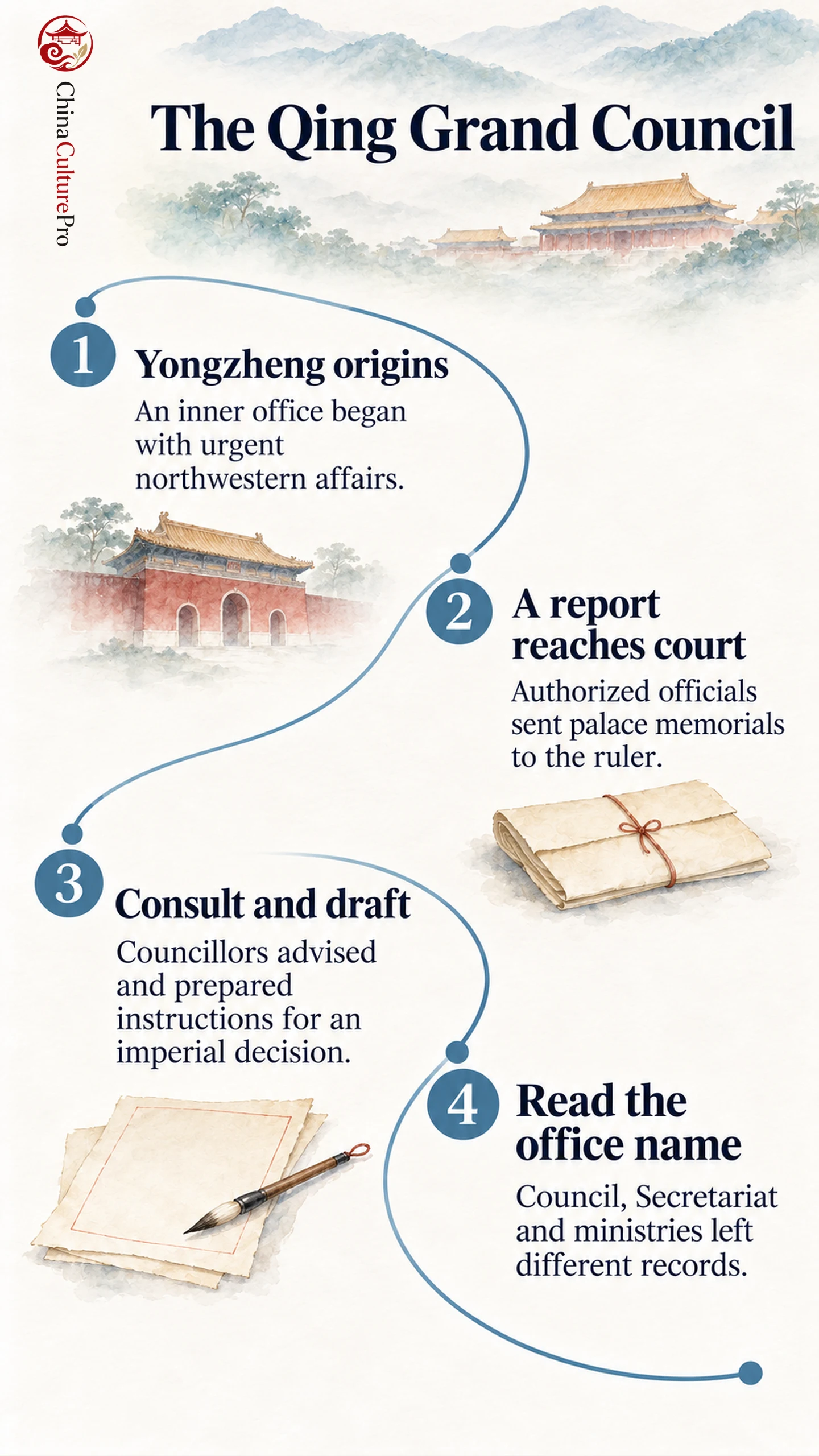
To follow Qing decision-making, imagine a report arriving from a province and a reply leaving the capital. The office structures matter because each reveals who had access to the report, who prepared advice and whose authority the reply carried.[1][2][3]
From a Confidential Office to a Standing Council
The Palace Museum gives 1729 as the usual date for the small office set up during the Yongzheng emperor’s northwestern campaigns. It records a formal change of name in 1732 and notes scholarly disagreements about when the institution began. Later rulers expanded its responsibilities across the Qing dynasty, and it remained in use until the governmental changes of 1911.[1][2]
The office’s location near the inner court made consultation convenient. The comparison of Chinese imperial palaces explains why a formal audience hall and offices close to the ruler served different functions.[1][2]
Follow a Document Through the Court
A palace memorial (奏摺, zòuzhé) was a written report that authorized officials could send directly to the emperor. This private channel developed under Kangxi and expanded under Yongzheng. Some memorials carried provincial information that needed restricted circulation.[3]
A report could prompt the emperor to consult his councillors. They could help review the issue, propose a response and draft an order based on his decision. The surviving paperwork makes it possible to distinguish an official’s report, a draft and a reply. Read the type of document before attributing its words to the ruler, a councillor or a provincial official.[1][2][3]
How the Grand Council Fit Among Qing Offices
| 仕事場 | What its records can show |
|---|---|
| Grand Council | Deliberation close to the emperor and preparation of instructions or replies.[1][2] |
| Grand Secretariat | Processing of regular submissions and formal court documentation.[1][3] |
| Six Ministries | Administration within continuing fields of work, with their own responsibilities and paperwork.[1][2] |
Names help set the scale of the evidence. Reports from Jiangsu during the Taiping war, for example, can show provincial dealings involving Li Hongzhang and Charles Gordon. To learn what the ruler or a particular central office did, look for a memorial sent to court or a reply bearing imperial authority.[3][4]
FAQs About Qing Grand Council
When was the Grand Council founded?
The Palace Museum identifies 1729 as the usual date for the founding office and 1732 for a formal change of name. Other dates reflect different readings of its formation.[1][2]
Did the Grand Council make decisions on its own?
Councillors advised, reviewed documents and handled drafts. The emperor retained formal decision-making authority.[1][2]
What is the difference between the Grand Council and the Grand Secretariat?
The Grand Secretariat was an established institution for processing routine paperwork. The Grand Council gave a smaller group direct access to the emperor for confidential and increasingly broad business.[1][2][3]
出典
[1] Palace Museum, Beijing. Grand Council institutions, dating and responsibilities
[2] Palace Museum, Beijing. Qing Grand Council documents and materials exhibition
[3] National Palace Museum. Understanding Qing Dynasty Palace Memorials
[4] Jonathan Chappell, Modern Asian Studies. Commemoration and official correspondence in the Taiping War