

Quick Answer: Who Was Qian Xuan?
Qian Xuan (钱选, Qián Xuǎn) was a scholar-painter of the Song–Yuan transition whose landscapes, figures, birds and flowers helped shape literati painting (文人画, wénrén huà).[1]
- スタイル: He used both richly colored landscapes and quieter ink with light color.[2]
- 表現力: Familiar natural subjects could carry feelings of loss and withdrawal.[4]
- Legacy: His compositions circulated through later copies as well as works bearing his name.[7]
Check each museum’s attribution before treating a celebrated image as a painting by his own hand.
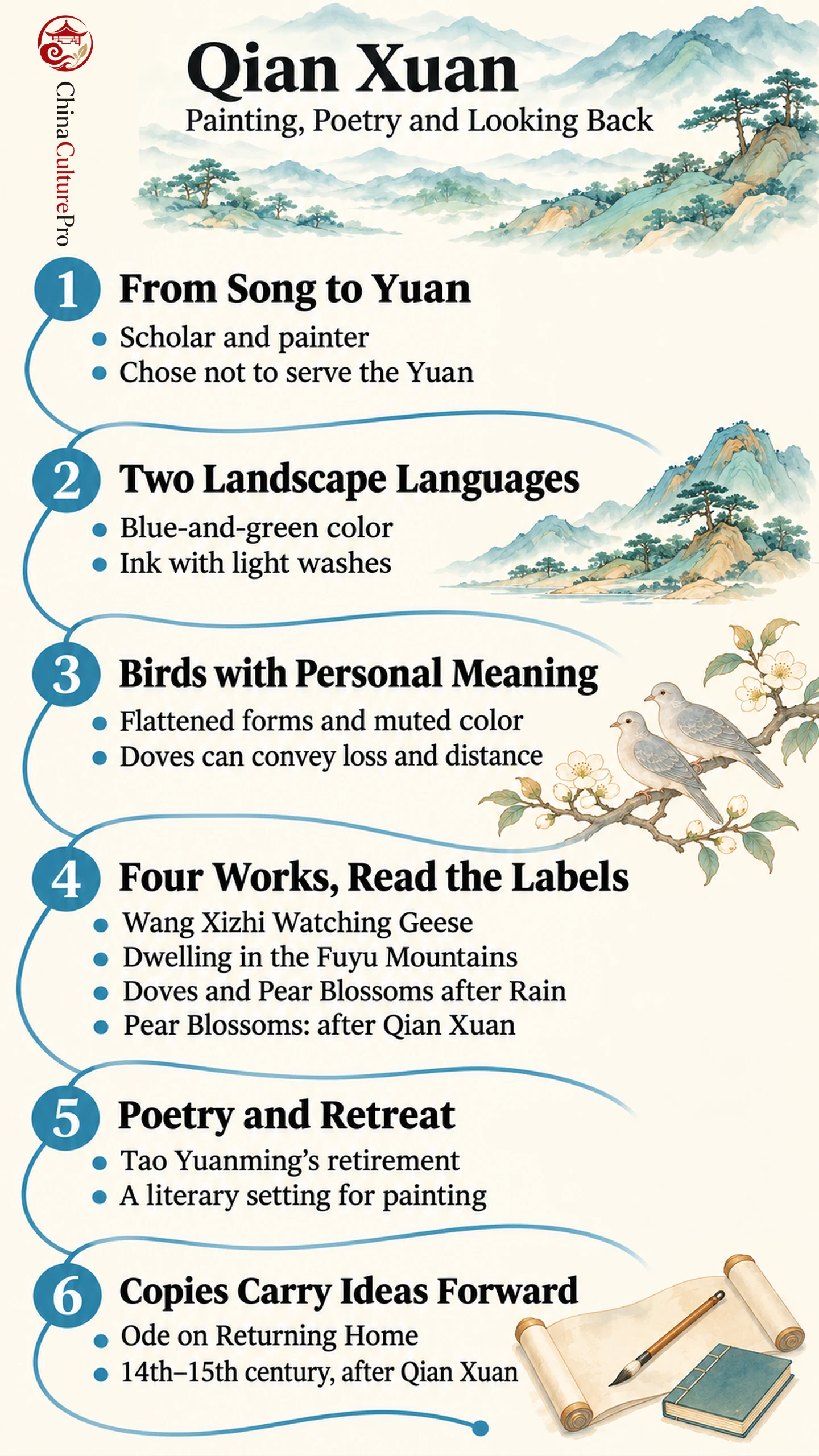
Looking old was a creative choice in Qian Xuan’s art. Angular mountains, flattened branches and restrained color could give a picture distance from the immediate world. To understand that choice, read the image alongside its literary setting and the evidence for its authorship.
A Song Scholar in a Changed Political World
Qian came from Wuxing, in present-day Zhejiang, and belonged to the educated world of the late Song dynasty. After its fall, he declined to serve the Yuan government and devoted himself to poetry and painting.[1]
The term yimin (遗民, yímín) describes a person remaining loyal to a fallen dynasty. Qian’s position after the conquest provides a context for the deliberate distance from ordinary reality in some of his landscapes.[3]
How Old Styles Became a Personal Language
A blue-and-green landscape (青绿山水, qīnglǜ shānshuǐ) uses strong mineral colors within an outlined structure. In the geese-viewing tradition associated with Qian, repeated angular forms and colored rock surfaces evoke earlier painting.[1] The result can feel carefully constructed rather than like a continuous view through real space.
His landscape painting also included quieter palettes. Dwelling in the Fuyu Mountains uses fine ink contours, washes and lightly applied color to describe a mountain setting surrounded by water.[2] Comparing these approaches reveals a range within his taste for older visual languages.
In Doves and Pear Blossoms after Rain, flattened birds and a compressed branch replace the lively naturalism expected of a spring subject. Muted color supports a mood of distance and loss.[4]
Four Works and Their Museum Attributions
Read the collection labels together: these works belong to different parts of Qian’s artistic record.
| Work | Date and format | Collection and attribution |
|---|---|---|
| Wang Xizhi Watching Geese | About 1295; handscroll, ink, color and gold on paper | Metropolitan Museum of Art; Qian Xuan.[3] |
| Dwelling in the Fuyu Mountains | Yuan dynasty; handscroll, ink and color on paper | Shanghai Museum; Qian Xuan.[2] |
| Doves and Pear Blossoms after Rain | Late 13th century; handscroll, ink and color on powdered paper | Cincinnati Art Museum; Qian Xuan.[5] |
| Pear Blossoms | About 1280; handscroll, ink and color on paper | Metropolitan Museum of Art; unidentified artist, after Qian Xuan.[6] |
The geese subject draws on a story about Wang Xizhi: the movement of the birds’ necks was said to inspire his calligraphy.[1] Read this as an artistic legend about learning from nature.
Dwelling in the Fuyu Mountains presents a secluded local landscape. Its later inscriptions and collecting seals also record a long history of viewing and ownership.[2] The surface carries both the painted retreat and traces of its subsequent reception.
Poetry, Copies and the Reach of His Art
In Pear Blossoms, the relationship between poem, fine line and pale color links the flowering branch with personal feeling.[6]
Ode on Returning Home, dated to the 14th–15th century and catalogued after Qian, preserves another composition through copying. Its subject invokes 陶淵明 and his preference for a home and garden retreat over official life.[7]
These works help explain Qian’s place in literati painting: a picture can express a cultivated position toward the world, while copies allow its visual ideas to reach later viewers.
FAQs About Qian Xuan
Was Qian Xuan a Song or Yuan painter?
Both contexts matter. He was educated under the Song and continued painting after its fall under the Yuan.[1]
Why does Wang Xizhi appear with geese?
The subject recalls the legend that their movements offered inspiration for his calligraphy.[1]
Are all famous Qian Xuan paintings by his own hand?
No. Pear Blossoms and Ode on Returning Home are currently catalogued as works after Qian.[6][7]
出典
[1] National Palace Museum. Viewing Geese at the Lanting Pavilion
[2] Palace Museum. Dwelling in the Fuyu Mountains
[3] Metropolitan Museum of Art. Wang Xizhi Watching Geese
[4] Cincinnati Art Museum, via Google Arts & Culture. Doves and Pear Blossoms after Rain: Curatorial Interpretation
[5] Cincinnati Art Museum. Doves and Pear Blossoms after Rain: Collection Record
[6] Metropolitan Museum of Art. Pear Blossoms
[7] Metropolitan Museum of Art. Ode on Returning Home