

Quick Answer: What Is Ordinary World About?
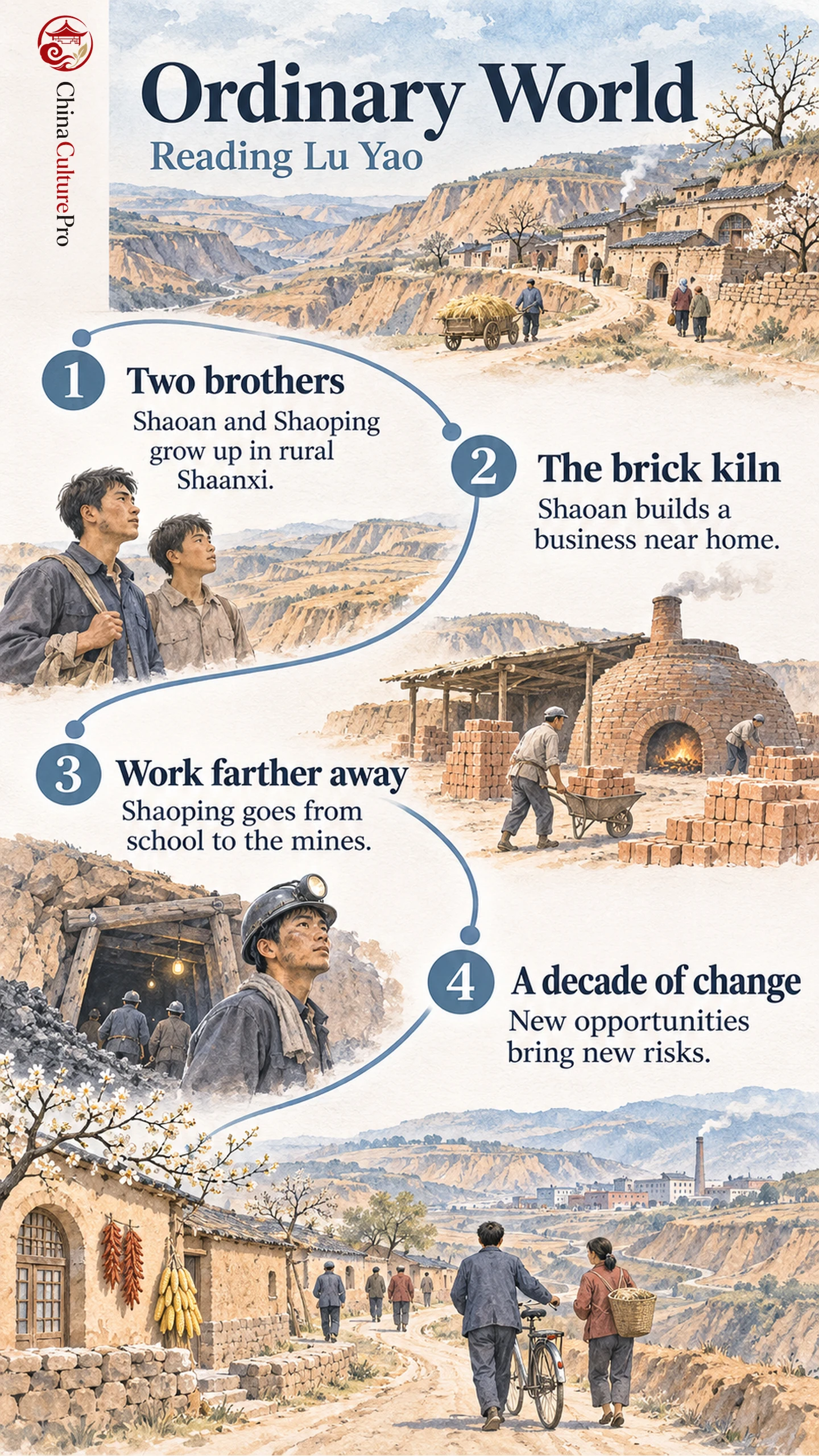
*Ordinary World* (平凡的世界, Píngfán de Shìjiè) is a three-part novel by Lu Yao (路遥, Lù Yáo). From 1975 to 1985, it follows two brothers from a farming family in northern Shaanxi. Sun Shaoan (孙少安, Sūn Shào’ān) takes on work and responsibilities near home. Sun Shaoping (孙少平, Sūn Shàopíng) moves from school to jobs in construction and mining.[1][2][3]
- Shaoan’s story: Changes in farming and credit give him a chance to build a brick business.
- Shaoping’s story: Education widens what he can imagine, while manual work gives him a living beyond the village.
- The decade: Economic reform changes what people can attempt and the risks they have to take.
The brothers offer two views of the same changes. Their jobs give them different ways to respond.[1][2]
The novel starts with people who have to make a living before they can make plans. The kinds of plans they can make change over the next decade.
The Sun Brothers and the People Around Them
| 登場人物 | What to follow |
|---|---|
| Sun Shaoan | The elder brother works in the village, takes on family obligations and later runs a brick kiln. |
| Sun Shaoping | The younger brother goes to county high school and later finds work away from home, including in a coal mine. |
| Tian Runye (田润叶, Tián Rùnyè) | A teacher with childhood ties to Shaoan. Her family has a different idea of whom she should marry. |
| Tian Xiaoxia (田晓霞, Tián Xiǎoxiá) | A friend and later partner of Shaoping. Her own path leads into journalism. |
Keep the two brothers and the two women with the surname Tian distinct. Runye’s story begins with years of familiarity between her and Shaoan. Xiaoxia and Shaoping come to know each other as young people looking toward a wider world.[1]
Why Shaoan Builds a Life in the Village
Shaoan stays close to home to work. He and Runye care for each other. Her father opposes the match. Shaoan marries Xiulian, and their household becomes part of his effort to make a living through the changes in farming and village work. The story keeps the work a household does close to the decisions it can afford to make.[1]
The changes reach Shaoan first through farming. He backs a new arrangement for his production team despite resistance from the village leadership. He later earns money hauling bricks and puts it toward a kiln of his own. The two decisions are connected. One concerns how a village organizes its work, and the next concerns what a worker can do with what he has earned.[1]
Shaoan takes a larger risk when he tries to expand the kiln. Borrowing gives him the means to try, and the trouble he has with the expansion shows how much he can lose. His ability to recognize an opportunity matters. So do the other people, the credit and the practical knowledge the business requires. The setbacks make clear which parts of the business he cannot supply alone.[1][2]
How Shaoping’s Work Takes Him Beyond Home
The younger brother first leaves for county high school. Poverty shapes the way he takes part in school life, including how he feels around other students. His friendship with Xiaoxia opens a connection to books and ideas beyond what school and work demand of him. It also gives her a place in the story beyond the village relationships around his brother.[1]
Shaoping later leaves home to take on temporary labor, finds construction work and becomes a coal miner. Each move gives him a different view of what workers can make of their lives. Xiaoxia’s journalism gives her another way of entering places beyond her home. When their paths come together, their relationship has to make room for work that sends them in different directions. Late in the novel, the mine also becomes a place where Shaoping is responsible for other workers. He learns what he can do there even as the job places him in danger.[1]
How to Read the Novel’s Decade of Change
Watch for the point at which a change in rules becomes a choice a character can make. A different arrangement for farming matters to a person deciding whether to stay. A loan matters to someone who has to make enough bricks to repay it. Large changes become legible through decisions a family might have discussed around a table. The three parts follow the brothers from the limited choices they face as young men to commitments that reach beyond their immediate household. Pay attention to the people their work comes to affect, from students to coworkers and neighbors.[1][2]
Yu Hua’s Brothers follows two other brothers through some of the same broad changes with a sharper emphasis on spectacle. In Shen Congwen’s Border Town, another rural household’s prospects are tied to a much smaller world around a ferry.
FAQs About Ordinary World
What years does Ordinary World cover?
The story spans 1975 to 1985. Publication began in 1986. The novel follows the late Cultural Revolution and early reform years through changes in village and urban life.[1][2][3]
When did Ordinary World win the Mao Dun Literature Prize?
The novel received the third Mao Dun Literature Prize in 1991. The work is generally issued in three parts.[3][4]
出典
[1] China National Radio. Ordinary World, three-part novel synopsis
[2] Liang Xiangyang. The historical period and creative origins of Lu Yao’s Ordinary World
[3] Heilongjiang CPPCC. Ordinary World, publication and award record
[4] Peking University Library. Ordinary World, Mao Dun Literature Prize list