


Quick Answer: What Is Moxibustion?
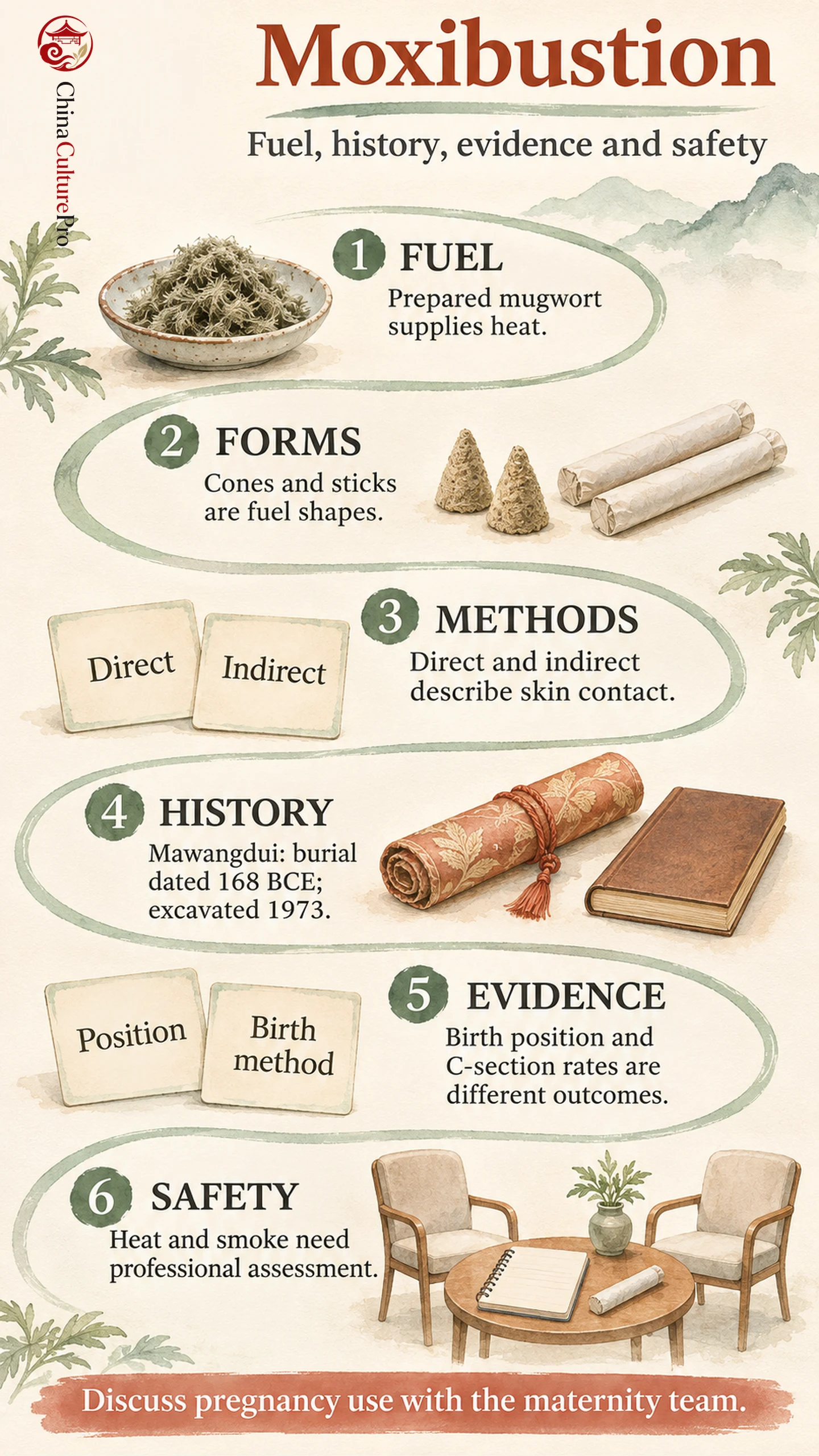
Moxibustion (艾灸, àijiǔ) is a heat-based practice within traditional Chinese medicine (中医, zhōngyī). It uses burning prepared mugwort material, commonly called moxa.[1][2]
- Fuel may be prepared in different shapes, including cones and sticks.
- Methods differ in how the burning material and its heat relate to the skin.
- Evidence must be read for a specific condition and outcome, with burns and smoke considered separately.
An old medical tradition or a warm sensation does not establish a treatment’s effectiveness. Pregnancy use requires discussion with the maternity team and appropriate professional direction.[2]
Moxibustion can be unfamiliar even to readers who recognize needle-based treatments. The key distinction is heat. Understanding the fuel and its application makes the historical records, modern devices and clinical questions easier to follow.
Mugwort Fuel and Different Ways of Applying Heat
Moxa wool (艾绒, àiróng) is prepared plant material, formed into moxa cones (艾炷, àizhù) or moxa sticks (艾条, àitiáo). The shape identifies fuel, not a clinical benefit.[1]
Another distinction concerns contact with the skin:
| Method label | Descriptive difference |
|---|---|
| Direct moxibustion (直接灸, zhíjiē jiǔ) | Fuel is applied directly on the skin.[1] |
| Indirect moxibustion (间接灸, jiànjiē jiǔ) | Burning material is separated from the skin by distance or an intervening material.[1] |
Indirect methods still involve heat. Fuel shape alone does not identify the treatment plan, and technique and the person’s circumstances matter.[1]
Early Manuscripts and Later Devices
Early evidence comes from manuscripts excavated in 1973 at Mawangdui (马王堆, Mǎwángduī), in Changsha, Hunan. Tomb 3’s burial is dated to 168 BCE. One text, Zubi Shiyi Maijiujing (足臂十一脉灸经, Zúbì Shíyī Mài Jiǔ Jīng), describes eleven vessels, their paths and associated illnesses, with moxibustion discussed as a response. Related eleven-vessel texts describe complaints involving pain or urinary function within their historical medical framework.[3]
Those records show heat treatment within an early model of the body. Their eleven vessels should not simply be assumed to reproduce every later account of Chinese medical meridians (经络, jīngluò). Nor does the burial date establish the invention date of every modern moxa method.[3]
Later equipment shows adaptation in a different setting. A surviving kit made in Tokyo in 1980–1985 includes a metal warmer, moxa sticks and instructions, and is catalogued as a kit for self-administration. It documents a particular device and period, rather than establishing that unsupervised use is suitable for every person or purpose.[4]
These examples connect texts, body models and material techniques without treating them as one timeless procedure. For a broader framework, the traditional Chinese medicine guide separates historical concepts from modern clinical testing.
Reading Evidence Through Separate Outcomes
Breech presentation—when a baby is positioned bottom or feet first—is one clinical question studied in moxibustion research. A 2023 review covering 13 studies and 2,181 women illustrates why different outcomes must be kept separate.[5]
| Outcome | Finding for moxibustion added to usual care | Certainty |
|---|---|---|
| Baby’s position at birth | Probably reduces the chance of a non-head-first position at birth. | Moderate.[5] |
| Caesarean birth | Probably makes little or no difference to the chance of caesarean birth. | Moderate.[5] |
| Need for external cephalic version | The effect on whether a clinician needs to attempt turning the baby is uncertain. | Low.[5] |
The findings do not mean that a change in fetal position necessarily changes the eventual mode of birth. They also do not supply one universal protocol or establish benefits for unrelated conditions. Adverse events were inadequately reported in most of the included trials, limiting safety conclusions.[5]
Pregnancy care involves individual assessment, follow-up and birth planning. Discuss any proposed moxibustion with the maternity team. UK patient guidance places this use under the direction of a registered healthcare practitioner.[2]
The useful lesson extends beyond this example: identify the treatment, comparison and outcome, then check the certainty and reported harms. “It worked” is too imprecise if one person means a position change and another means avoiding surgery.
Burns, Smoke and Professional Assessment
Burns, blistering, allergic reactions, infection and discomfort from smoke have been reported in the moxibustion literature. A review of adverse events also found that the available reports could not establish how often such problems occurred.[6]
Case reports are useful for recognizing possible harm, but their selected examples do not supply a reliable risk percentage. A separate review of 64 reported cases across 24 articles emphasized how technique, practitioner skill, the person’s condition and treatment environment can affect safety.[1]
Before clinical use, discuss the exact method, relevant health circumstances, heat monitoring, smoke exposure and the plan for managing any adverse reaction. A device labelled for home use or a method described as indirect does not answer those questions by itself.
Historical indications should also be read as historical indications. A record that a treatment was used for an illness is different from evidence that it improves the corresponding modern clinical condition.
FAQs About Moxibustion
Does moxibustion always require needles?
No. Moxibustion uses moxa heat, while acupuncture (针刺, zhēncì) uses needles. They can be combined, but are distinct practices.[3]
Is indirect moxibustion automatically free of burn risk?
No. Separating burning material from the skin does not eliminate heat exposure. Indirect methods still require appropriate precautions against accidental burns.[1]
Do breech studies show that moxibustion avoids caesarean birth?
The 2023 review found that adding it to usual care probably makes little or no difference to caesarean birth rates, despite a probable effect on birth position.[5]
Does a traditional indication establish a modern treatment benefit?
No. It establishes a historical use. Clinical benefit and safety require evidence appropriate to the actual condition, procedure and outcome.
出典
[1] Xu J, Deng H, Shen X. Safety of Moxibustion: A Systematic Review of Case Reports
[2] Royal College of Obstetricians and Gynaecologists. Breech Baby at the End of Pregnancy
[3] Huang C, et al. Moxibustion in Early Chinese Medicine and Its Relation to the Origin of Meridians: A Study on the Unearthed Literatures
[4] Science Museum Group. Moxibustion Kit for Self Administration, Tokyo, 1980–1985
[5] Cochrane. Moxibustion for Turning a Baby in Breech Position
[6] Park JE, Lee SS, Lee MS, Choi SM, Ernst E. Adverse Events of Moxibustion: A Systematic Review