

Quick Answer: What Is Acupuncture?
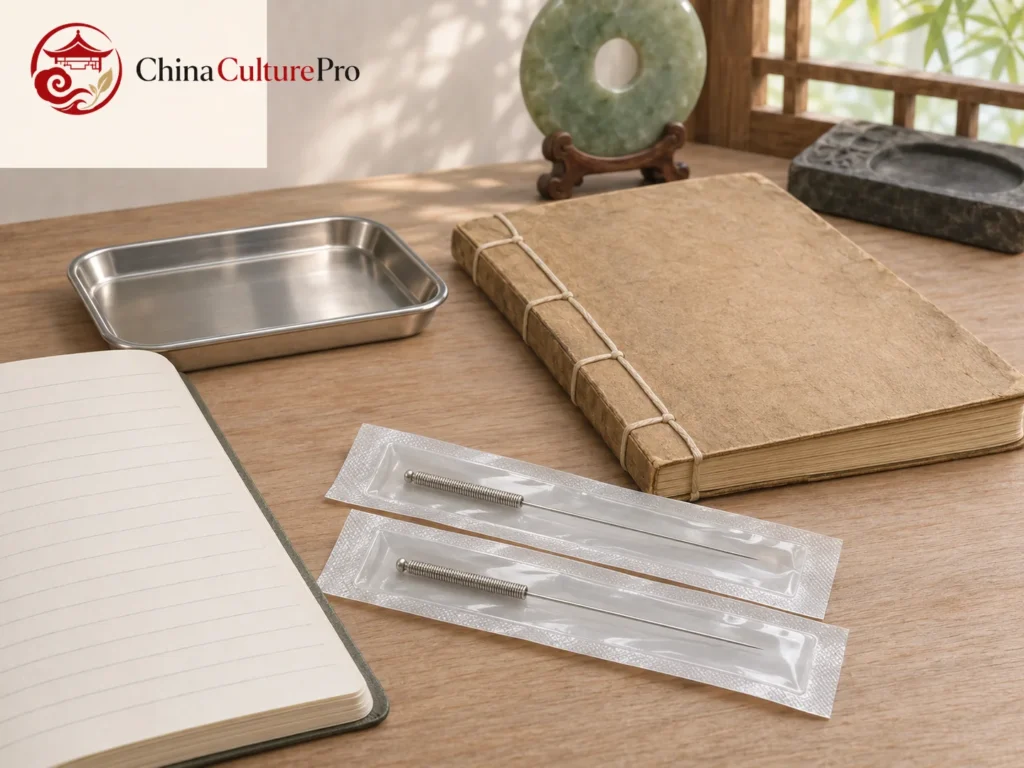
Acupuncture (针刺, zhēncì) involves inserting fine needles through the skin. It developed within traditional Chinese medicine (中医, zhōngyī).[1]
- Its Chinese history includes medical books, teaching models and practitioner traditions.
- Modern studies assess particular conditions, methods and outcomes.
- Professional treatment requires assessment, consent and appropriate safety measures.
Evidence for a specific use does not establish that acupuncture treats every illness. This article explains the practice; it does not provide instructions for self-needling.

The image of a needle is familiar, but the questions behind it are often mixed together. Where did the practice develop? What did a historical body chart mean? Does a modern course improve a patient’s function? A useful account keeps those questions connected while allowing each its own evidence.
Chinese Origins, Medical Books and Teaching Models
Acupuncture has been practised in some form for at least 2,500 years, although that broad history should not be mistaken for an unchanged modern procedure.[1]
A dated book gives a more concrete historical anchor. The 1601 Zhenjiu Dacheng (针灸大成, Zhēnjiǔ Dàchéng), compiled by Yang Jizhou, gathered earlier medical writings and practitioner experience into a substantial compendium. It shows accumulated teaching and compilation, rather than a single moment when needling was invented.[2]
Teaching objects also show the tradition’s wider circulation. A surviving wooden acupuncture model made in Japan in 1681 carries point and channel markings. It records a particular teaching aid in another East Asian setting; it is not evidence that every practitioner used an identical map or technique.[3]
For readers exploring traditional Chinese medicine, these are useful distinctions. A book can preserve a line of learning, and a model can show how knowledge was represented. Neither object, by itself, measures the results of treating a present-day medical condition.
Traditional Explanation and Modern Research Questions
In the traditional account, qi (气, qì) is associated with vital activity and flows through meridians (经络, jīngluò), the body’s conceptual channels. Acupuncture points belong to that explanatory framework.[3]
Modern research asks different questions about nervous-system responses, effects in other tissues and nonspecific effects associated with the treatment encounter. How acupuncture works is not fully understood. A measured response does not, on its own, verify every part of a traditional channel theory.[1]
The history of qi および Chinese medical meridians therefore deserve their own explanations. Understanding that vocabulary helps with reading historical material without turning a cultural model into a proven anatomical diagram.
What the Evidence Shows for Specific Conditions
Acupuncture may help with some pain conditions, including back or neck pain and knee pain associated with osteoarthritis. Benefits can differ depending on the comparison: no treatment, usual care and sham procedures are not equivalent controls.[1]
A 2025 randomized trial illustrates the distinction. It enrolled 800 adults aged 65 or older with chronic low-back pain, comparing usual medical care alone with two acupuncture programmes added to that care.[4]
| Trial group | Adjusted share with at least 30% improvement in disability at six months |
|---|---|
| Usual medical care alone | 29.4%.[4] |
| Standard acupuncture plus usual care | 39.1%.[4] |
| Standard acupuncture with maintenance sessions, plus usual care | 43.8%.[4] |
The standard programme offered 8–15 sessions over 12 weeks; maintenance added 4–6 sessions during the following 12 weeks. The outcome concerned self-reported back-pain-related disability, not a cure. The two acupuncture groups did not differ significantly on that disability outcome.[4]
Because the trial used usual care rather than sham acupuncture as its control, it assessed an added treatment programme. It could not isolate the contribution of attention and other nonspecific effects. Its participants, condition and comparison also limit how broadly the result can be applied.[4]
This is the level of detail worth looking for in any claim: which patients, which treatment, compared with what, and measured how? A meaningful improvement in everyday function is different from complete pain relief, and neither should be assumed from a historical reputation.
A Professional Appointment and Its Safety Boundaries
A professional encounter begins with assessment and discussion of benefits, risks and alternatives. As one UK hospital-service example, needles may remain for a few minutes or up to 20 minutes, with manual movement by the practitioner. That is a service example, not a universal appointment length.[5]
Some methods use manual manipulation; electroacupuncture applies small electrical currents to the needles. It is important to identify the actual method being proposed.[1]
Before treatment, disclose pregnancy, bleeding disorders, blood-thinning medicines, infection risks and implanted electrical devices. These issues can change the assessment or proposed treatment; disclosure does not mean every person with one of them is automatically excluded.[5]
Ask who will provide treatment, what relevant training they have, and how they use sterile, single-use needles. Improper needling can cause serious harm, including infection and punctured organs.[1]
Minor bleeding, bruising, discomfort or light-headedness can occur. Tell the practitioner about symptoms rather than treating pain or worsening as proof of benefit. Seek medical help for chest pain or breathlessness after needling, particularly following treatment around the chest, middle back or shoulder.[5]
Agree beforehand on what improvement would matter and when the plan will be reviewed. That keeps the discussion focused on the patient’s actual problem rather than on completing an indefinite course. The broader comparison in TCM and biomedicine explains why traditional reasoning and clinical evaluation ask different questions.
FAQs About Acupuncture
Is acupuncture the same as moxibustion?
No. Moxibustion (艾灸, àijiǔ) uses heat associated with burning herb material, while acupuncture uses needles. The two may be discussed together historically, but they are distinct methods.[6]
Does an acupuncture sensation prove that treatment is working?
No. A sensation during needling is different from a measured improvement in pain or function. Report uncomfortable symptoms and assess the outcome agreed with the practitioner.
How many sessions does everyone need?
There is no single course for every condition and person. A trial’s schedule describes what researchers tested; it is not a universal prescription.
Can acupuncture replace medical assessment?
Do not use it to postpone assessment of a health problem. Discuss how any proposed acupuncture fits into your overall care.[1]
出典
[1] National Center for Complementary and Integrative Health. Acupuncture: Effectiveness and Safety
[2] Library of Congress and National Central Library. Zhen jiu da cheng, 1601 edition
[3] Science Museum Group. Wooden Acupuncture Model, Japan, 1681
[4] DeBar LL, Wellman RD, Justice M, et al. Acupuncture for Chronic Low Back Pain in Older Adults: A Randomized Clinical Trial
[5] University College London Hospitals. Acupuncture for Chronic Pain and Headache
[6] National Center for Complementary and Integrative Health. Traditional Chinese Medicine, 2015 fact sheet