


Quick Answer: What Is Miscellaneous Plants by Xu Wei?
Miscellaneous Plants (杂花图, Zá Huā Tú) is a Ming-dynasty ink-on-paper handscroll by Xu Wei (徐渭, Xú Wèi), held by Nanjing Museum. About 10.5 meters long, it brings together flowering plants, fruit and vegetables through varied brushwork. Exhibition accounts identify thirteen plant types. Large trunks, foliage and vines establish the main accents, while smaller motifs and open intervals help the separate subjects feel connected.[1][2][3]
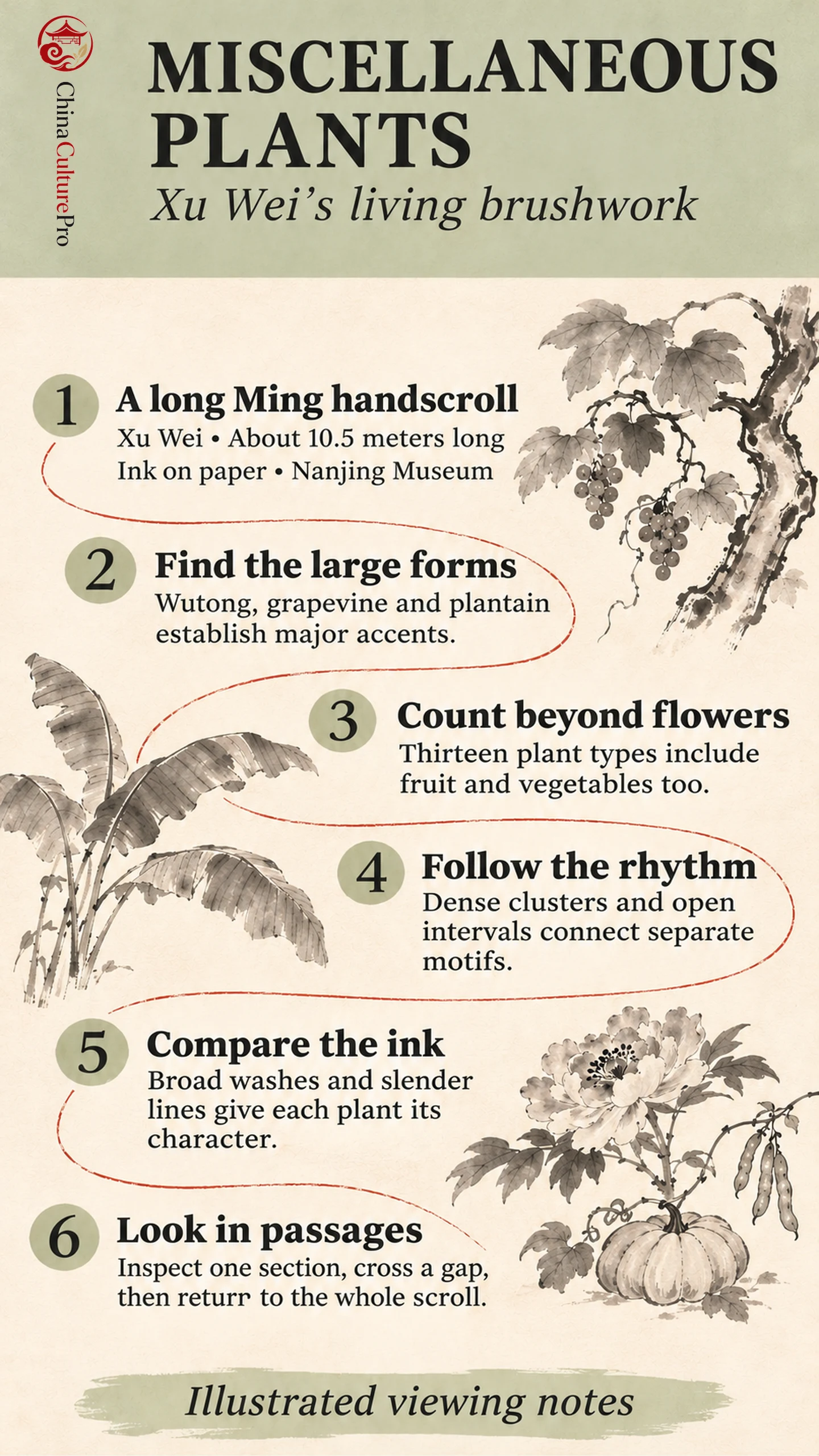
An entire-scroll thumbnail can make this work look like a thin strip of dark marks. Approach it in shorter passages, then compare their rhythms. The challenge is to see both the character of an individual plant and its contribution to the sequence.
The Nanjing Handscroll at a Glance
| 項目 | Identification |
|---|---|
| 芸術家 | Xu Wei |
| 時代 | Ming dynasty |
| Format | Handscroll |
| 媒体 | Ink on paper |
| Approximate length | 10.5 meters |
| Commonly reproduced dimensions | 30 cm high × 1053.5 cm long |
| Collection | Nanjing Museum |
Published measurements differ: another reference gives 37 × 1049 cm. Both sets describe an exceptionally long, low work. The reason for their difference is not established in the sources cited here.[1][4]
This article concerns the Nanjing scroll. Xu painted other works with comparable English titles, so collection, format and dimensions matter when identifying a reproduction.
Thirteen Plant Types, with Large Forms Setting the Pace
The wutong (梧桐, Wútóng), grapevine and plantain give the scroll some of its largest forms. Their different structures provide a useful starting point: a substantial trunk, a branching vine and broad, spreading leaves ask different things of the brush.[2][3]
| Large plant form | 比較する点 |
|---|---|
| Wutong | Trunk weight and the spread of large leaves |
| Grapevine | Branch direction, clustered foliage and hanging fruit |
| Plantain | Broad leaf surfaces and the movement of the stems |
The remaining motifs include peony, pomegranate, lotus, chrysanthemum, pumpkin, beans, crape myrtle, plum, bamboo and narcissus. Together with those three large forms, they make the thirteen types identified in the exhibition discussion.[2][3]
Use the names to orient yourself, then return to the image. Two broad leaves can differ in weight, edge and direction even when their species are already known. The painting becomes more interesting when identification leads to comparison rather than ending it.
Fruit, flowers and vegetables share the same pictorial space. Their forms offer rounded masses, thin stems, spreading surfaces and clusters of small marks, giving Xu a wide range of possibilities within Chinese bird and flower painting.
How Separate Motifs Become a Continuous Scroll
The subjects are not simply presented as equally sized specimens. Large and small forms alternate, while denser patches give way to more open passages. Changes in brush speed, ink tone and direction help maintain a feeling of continuity across separate plant groups.[2]
Choose one transition rather than one isolated flower. Follow the direction of a stem toward the edge of its group, then notice the next dark accent. Does it continue that movement, interrupt it or draw the eye elsewhere?
Open paper can act as a pause. A less crowded stretch allows the preceding cluster to register before another form appears. If every portion were equally dense, the sequence would lose much of its variation.
The handscroll format makes that comparison especially productive. Viewed in successive sections, the picture offers a changing experience of attention. Seen all at once, the same work reveals larger patterns of emphasis that a close detail can conceal.
For the artist’s broader practice, see Xu Wei’s works and artistic legacy. Here, the long format gives his changes of pace room to develop.
Expressive Ink Still Depends on Control
The expressive approach associated with xieyi (写意, Xiěyì) values the brush’s power to convey a subject with selective, lively handling. Xu’s flower painting is important for its varied lines, washes and tonal contrasts, as well as for the recognizable plants they produce.[5]
In a broad leaf, compare a dark area with an adjoining pale wash. Look for where the surface seems saturated and where the paper remains active within the mark. Then move to a thinner stem and observe how a narrower line carries direction.
Such differences make the image feel animated. They also reward looking beyond a general impression of freedom: a heavy leaf, a resilient vine and a small flower need different kinds of marks to retain their characters.
The guide to Chinese ink painting explains the wider vocabulary of line and wash. A comparison of gongbi (工笔, Gōngbǐ) and xieyi places selective brushwork beside more meticulous approaches to description.
Xu is often discussed alongside Chen Chun (陈淳, Chén Chún) in the development of expressive flower painting.[2] The page on Chen Chun offers a useful comparison, while this scroll remains distinctive for the way its large plant forms organize a sustained horizontal sequence.
How to Follow the Plants and the Brushwork
- Establish the format. Look at the whole scroll’s proportions, then choose a section large enough to include more than one plant group.
- Compare three large forms. Find the wutong, grapevine and plantain. Notice how trunk, vine and leaf surfaces differ in their handling.
- Read the transitions. Move between a dense cluster and an open interval. Follow the directions that carry attention across the gap.
- Return to the whole. Compare the weight and spacing of the sections you inspected. Ask how the smaller motifs support the larger accents.
FAQs About Miscellaneous Plants by Xu Wei
Why does a flower painting include vegetables and fruit?
Its subject range extends beyond blossoms to cultivated plants and their varied forms. Pumpkins, beans and grapes contribute to the same ink sequence as flowers, bamboo and trees.[2][3]
What year was Miscellaneous Plants painted?
An exact creation year is not established by the exhibition accounts cited here; they identify it as a Ming-dynasty work.[2][3]
Was the entire scroll necessarily painted in one sitting?
A feeling of continuous movement is a visual effect. It does not, by itself, establish how many painting sessions Xu used to make the scroll.
出典
[1] China Online Museum. Miscellaneous Plants: Nanjing Museum handscroll identification
[2] The Paper, Qiu Haihong and Huang Song. Nanjing Museum’s Chen Chun and Xu Wei exhibition: plant groups and pictorial rhythm
[3] China Jiangsu Net, Zhang Ke. Nanjing Museum exhibition report with curator Pang Ou’s explanation of the long scroll
[4] Encyclopedia of China Publishing House. Various Flowers by Xu Wei: alternative published measurements
[5] National Palace Museum. Flowers and Bamboo: context for Xu Wei’s expressive ink handling, a different work