
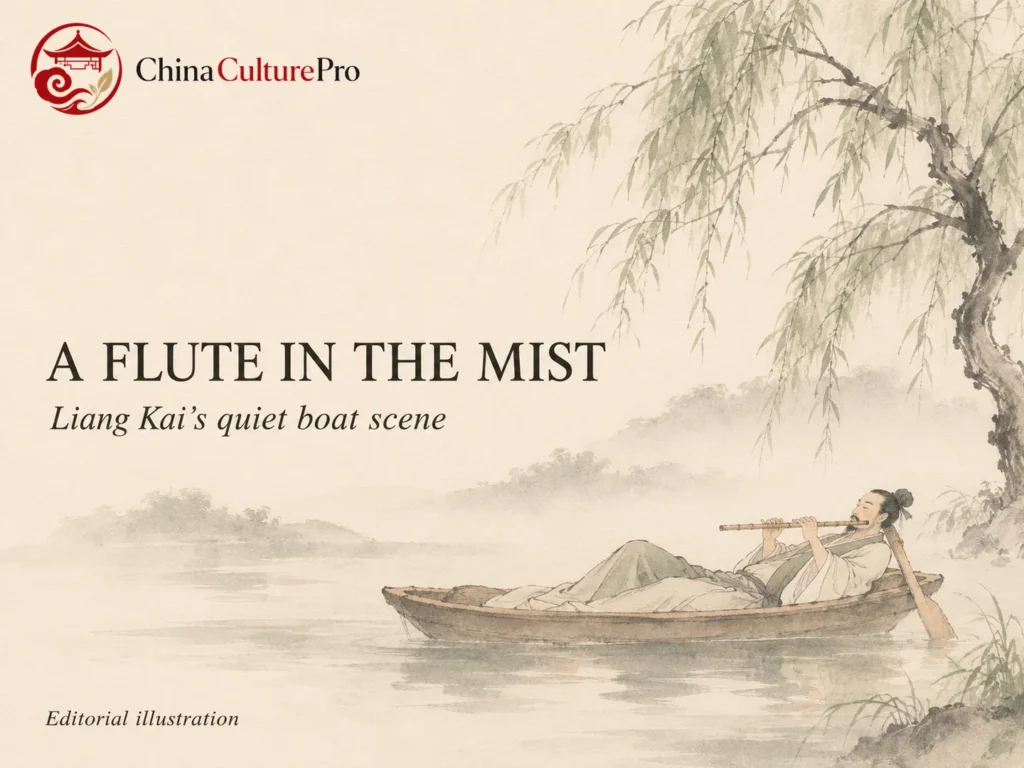

Quick Answer: What Is Lying in a Boat and Playing the Flute?
Lying in a Boat and Playing the Flute (柳溪卧笛图, Liǔ Xī Wò Dí Tú) is a small Southern Song album leaf by Liang Kai (梁楷, Liáng Kǎi), held by the Palace Museum in Beijing. It measures 26.1 × 26.1 cm and is catalogued as ink and color on silk. A reclining figure plays a flute in a boat amid misty water and willows. The contrast between pale washes and finely drawn willow leaves gives this compact scene much of its visual interest.[1][2]

This is a picture to approach slowly. The person is small enough to escape a quick glance, while much of the surrounding setting seems to hover between visibility and disappearance. Finding the action changes how you experience the apparent stillness.
The Album Leaf at a Glance
| 項目 | Identification |
|---|---|
| 芸術家 | Liang Kai |
| 時代 | Southern Song dynasty |
| Exact year | Not established by the sources used here |
| Format | Album leaf |
| 媒体 | Ink and color on silk |
| Picture size | 26.1 cm high × 26.1 cm wide |
| Collection | Palace Museum, Beijing |
| Signature | The artist’s name, Liang Kai |
The Chinese title refers to a willow-lined stream and a reclining flute player. You may also encounter the English title Playing a Flute in a Boat. The dimensions, subject and Beijing collection identify the same small work.[1][2]
Keep the original scale in mind when looking at an enlarged reproduction. Its nearly square field contains a whole atmospheric setting within a width of just over 26 centimeters.
A Small Gesture Suggests a Sound
The figure reclines with a paddle serving as a headrest and plays for personal enjoyment. A few small marks establish an activity within the broad, softly handled setting.[1]
Look at the orientation of the body before trying to resolve every detail. Reclining makes the figure feel at ease, while the flute implies a sustained action. The resting posture and continuing action coexist.
You can then imagine how a flute might sound across the misty water. Imagining sound is one way of engaging with the painted gesture; no particular tune is identified. The painted gesture provides the cue; the viewer supplies an auditory possibility.[2]
Try covering the figure briefly in a reproduction, then uncover it. Without the player, the pale setting may appear mainly atmospheric. With the gesture restored, the same space can feel like somewhere a sound travels. This small comparison helps explain why a tiny person can carry so much of the scene’s effect.
Pale Washes, Fine Willow Leaves and Open Space
The water and sky merge through light ink, while the willow leaves receive fine, closely worked strokes. The scene combines economy in its broad handling with precision in selected details.[1]
Compare an edge that remains distinct with one that fades into the surrounding tone. A sharply described branch or leaf gives the eye something definite to hold. A weaker contour lets a form seem partly obscured, encouraging you to sense an interval beyond what is fully drawn.
The pale passages therefore deserve as much attention as the small dark marks. When looking on a screen, avoid increasing contrast until every faint shape becomes hard-edged. Doing so can flatten the very differences that make the scene feel misty.
The guide to Chinese ink painting offers a wider introduction to wash, line and tonal variation. Here, notice their different jobs: a wash can suggest an enveloping condition, while a fine stroke can identify a particular leaf.
You can also compare the boat’s limited, inhabitable space with the less clearly bounded water around it. That shift from a specific human position to an uncertain distance is one useful entry into Chinese landscape painting.
An Academy Painter with More Than One Brush Language
Liang Kai served at the Southern Song painting academy in Hangzhou around 1201–1204. His wider career is also associated with Chan (禅, Chán) Buddhist circles and with works using abbreviated brushwork.[2][3]
Those connections help explain why his art is discussed through both disciplined technique and expressive economy. They do not establish an exact date for this leaf or make its fine willow strokes an anomaly. The picture itself shows that a selective use of detail can coexist with very light handling elsewhere.
A simple sequence in which meticulous academy pictures always came first and freer religious pictures always came later is too secure for the surviving evidence. Many works are undated, and the relationship between style, audience and chronology requires care.[2]
For a broader view of that range, see Liang Kai’s works and artistic legacy. For this leaf, the most useful first step remains comparing what his brush makes definite with what it leaves to atmosphere.
How to Look from the Boat into the Mist
- Locate the action. Find the reclining figure and identify the playing gesture. Keep the whole boat visible before enlarging the person.
- Compare the marks. Move from a finely drawn willow passage to a pale wash. Notice how their different edges affect attention.
- Follow the opening. Let your eye travel outward from the boat into the less defined setting. Resist filling every interval with an imagined object.
- Imagine and reassess. Consider the sound suggested by the flute, then return to the full square image. Ask how the tiny action changes the surrounding space.
FAQs About Lying in a Boat and Playing the Flute
When did Liang Kai paint this work?
It belongs to the Southern Song period. The sources used here do not establish an exact year; dates for the painter’s academy service should not be substituted for the painting’s date.[1][2][3]
Is the flute player a named poet or historical figure?
The player is presented as a cultivated person enjoying music. No named historical identity is established in the object description.[1]
Is the painting necessarily a Buddhist image?
Liang Kai’s association with Chan Buddhism is relevant to his wider career. A quiet landscape and reclining musician alone do not establish a specific Buddhist narrative or doctrine for this leaf.[2][3]
出典
[1] 故宮博物院。 柳溪卧笛图页: collection description, dimensions and signature
[2] James Cahill, University of California, Berkeley. Lecture 11D: From Academy to Chan, Liang Kai; especially item 11.42.15
[3] Metropolitan Museum of Art. Poet Strolling by a Marshy Bank: contextual biography of Liang Kai