
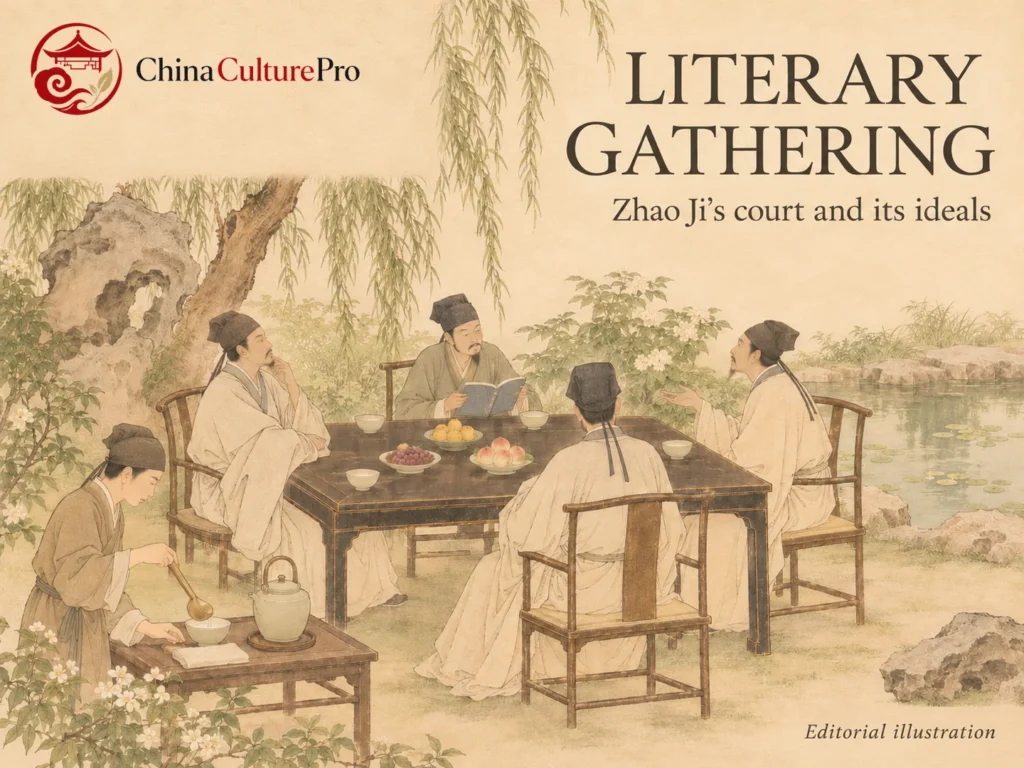

Quick Answer: What Is Literary Gathering?
Literary Gathering (文会图, Wén Huì Tú) is a Song hanging scroll traditionally associated with Emperor Huizong, Zhao Ji, in the National Palace Museum, Taipei. Painted in ink and color on silk, it measures 184.4 × 123.9 cm. Scholars banquet in a garden while attendants prepare tea nearby. Its exacting style suggests Huizong’s Painting Academy; the traditional attribution should not be treated as proof that the emperor personally painted it.[1][2]

The picture presents cultivated sociability through food, utensils, garden space and poetry. Reading the upper inscriptions alongside the scene below reveals an ambition beyond recording a pleasant meal: the gathering also evokes an ideal of talented people assembled around a cultivated court.[4]
The Object and Its Traditional Attribution
| 項目 | Identification |
|---|---|
| 伝統的な連想 | Zhao Ji, Emperor Huizong |
| Authorship qualification | Probably connected with his Painting Academy; personal execution is uncertain |
| 時代 | Song dynasty |
| Format | Hanging scroll |
| 媒体 | Ink and color on silk |
| Picture dimensions | 184.4 cm high × 123.9 cm wide |
| Collection | National Palace Museum, Taipei |
The catalogue name preserves the imperial association, while the descriptive record discusses academy production and questions the authenticity of the poetic handwriting and imperial cipher. A name in a catalogue field and a detailed attribution assessment therefore need to be read together.[1]
This distinction leaves several possibilities open without requiring a speculative verdict. An artwork can reflect an emperor’s artistic preferences, carry inscriptions associated with his court and still lack secure evidence for his own brush throughout. Song Huizong’s historical and artistic context helps distinguish the ruler’s patronage from the execution of an individual picture.
A Banquet and a Separate Tea-Preparation Scene
A large, dark lacquered table stands beneath trees by a pond. Tableware, food and fruit crowd its surface, while scholars gather around it. In the foreground, a second, smaller table serves a different purpose: attendants prepare tea. The arrangement separates the guests’ sociability from the work that supports it.[2][3]
The tea detail is particularly informative. An attendant uses a long-handled spoon to take powdered tea from a container. This belongs to the preparation associated with diancha (点茶, diǎnchá), or whisked tea, rather than simply showing modern-style loose leaves steeping in a pot.[1]
Treat the foreground as part of the painting’s structure, not an incidental glimpse of utensils. The smaller table gives you a near point from which to move toward the larger banquet. Differences in scale, placement and activity help organize a scene that could otherwise become a dense inventory of people and objects.
The broader guide to Chinese tea culture provides context for changing preparation practices. This image supports a particular historical mode of preparation; it does not supply every step of a tea recipe.
The Poems and the Ideal of the Eighteen Scholars
The poems assigned to Huizong and his minister Cai Jing occupy opposite sides near the top. Their contents invoke the Eighteen Scholars (十八学士, Shíbā Xuéshì) associated with Tang Taizong. They place the pictured gathering in a tradition of rulers assembling literary and political talent.[1][2]
In the imperial poem, distinguished scholars and literary achievement enhance the state. Cai Jing’s answering poem advances the claim that the present age surpasses the Tang precedent. Read together, the texts turn a cultivated gathering into an assertion about the court’s human resources and cultural standing.[1][4]
The idea of wenhui (文会, wénhuì), a literary gathering, also connects with the Analects (论语, Lúnyǔ): shared learning brings people into friendship, and friendship supports moral cultivation. This helps explain why social refinement and political purpose can occupy the same picture.[4]
The Tang dynasty supplies the admired precedent, while the Song dynasty supplies the courtly setting in which it is reworked. This relationship does not identify each painted guest as a particular Tang scholar. Nor does interpreting a poem’s message resolve the separate question of whether its surviving handwriting is an authentic autograph.
Garden Space and Exacting Brushwork
The setting is carefully constructed through trees, bamboo, waterside space and finely described objects. Outlined vegetation and strong, precise drapery lines reward close viewing. Their controlled handling contributes to the image’s combination of visual richness and scholarly composure.[1][2]
Compare the busy table with the openings around it. The surrounding garden gives the figures room to gather, stand and move; the tree canopy links their compact activity with the much taller field of the scroll. Chinese gardens offer context for this cultivated relationship between plants, water and social space.
The scene is therefore useful as evidence of artistic choices as well as material culture. A carefully painted bowl can tell you about the importance of tableware within the image, but it does not automatically identify a surviving ceramic or document a specific, fully recoverable banquet.
How to Read the Painting in Four Passes
- Establish the two activity areas. Locate the main banquet table and the smaller tea-preparation table. Follow how attendants and guests are distributed around them.
- Compare figure, object and garden detail. Move from a garment fold to tableware, then to an outlined branch. Ask how similar control of line holds different materials together.
- Read both upper poems. Compare their claims about cultivated talent and the Tang precedent. Distinguish what the words argue from what the painted scene directly shows.
- Return to the attribution record. Keep the imperial association, probable academy setting and uncertain personal authorship separate. Examine inscriptions as evidence to assess rather than automatic guarantees.
The guide to Chinese painting inscriptions and seals supports that final pass. Here, the relationship between image and writing is central to the interpretation, while the authenticity of a written mark remains a distinct question.
FAQs About Literary Gathering and Zhao Ji
Does the painting show eighteen identified Tang scholars?
The Eighteen Scholars are a historical and pictorial precedent invoked by the inscriptions. That connection does not establish eighteen named portraits within this garden scene.
Is it a handscroll or a hanging scroll?
It is a hanging scroll, 184.4 cm high and 123.9 cm wide. Its vertical organization should be considered as a whole before inspecting details.[1][3]
Does the tea scene show loose leaves steeped in a pot?
The foreground detail is interpreted as powdered-tea preparation associated with whisking. It should not be reduced to a modern loose-leaf brewing scene.[1]
出典
[1] National Palace Museum. Literary Gathering, collection record, inscriptions and attribution discussions
[2] National Palace Museum. Literary Gathering, selected-work introduction
[3] Bureau of Cultural Heritage, Ministry of Culture. Literary Gathering, National Cultural Memory Bank record
[4] I Lo-fen. Heavens’ Blessing for a Thousand Years: Sung Hui-tsung’s Literary Gathering and its Poetic Inscriptions