

Quick Answer: What Is Lei Gong?
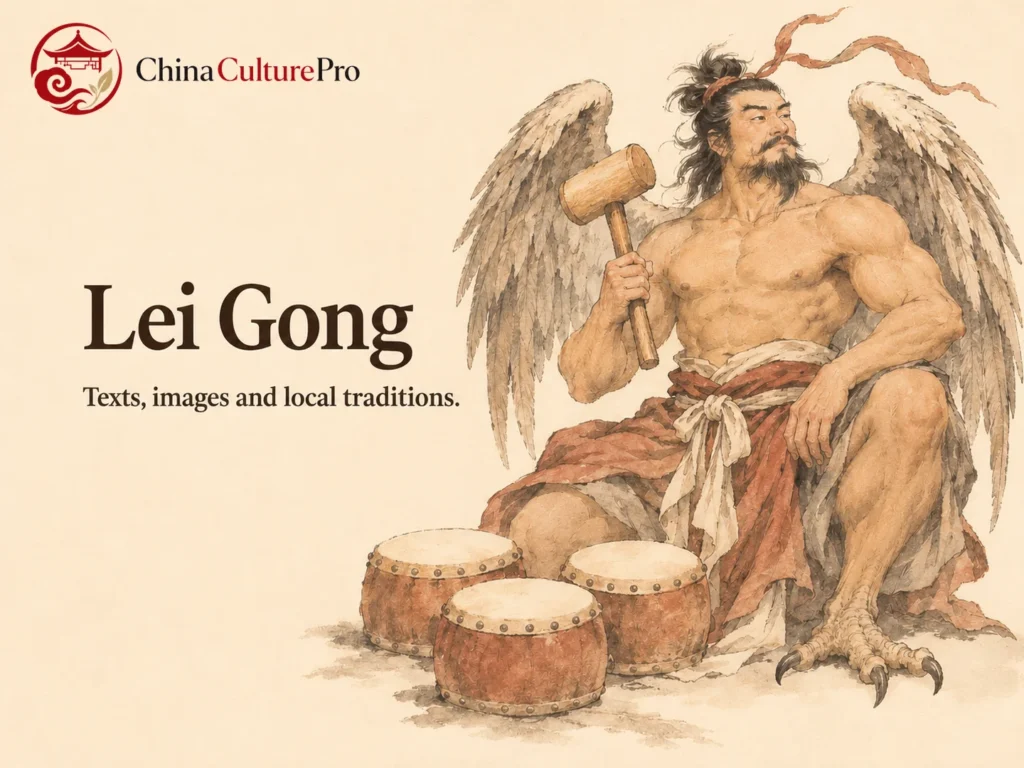
Lei Gong(雷公,Léigōng), the Lord of Thunder, is a Chinese thunder deity represented in texts, religious images and folk traditions. Drums and a striking implement are characteristic identifiers, while the figure’s body and companions vary across sources.[1]
- Function: Personifies thunder, sometimes with a role in punishing wrongdoing within religious narratives.
- Images: May appear as a powerful figure with drums, wings, claws, a mallet or a chisel.
- Context: Belongs to overlapping literary, Daoist and local religious traditions.
Texts, images and local titles must be interpreted in their own settings.
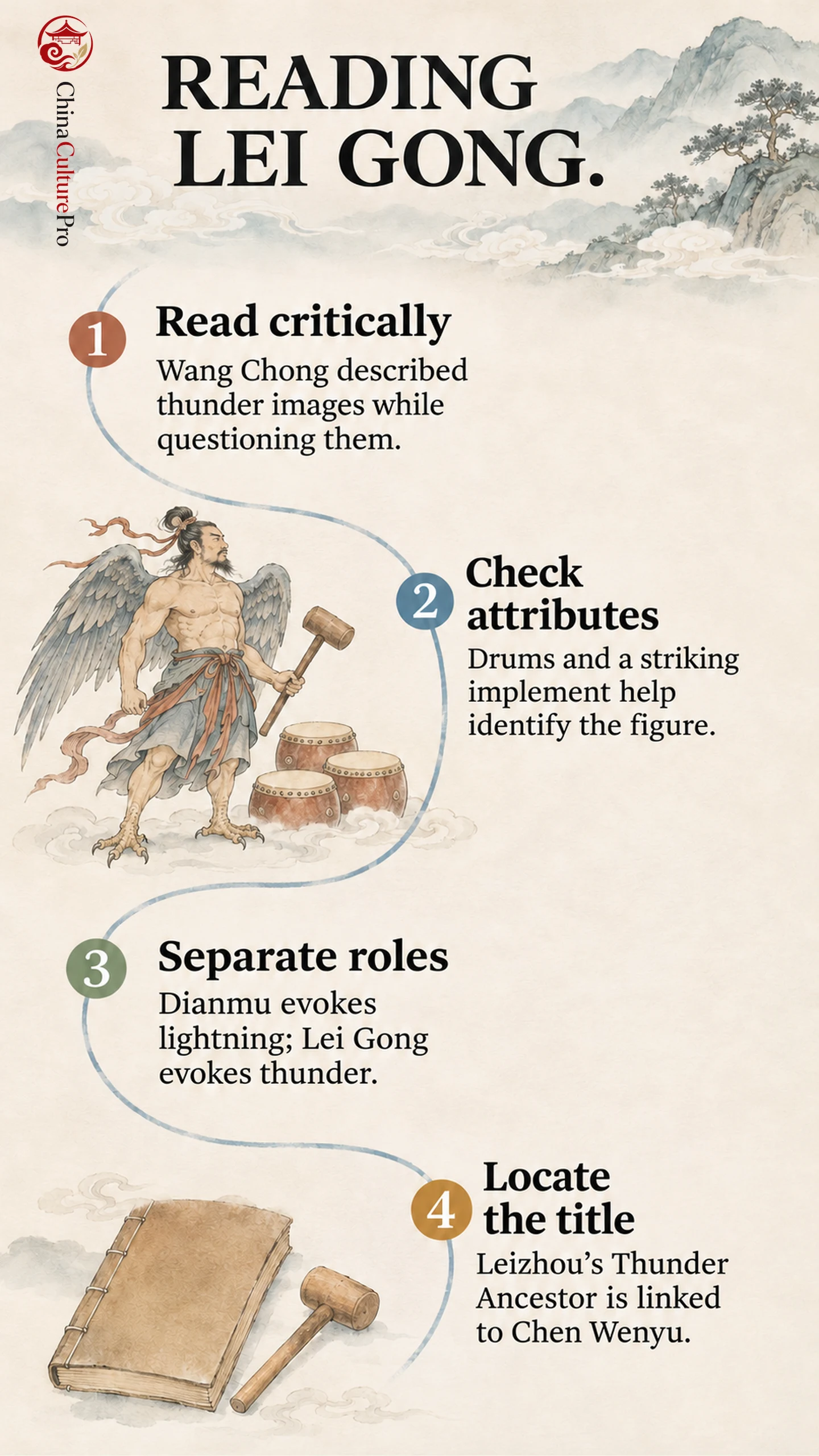
A winged figure raising a mallet above a cluster of drums turns a sound into something visible. Yet thunder imagery has more than one history. This introduction to Chinese gods and goddesses distinguishes what early writers described, what later objects show and how named communities understood their own thunder traditions.
Early Thunder Figures and Wang Chong’s Critique
The *Classic of Mountains and Seas*(山海经,Shānhǎi jīng)describes a thunder spirit in a marsh with a dragon’s body and a human head, beating its belly.[1] That brief image differs from the familiar winged figure surrounded by separate drums. Read the classical text as a particular account rather than a complete design manual for later statues.
Wang Chong(王充,Wáng Chōng), an Eastern Han writer, gives another description in the *Lunheng*(论衡,Lùnhéng). He reports that painters depicted thunder as linked drums alongside a strongman called Lei Gong. The figure held the drums with one hand and raised a striking implement with the other.[2]
Crucially, Wang records this image in order to question it. He asks how drums could hang unsupported and how a figure without a place to stand could produce thunder. He also challenges explanations that make thunder deaths punishment for hidden misconduct.
His argument provides evidence both for the imagery circulating in his time and for disagreement about its meaning. Reporting a belief is not the same as endorsing it. Nor should his own alternative account of natural forces be presented as modern meteorology: its value here is the criticism it preserves within an ancient intellectual setting.
The contrast prevents a misleading account in which all early Chinese people accepted one literal thunder god. A text may preserve an image, argue against it and still help us understand its cultural importance.
Drums, Wings and the Image of the Thunder God
A Qing architectural ornament in Xiamen University’s Anthropology Museum provides a later example. The glazed ceramic relief has spread wings, powerful limbs, clawed feet and an open animal-like mouth. Green, orange and blue enliven its surface. Measuring 58.5 centimeters high and 64 centimeters wide, it was a substantial architectural component.[1]
Here the figure’s forceful body suits its place on a building. The university interprets the ornament through auspicious wishes. That setting adds a purpose beyond illustrating a tale: a thunder figure could participate in the visual language of a decorated structure.
When identifying an unfamiliar image, consider a cluster of attributes. Drums refer to the rolling sound; a raised mallet suggests the action that produces it in the imagined scene. Wings, claws and a fierce face reinforce a supernatural appearance, but none alone securely identifies every object. A modern fantasy design can borrow all these features without reproducing a specific historical statue.
Dianmu and Daoist Ritual Contexts
Dianmu(电母,Diànmǔ), the Lightning Mother, supplies a related but distinct role. In familiar paired images she carries mirrors associated with flashes of light, while Lei Gong’s drums evoke thunder. Daoist descriptions place these figures in prayers for rain or snow and in larger ritual settings.[3]
Within this religious framework, thunder powers are also organized hierarchically. Lei Gong can be treated as subordinate to a higher thunder divinity called Leizu(雷祖,Léizǔ), the Thunder Ancestor. This is a structured ritual setting, not simply a two-character weather story.
The broader context of 道家思想 helps explain why images, divine titles and ritual roles need not correspond to one universally shared family biography. Moral judgment and punishment belong to the religious interpretation; they should not become the article’s explanation of real lightning strikes.
Leizhou’s Thunder Ancestor and Local Identity
In Leizhou, Guangdong, the Leizu Shrine commemorates Chen Wenyu(陈文玉,Chén Wényù), identified locally as a Tang prefect and Thunder Ancestor. The municipal record dates the shrine’s foundation to 642 and records its designation as a nationally protected monument in 1996.[4]
This is a named person tied to a particular place and commemorative institution. It should remain distinct from the higher thunder divinity described in a Daoist hierarchy. Sharing a title does not erase different histories.
The example also shows why Chinese folk religion requires local context. Ask which shrine, community or text uses a name, and whether it identifies a historical official, a divine office or an imagined weather figure. Those questions reveal more than treating every thunder-related title as an interchangeable alias.
FAQs About Lei Gong
Is Lei Gong the same as Dianmu?
No. They are commonly associated figures, but Lei Gong governs thunder and Dianmu lightning in the paired tradition.[3]
Did ancient Chinese writers all accept the thunder god literally?
No. Wang Chong described thunder-god paintings while arguing against their literal explanation and the idea of thunder as moral punishment.[2]
Is every figure called Leizu the same deity?
No. The title can occur in different settings, including a Daoist thunder hierarchy and Leizhou’s commemoration of Chen Wenyu.[3][4]
出典
[1] Xiamen University Archives and Cultural Heritage Management Center. Qing painted ceramic thunder-god architectural ornament
[2] Shidianguji. Wang Chong, Lunheng: Leixu chapter
[3] Daoist Culture Centre. Lei Gong and Dianmu
[4] Zhanjiang Municipal Government. Leizu Shrine