
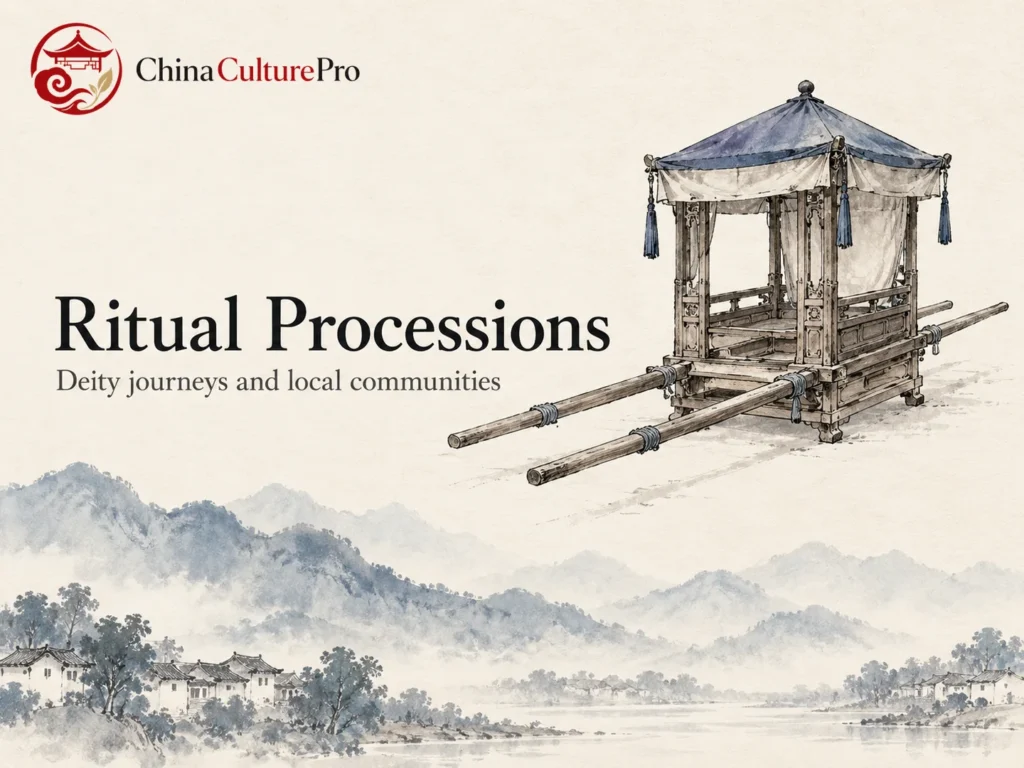

Quick Answer: What Are Chinese Ritual Processions?
Chinese ritual processions move a religious focus through a community’s streets, between temples or onto water. They can honor a deity, express prayers for protection and connect participating communities through a shared ceremonial journey.
- **Religious focus:** A deity’s image or ritual vehicle gives the movement its devotional meaning.
- **Participants:** Image bearers, religious specialists, associations and performance troupes can have different responsibilities.
- **Local form:** Routes, occasions, vehicles and participants vary by community.
These processions are one expression of local religious life, not a single nationwide rite. A ritual ship procession and a procession carrying a temple image need not follow the same sequence.[2][3]
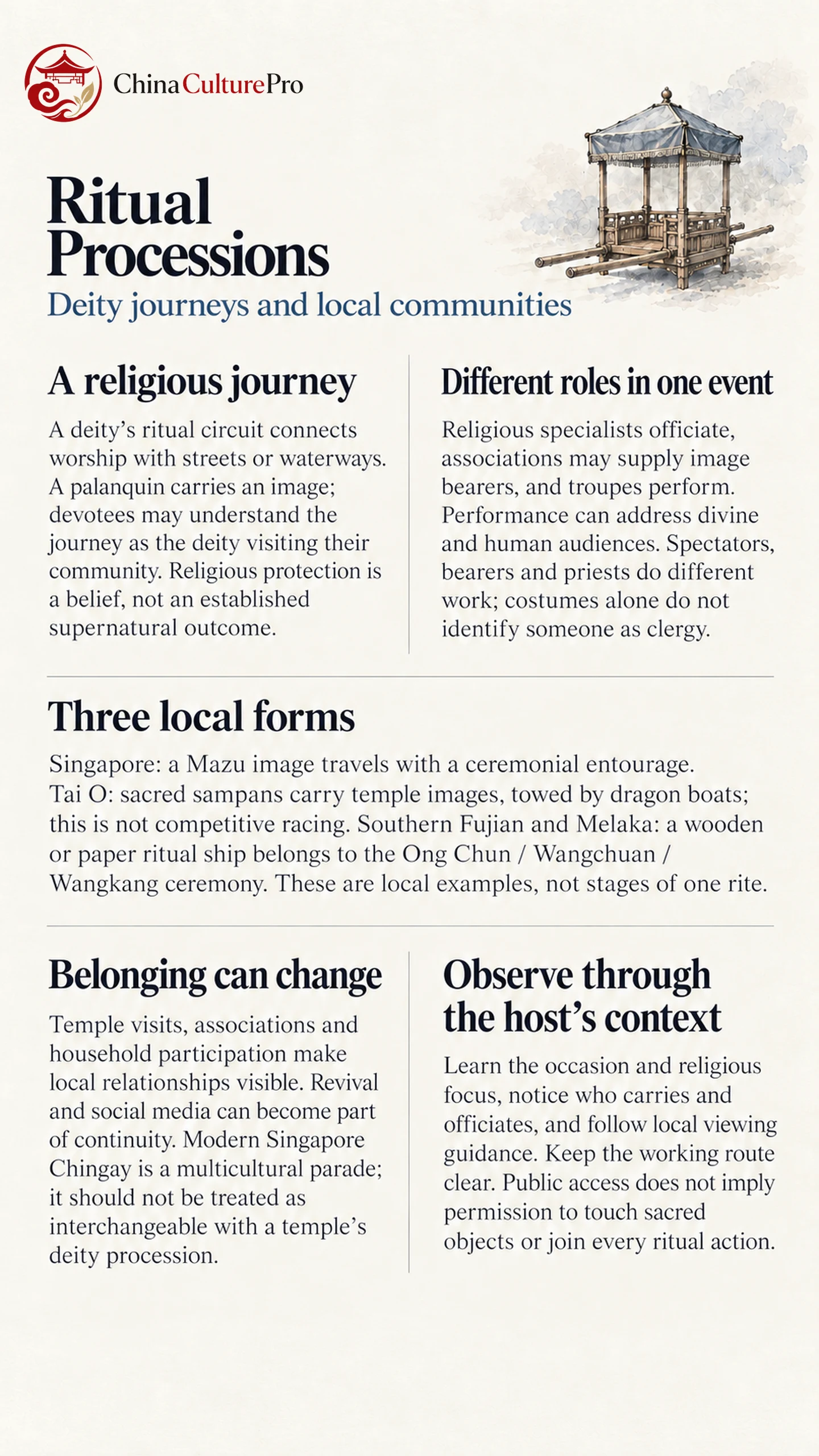
A procession can turn familiar streets or waterways into a ceremonial route. Understanding it means looking beyond colorful costumes: what is being carried, whom participants are honoring, how the route connects places, and which community has organized the movement.
A Deity on the Move: Images and Palanquins
Raojing (绕境, ràojìng) refers to a deity’s ritual circuit through an area. Shenjiao (神轿, shénjiào) is a palanquin used to carry a deity’s image during such journeys. Its architecture can evoke a temple in portable form, although shapes and carrying arrangements vary.[1]
Devotees may understand the image’s journey as the deity visiting or inspecting their community. This is a religious interpretation, not evidence of supernatural protection.[1]
A temple festival is the wider occasion; a procession is a particular mobile ceremony within it. Some move along roads, while others use waterways or combine different modes of transport. The occasion alone does not tell an observer what vehicle or route to expect.[2][3]
Bearers, Religious Specialists and Performance Troupes
At Thian Hock Keng in Singapore, Mazu (妈祖, Māzǔ) birthday observances combine Buddhist prayers, Daoist rituals and street festivities. This example shows why a procession cannot be assigned a single religious identity from its appearance alone.[4]
Its 2024 procession distinguished Daoist priests, leading devotees and association bearers. The work of carrying the image differed from officiating, while spectators occupied another role.[5]
Performance can also be devotional. In southern Taiwan, procession troupes present ritual drama for gods as well as human audiences. Their stories, costumes and movement therefore deserve interpretation within the ceremony, rather than as an unrelated show. Temple music supplies further context for religious sound, whose traditions also differ by setting.[7]
Three Local Forms: Street, Water and Ritual Ship
These examples compare actual movement and organization, rather than presenting stages of one universal ceremony.
| Local example | What moves | What the example clarifies |
|---|---|---|
| Mazu procession, Singapore | A deity image travels with a ceremonial entourage; the 2024 event followed a planned route including visits to other religious institutions. | A temple and participating associations connect urban places through worship.[5] |
| Dragon boat water parade, Tai O, Hong Kong | Three fishermen’s associations place temple images on sacred sampans, which their dragon boats tow through local waters. | The sacred sampan carries the images; it is distinct from the towing dragon boat.[2] |
| Ong Chun / Wangchuan (王船, wángchuán) / Wangkang, southern Fujian and Melaka | A wooden or paper model ship forms part of ceremonial movement associated with Ong Yah. | Shared maritime religious heritage takes different local forms in China and Malaysia.[3] |
Wangchuan names the ritual ship. Ong Chun and Wangkang are regional renderings associated with this ceremony, not Mandarin pronunciations. The model is a sacred vehicle within participants’ beliefs, rather than an ordinary passenger boat.[3]
Tai O’s event is also different from competitive dragon boat racing. Sharing boats and a festival season does not make the religious water parade a race.[2]
Routes, Belonging and Changing Traditions
A route connects particular people and institutions. In rural Chaozhou, different villages have held deity processions on separate dates, assembling images from local temples and receiving household offerings. The organizing unit is therefore a specific local community, not simply an undifferentiated national tradition.[6]
In the Singapore example, temple visits and incense exchanges acknowledge institutional relationships. Such connections make local belonging visible; they do not establish that every resident participates or shares one interpretation.[5]
Thian Hock Keng revived its procession in 2016 after a long interruption and publicized its 2024 celebrations through social media. Continuity can include revival and new communication channels; past arrangements do not establish a future route.[5]
The modern Singapore Chingay parade offers a useful comparison. Established in 1973, it developed into a multicultural performance event. Its public cultural identity should not be treated as interchangeable with a particular temple’s deity procession merely because both can feature elaborate costumes and moving performers.[8]
How to Observe and Interpret a Procession
Begin with the host community’s explanation of the occasion, deity or ritual vehicle. Notice who carries the image, who officiates, and where the route goes. These observations reveal more than assuming every ceremonial movement has the same meaning.
Follow the organizer’s guidance on viewing positions and photography, keeping the working route clear. Access to a public procession does not imply permission to handle sacred objects or join every ritual action. Temple etiquette provides broader guidance for respectful conduct around hosts, shrines and participants.
FAQs About Chinese Ritual Processions
Is every Chinese ritual procession Daoist?
No. Identify the particular temple, community and ritual specialists. The Mazu example in Singapore brings together several forms of observance; the roles of priests, bearers and performers remain distinct.
Is a dragon boat water parade the same as a race?
No. Tai O’s water parade transports temple images on sacred sampans towed by dragon boats. The religious purpose and movement differ from competitive racing.
Do deity images remain outside their temples?
Not necessarily. In Tai O, images are received from temples for the observance and returned afterward. Other communities have their own arrangements; temporary movement does not imply permanent relocation.
Is every Chinese-style street parade a religious ceremony?
No. Costumes, floats or drumming alone do not establish the purpose. Modern Singapore Chingay is a multicultural parade, while a temple procession has a particular religious focus.
出典
[1] National Museum of Taiwan History. Deity Palanquin: Collection Record 2006.003.0001.0001
[2] Hong Kong Intangible Cultural Heritage Office. Tai O Dragon Boat Water Parade
[3] Department of National Heritage, Malaysia. Ong Chun/Wangchuan/Wangkang Ceremony
[4] National Heritage Board, Singapore. Practices Related to Mazu
[5] Alvin Tan, National Library Board Singapore. Mazu Worship in Singapore (2025)
[6] Irene Eng and Yi-Min Lin, The Journal of Asian Studies. Religious Festivities, Communal Rivalry, and Restructuring of Authority Relations in Rural Chaozhou, Southeast China (2002)
[7] Donald S. Sutton, The Journal of Asian Studies. Ritual Drama and Moral Order: Interpreting the Gods’ Festival Troupes of Southern Taiwan (1990)
[8] People’s Association, Singapore. The Chingay Story