


Quick Answer: What Is Kong Yiji About?
*Kong Yiji* (孔乙己, Kǒng Yǐjǐ) is a short story by Lu Xun (鲁迅, Lǔ Xùn) about a poor, educated man who drinks at the Xianheng Tavern (咸亨酒店, Xiánhēng Jiǔdiàn). A former tavern boy remembers him as a customer who wears a scholar’s clothes but stands at the counter with laborers. The other customers make him a source of amusement.[1][2]
- The setting: Clothes, seating and the price of a bowl of wine tell you where someone stands.
- The character: Kong wants the recognition that learning promises and has little else to rely on.
- The narrator: The boy remembers Kong partly because his visits gave people something to laugh about.
Watch what the tavern remembers once Kong stops coming.[1]
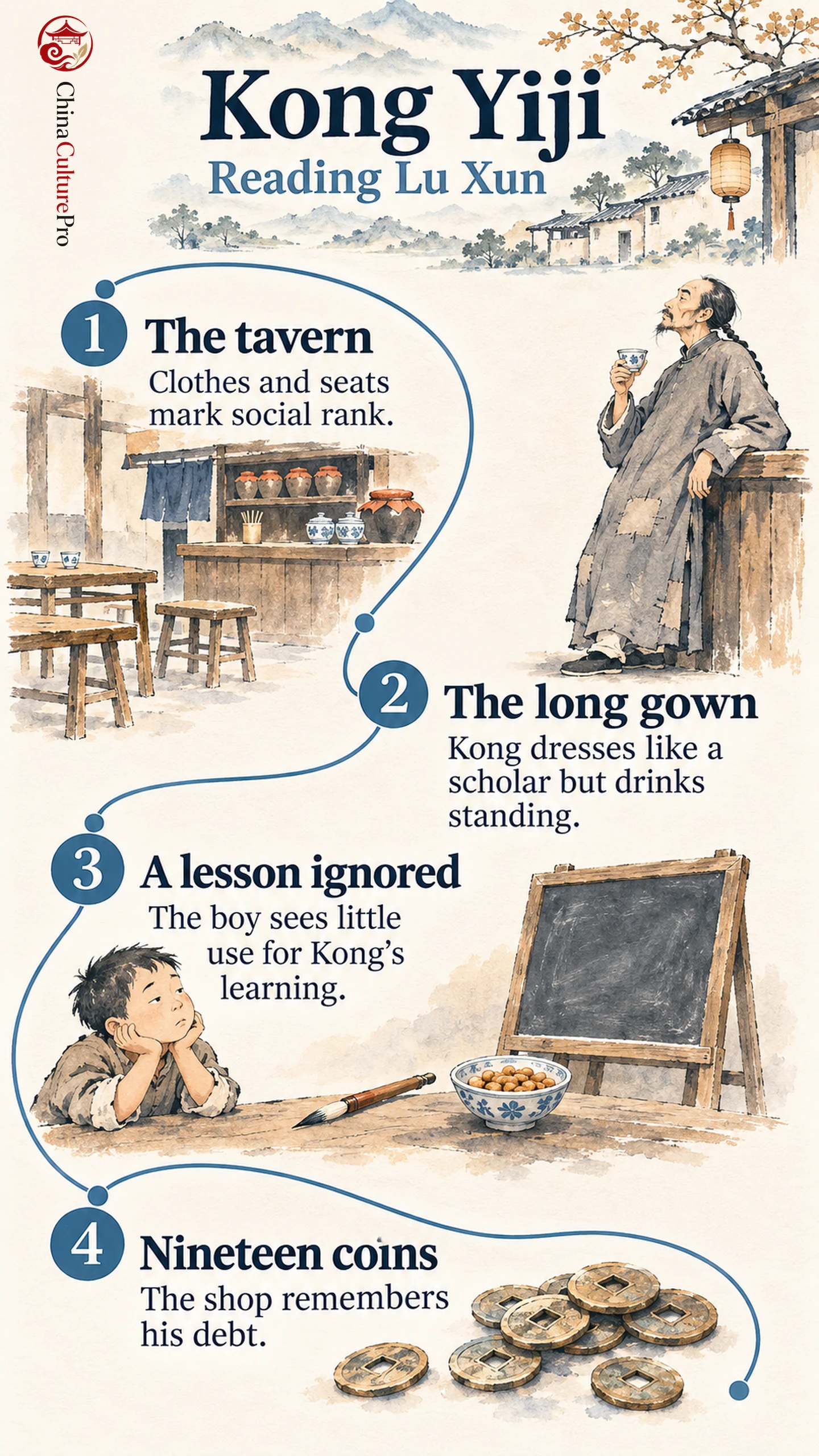
Lu Xun gives the tavern an ordinary rule about who sits and who stands. The story begins to move when one customer does not fit it.
Why the Long Gown and the Counter Matter
Workers in short jackets buy wine and drink standing outside the counter. Better-off men in a long gown (长衫, chángshān) can sit in a room beside the shop and order food. The narrator explains how those habits work before he introduces Kong. He is the one customer who wears a long gown and drinks standing. His clothes make a claim that the other drinkers find easy to question.[1]
The gown is old and dirty. Its condition tells the reader something the garment’s style alone cannot. Kong still identifies with men whose education gives them status, while he lives in circumstances that make his claim an easy target. In Qian Zhongshu’s Fortress Besieged, a degree plays a different role in a later period, when academic credentials can get a man a job his learning might not secure.
What the Lesson About a Character Reveals
Kong wants to show the boy four ways of writing the character 茴 (huí), the first character in the name of the beans served at the tavern. The boy sees no reason to learn the variants. He is there to serve wine. Kong is pleased to have a piece of knowledge to pass on, and the boy sees the lesson as a delay in his work.[1][3]
The mismatch gives the scene its humor and its loneliness. Kong can offer the boy a small lesson and gives beans to children who crowd around. These actions leave room for generosity in a man the adults mostly treat as a joke. The habits of formal learning that make him hard to listen to are also among the few things he can offer other people.[1]
How the Tavern’s Laughter Works
People ask Kong about accusations of stealing and laugh at the distinctions he tries to make in reply. They also ask about his failure to gain a scholar’s qualification. Each question puts him in a position where whatever he says can be turned back against him. The tavern customers can agree on how funny he is without needing to agree on much else.[1]
The boy looks back on a workplace where the owner is stern and customers rarely make his day pleasant. Kong’s presence gives him a chance to laugh too. That explanation makes the narrator part of the scene. In A Madman’s Diary, Lu Xun also gives readers reason to question what a community considers normal, through a very different voice.
What the Nineteen Coins and the Last Line Mean
This section discusses the ending. Kong returns with injured legs and has to move by supporting himself on his hands. Later, the tavern keeper periodically remembers that Kong owes nineteen coins. The debt is precise enough to record and repeat. The narrator has no equally precise account of what became of Kong.[1]
The narrator closes by putting a guess and an assertion next to each other. In English, the sense is that Kong must have died, though the narrator never saw him again. The gap between certainty about the debt and uncertainty about the death is one of the sharpest things in the story. A man’s absence becomes part of the tavern’s routine as quietly as his presence once supplied a joke.[1]
FAQs About Kong Yiji
Where does the name Kong Yiji come from?
Kong is his surname. People attach Yiji to it from a familiar string of characters used for writing practice. The name the reader gets is a nickname the community can use to make fun of him.[1]
When was Kong Yiji first published?
It appeared in *New Youth* in April 1919 and was later collected in *Call to Arms*. William A. Lyell’s English translation appears in *Diary of a Madman and Other Stories*.[1][2][4]
出典
[1] Lu Xun. Kong Yiji, the original Chinese short story
[2] Duwen. Kong Yiji, text and original publication note
[3] Harvard University repository. Collecting as Cultural Technique, discussion of Kong Yiji and writing
[4] University of Toronto Press Distribution. Diary of a Madman and Other Stories, translated by William A. Lyell