

Quick Answer: How Is Hong Kong Mahjong Played?
Hong Kong mahjong (麻将, májiàng) is a four-player draw-and-discard game. Build a legal hand, meet the agreed faan (番, fān in Mandarin) minimum, and then convert its value into the payment required by your table.
- An ordinary winning hand has four groups and a pair.
- Numbered tiles, winds and dragons form the core 136-tile set; eight optional bonus tiles make 144.
- Players may claim permitted sequences, triplets and quads.
- Faan measure scoring features; they are not simply the number of points paid.
The scoring examples below use a published three-faan-minimum, ten-faan-cap competition framework. Home tables and other published versions can differ.[1][2][3]

A familiar-looking tile set can hide an unfamiliar agreement. Knowing a few high-value patterns helps, but the first useful question is which complete rulesheet the group follows. Our mahjong rules guide introduces the shared turn sequence before the regional details below.
Tiles, Seats and the Opening Deal
The core set contains three numbered suits, each running from one to nine with four copies of every tile, plus four copies of each wind and dragon. There are four wind identities and three dragon identities. Thus 108 numbered tiles plus 28 honors make 136; flowers and seasons add eight individual bonus tiles when used.[2]
Shuffle and build four two-high walls. East, the dealer, starts with fourteen tiles and discards first; the others start with thirteen. Ordinary turns run counterclockwise, interrupted by claims.[2] Dividing144 tiles among four walls gives36 per wall, or eighteen stacks;136 gives34 per wall, or seventeen stacks.
Bonus tiles are exposed and replaced rather than used in a sequence, triplet or pair.[2] For help telling a flower from a numbered Bamboo tile, use our mahjong tile guide.
Keep seat wind and prevailing wind separate. Seat wind belongs to your position for the hand; prevailing wind belongs to the round. A wind triplet can receive both applicable awards when those winds coincide.[3]
Build Groups and Make Permitted Claims
A chow (吃, chī) is a sequence of three consecutive numbers in one suit. A pung (碰, pèng) is three identical tiles; a kong declaration (杠, gàng) makes four identical tiles into a declared quad. A quad still occupies one group slot and requires a replacement draw, so it increases the physical tile count.[4]
Chow claims use the previous player’s discard. Pung claims can use any opponent’s latest discard; a discard may also complete a permitted quad. A legal win outranks pung or kong claims, which outrank chow.[2]
For example, Bamboo 2–3 can take the previous player’s Bamboo 4 as a sequence. It cannot take a player’s discard from across the table for that purpose. Holding three identical Dots 6 tiles is different: a matching discard can complete a quad under the normal claim rules.
Do not dismantle a declared quad to retrieve a tile for another group. Having four matching tiles concealed in your hand is not the same as declaring that quad. Some accepted special hands have a different structure, but a completed-looking arrangement still needs the qualifying score.[4]
Count Faan Before Converting to Points
Three faan is a common minimum, not an intrinsic property of every Hong Kong table. In the competition framework used here, a hand needs at least three and the counted value is capped at ten; listed limit hands also score ten.[1]
These basic scoring features are useful starting points. “Faan” is a Cantonese label; the Mandarin reading of the character is given above, rather than being presented as a Cantonese pronunciation.
| 比較項目 | Faan | 何を表すか |
|---|---|---|
| All sequences | 1 | Four sequences and a pair |
| All Pungs (对对糊, duìduìhú) | 3 | Four triplets or quads and a pair |
| Dragon group | 1 | A triplet or quad of one dragon identity |
| Qualifying wind group | 1 per applicable wind award | A triplet or quad matching seat wind or prevailing wind |
| Self-draw | 1 | Winning with a tile drawn from the wall |
These values are supported by the published scoring descriptions used here. They are a short reference, not a full catalogue of special hands, exclusions or flower bonuses.[3]
A hand may satisfy several features, but a name alone does not prove that every possible award can be stacked. Use the chosen sheet’s combination rules. Then check the minimum before converting the accepted total into settlement points.
A Worked Hand and Its Payment
Consider an original practice hand in a game without bonus tiles. Three triplets are already exposed: Characters 2–2–2, Dots 5–5–5 and Bamboo 7–7–7. The concealed remainder is two Red Dragons and West–West. Another player discards the third Red Dragon.
The completed hand has fourteen tiles: four triplets plus a pair. All Pungs gives three faan and the dragon triplet adds one, making four. Assume no other scoring conditions apply. The pair of West tiles is not a wind triplet and earns no wind-group award.
The following figures are settlement points in the selected competition table, not currency. Each row assumes the final faan total has already included any winning-method bonus.[1]
| Final accepted faan | Discarder pays on a discard win | Each opponent pays on self-draw |
|---|---|---|
| 3 | 32 | 16 |
| 4 | 64 | 32 |
| 5 | 96 | 48 |
In the four-faan discard example, the discarder pays 64 and the other two pay nothing. If the same arrangement instead finishes by drawing the Red Dragon, self-draw adds one faan: five faan means 48 from each opponent, or 144 received. It is not a four-faan self-draw payment.
These ordinary examples assume no special responsibility rule changes who pays. The lesson is to calculate the hand first, including how it won, then read the correct payment column. Our mahjong scoring systems guide compares this process with other Chinese frameworks.
Agree on the Table’s Rules Before Playing
Other published tables use different limits, payment responsibilities and dealer conventions. Some distinguish a full doubling scale from a more gradual half-spicy (半辣, bànlà) scale at higher faan. A thirteen-faan cap in one guide does not override the ten-faan cap in another.[4]
Before the first deal, settle these questions together:
- Are the eight bonus tiles included, and which awards can they supply?
- What is the minimum, and which special hands are accepted?
- What conversion scale and cap apply?
- Does only the discarder pay, or do the other opponents contribute too?
- Are dealer payments doubled, and when does the dealer change?
- How are simultaneous winning claims and special responsibility situations resolved?
Save the agreement with the scoring chart. If a calculator offers different presets, select the matching one before entering the hand. Do not borrow the continued-winner procedure from Sichuan mahjong, or assume that American mahjong uses the same winning catalogue.
Tile Craft and Hong Kong Cultural Tradition
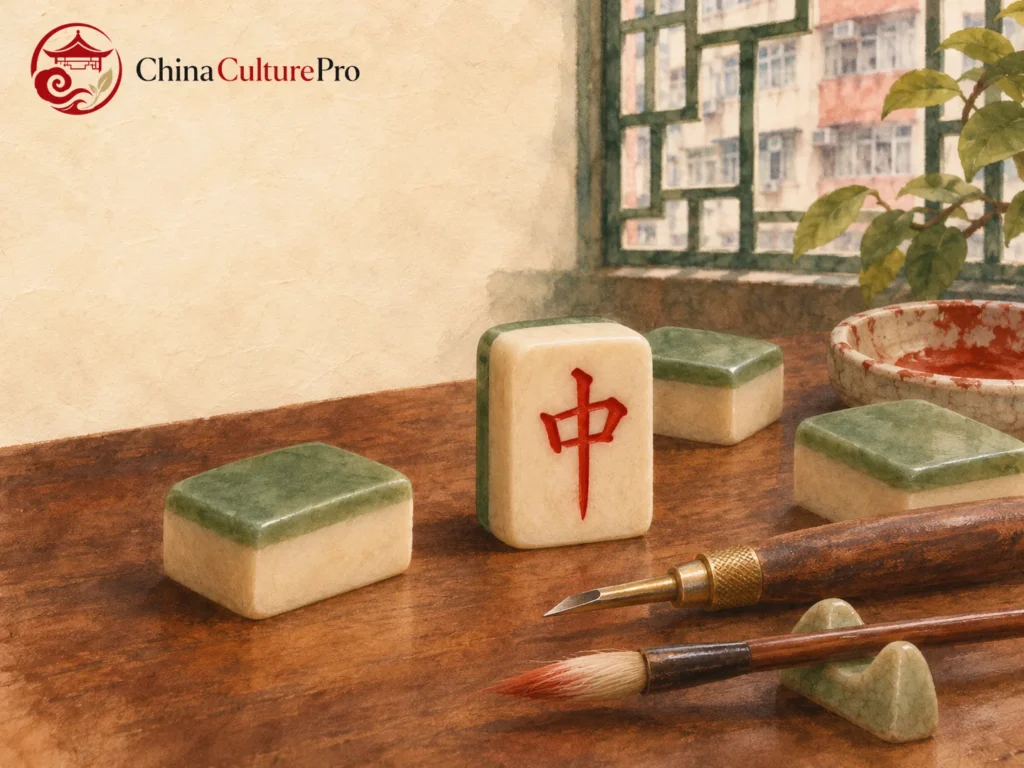
The tiles also carry a local craft tradition. Mahjong Tile Making Technique appears in Hong Kong’s intangible cultural heritage inventory as item 5.61. Its documented processes include cutting, polishing, carving and coloring. This is a local inventory designation, which should not be confused with a UNESCO worldwide inscription.[5]
An educational booklet describes acrylic hand-carving and the gradual replacement of handmade production by machinery. It also records younger craftspeople creating new tile designs through the inherited techniques.[6] A decorated set can therefore express a continuing craft as well as serve a game; its artistic style does not establish which scoring rules its owners follow.
For the game’s wider development and social settings, see mahjong history and playing traditions.
FAQs About Hong Kong Mahjong
Is Seven Pairs always accepted?
No. Seven Pairs (七对, qīduì) is optional in some published home-table guides and is not an accepted winning structure in the competition framework used for this article’s scoring example.[1][4]
Does the dealer always stay East after winning?
No. Some casual rules repeat the dealer after an East win, while the competition rules used here rotate without dealer repeats. Establish the convention before the game.[1][4]
Do flowers belong in a winning hand?
Expose flowers and draw replacements; they do not fill ordinary groups or the pair. Their scoring depends on the chosen rules.[2]
Is three faan the same as three points?
No. Faan must be converted through the selected scale, then the payment conditions applied. The competition example here gives a three-faan discard win a 32-point payment.[1]
出典
[1] Hong Kong Mahjong Association. 香港麻雀總例: Hong Kong Mahjong Rules
[2] Mahjong Time. Hong Kong Mahjong Rules, four-part tutorial
[3] Mahjong Time. Hong Kong Mahjong Scoring
[4] Jiada Mahjong. Hong Kong Mahjong: payments and table agreements
[5] Intangible Cultural Heritage Office, Hong Kong. Intangible Cultural Heritage Inventory, December 2024, item 5.61
[6] Intangible Cultural Heritage Office, Hong Kong. Educational Booklet: Mahjong Tile Making Technique