
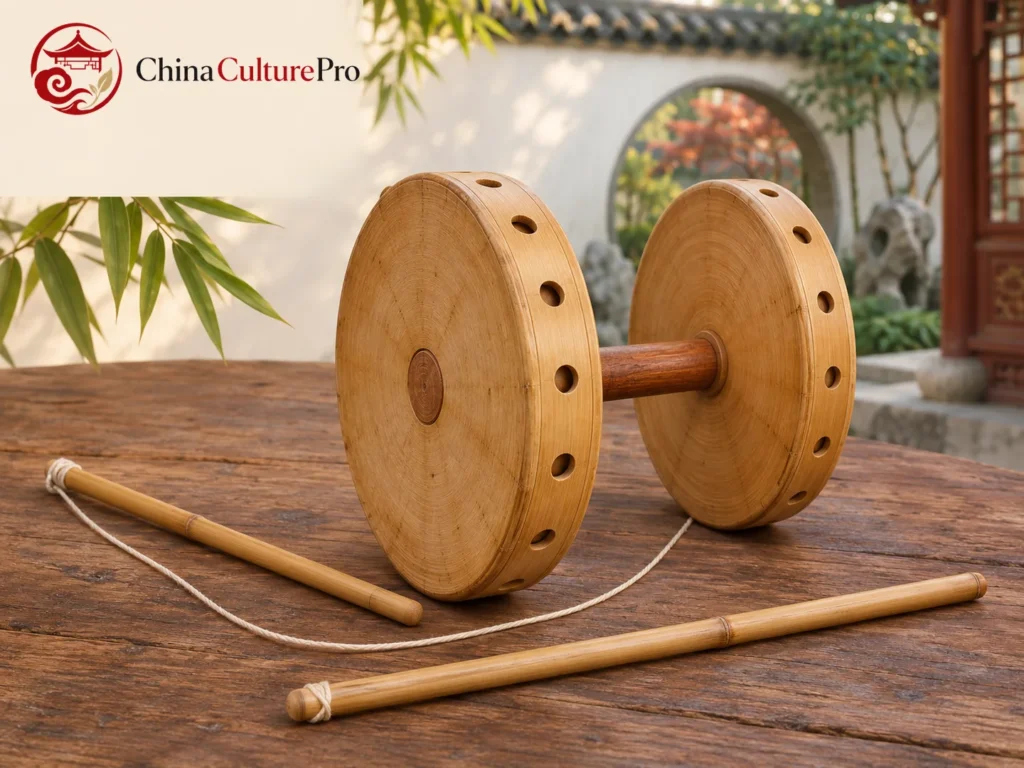

Quick Answer: What Is a Chinese Diabolo?
A Chinese diabolo is a spinning prop controlled with a string stretched between two handsticks. The player’s movements drive its axle, building rotation before attempting balances, throws or other patterns. It belongs to both folk play and acrobatic performance.[2]
- Traditional versions often use hollow bamboo-and-wood discs.[1]
- A two-ended model has a disc on each end of its central axle.[1]
- The prop can leave the string and return to it during a performance.[5]
“Chinese yo-yo” is a familiar English nickname. The basic diabolo setup uses two sticks and a separate prop; it does not work like a toy hanging from one finger.[2]
Watching only the highest throw misses much of the skill. The quieter work—starting the spin, keeping it aligned and preparing the next movement—makes the visible trick possible. This combination of play and trained control connects diabolo with the wider world of Chinese traditional games.
Kongzhu, Che Ling and the Chinese Yo-Yo Name
Kongzhu (空竹, kōngzhú) means “hollow bamboo,” referring to traditional construction. The activity is called dou kongzhu (抖空竹, dǒu kōngzhú), or spinning/shaking the hollow bamboo.[3] Che ling (扯鈴, chě líng) is another established name, commonly used in Taiwan.[4]
The shape helps identify what you are looking at.
| 表現形式 | Visible construction | 覚えておきたい違い |
|---|---|---|
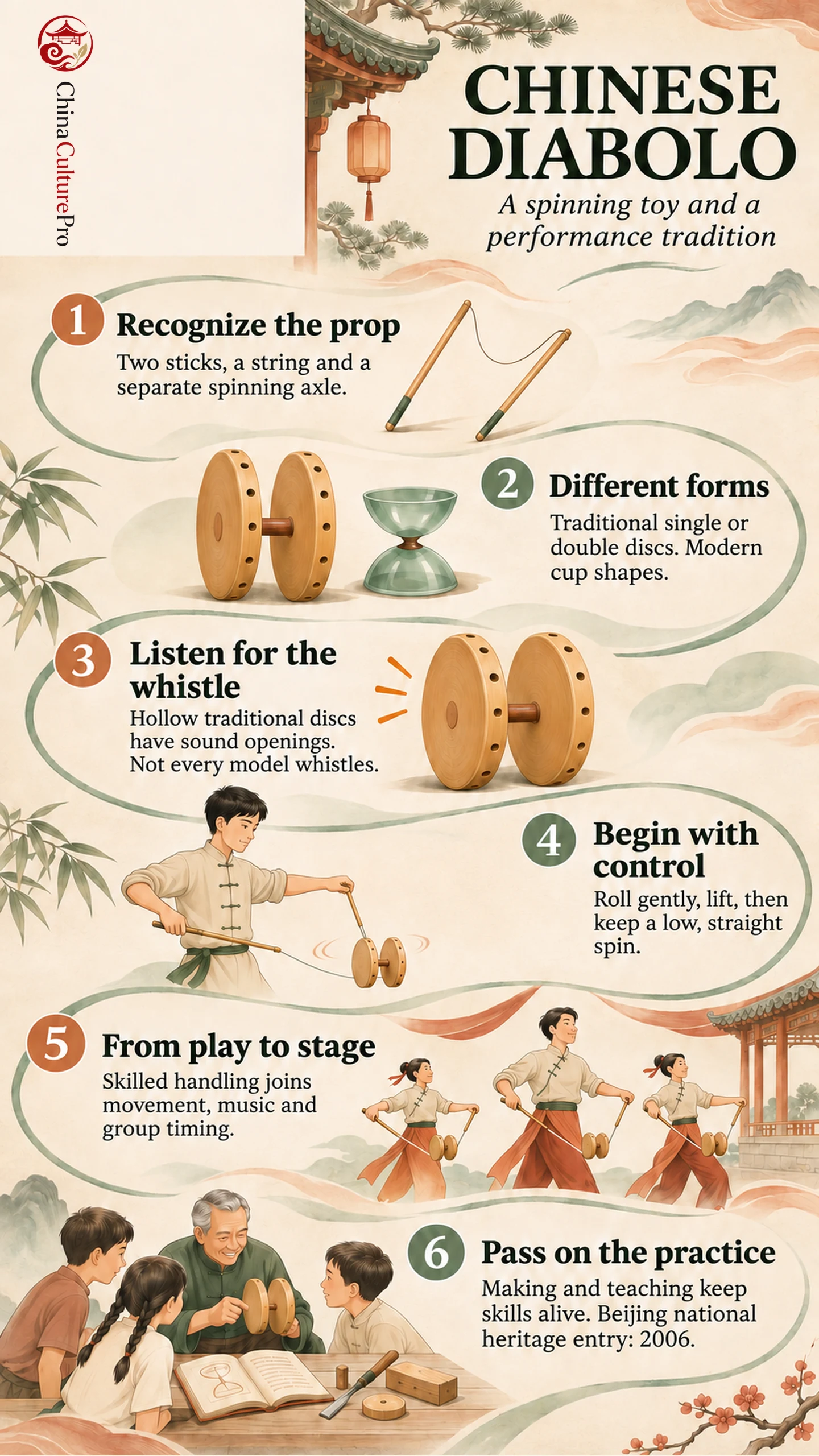
| Traditional double-disc kongzhu | A hollow disc at each end of a wooden axle | Often includes whistle openings.[1] |
| Traditional single-disc kongzhu | A disc at only one end of the axle | Requires a different balance from a symmetrical model.[1] |
| Modern cup-shaped diabolo | Two broad cups joined around a narrow axle | Materials and axle mechanisms vary.[4] |
Whistling comes from openings around the hollow traditional discs as the prop spins. It is part of the object’s design, rather than a sound every diabolo must make. A quiet modern prop can still be a diabolo.[4]
The equipment sits between toy-making and performance. A maker shapes the object’s sound and response; a player learns how those qualities behave on the string. The broader history of Chinese traditional toys helps place that relationship alongside other forms of skilled folk play.
A Documented Tradition in Ming and Qing Beijing
A firm historical anchor is the Ming-period Dijing jingwulue (帝京景物略, Dìjīng jǐngwù lüè), which describes making and playing the object. The national heritage entry also points to material from the Ming Dingling tomb. This supports a longstanding tradition without fixing the first invention to a single ancient year.[1]
In Beijing, the activity became closely associated with temple-fair culture during the Ming and Qing periods. Its movement and sound suited public entertainment: the spinning object could attract attention before a performer added more elaborate patterns.[2]
Be careful with precise claims of several thousand years. A repeated age in a promotional introduction needs an identifiable text or object behind it. The documented Ming tradition is useful evidence in its own right; it does not need an unsupported earlier birthday.
History also belongs to the people who pass the skill on. Traditional making, public play and professional performance can develop together, rather than following one simple sequence in which a toy stops being a toy as soon as it reaches a stage.
How Two Sticks and a String Create Spin
The string contacts the narrow axle. Alternating pulling and easing movements transfer motion to the prop; continued controlled action builds or maintains its rotation. The two hands have different jobs during a basic start, rather than making identical large swings.[2]
This sequence describes a right-handed start with an ordinary fixed-axle model; left-handed learners mirror it. Check the instructions for your particular model.[5]
- Hold one stick in each hand and place the diabolo on the string on the ground in front of your right leg.
- Roll it gently toward the left. Let it roll rather than dragging it sideways.
- After it passes your left leg, lift it from the ground, keeping it in front of you.
- Maintain the spin with small up-and-down movements of the right stick while the left stays relatively steady.[5]
The first goal is a controlled spinning prop on the string. If it tilts badly or tangles, pause and reset; increasing the force does not replace finding the alignment.
Use a clear practice area and an instructor for the move from a low start to throws. Short instruction can describe the mechanism, but it cannot watch a beginner’s string path or correct a moving prop in real time.
From Folk Play to Choreographed Performance
Traditional technique includes varied string movements, balances and releases. Modern performers can link those elements into routines rather than present one isolated trick after another. New forms can preserve the central spinning skill while changing the surrounding presentation.[3]
One example is Taipei’s Diabolo Dance Theatre (舞鈴劇場, Wǔlíng Jùchǎng). A 2015 interview traces its development from a school group into a stage company, incorporating dance teachers, composers, costume design and theatrical collaboration. The transition changed the performance setting and artistic structure while retaining diabolo as the focal prop.[4]
When watching a routine, notice three things:
- Control before release: a stable preparation can be less conspicuous than the throw it enables.
- Paths through space: string, arms and prop can form patterns across the performer’s body.
- Timing with others: shared entrances, catches and movement make a group routine readable.
These are viewing prompts, rather than a universal judging system. A park player, a traditional solo specialist and a theatre ensemble may value different aspects of the same basic object.
Learning and Passing On the Skill
Transmission includes making as well as performing. Practitioners teach through apprenticeships, school visits and local activity groups, while makers adapt traditional designs into new objects. This keeps knowledge about handling and construction in circulation.[3]
A 2026 Hong Kong workshop programme illustrates a practical teaching order: holding the sticks, winding the string and using simple shaking movements to accelerate the spool. It presents foundational control before spectacle; the listing is a dated example, not an invitation to a currently available class.[6]
Beijing’s diabolo-spinning tradition entered China’s first national intangible cultural heritage list in 2006 as project VI-4. That designation concerns a living practice and its transmission, not simply the preservation of an old wooden toy.[1]
For a learner, the next useful step is modest: identify the model, learn its starting direction, then sustain a low, straight spin. Understanding that foundation makes both informal play and advanced performance easier to appreciate.
FAQs About Chinese Diabolo
Is a diabolo attached to its string?
In the basic setup, the prop rests and spins on the string rather than being permanently fastened to it. That allows releases and catches.[5]
Why do some Chinese diabolos whistle?
Hollow traditional discs have sound openings that produce a whistle during rotation. Other constructions can be much quieter.[4]
Is diabolo spinning a Chinese heritage tradition?
Yes. Beijing’s diabolo-spinning entry was included in China’s national heritage list in 2006. This is a national designation, not a UNESCO inscription.[1]
Should beginners start with high throws?
No. Begin with starting, alignment and a controlled low spin. Learn releases with instruction after those basics, rather than copying a stage routine immediately.[5][6]
出典
[1] China Intangible Cultural Heritage Network. Diabolo spinning: national representative project VI-4
[2] Beijing Municipal Government. Diabolo
[3] Beijing Culture and Arts Inheritance Development Center. Diabolo spinning: creating new patterns with a small prop
[4] Taipei City Government. The Diabolo Spins Its Way from Ancient China to the Modern Stage
[5] CIRCUS A.C.T. E-handbook: basic diabolo exercises
[6] Hong Kong Leisure and Cultural Services Department. Chinese Culture Festival 2026: traditional diabolo workshops