

Quick Answer: What Is a Dragon Kite in Haikou?
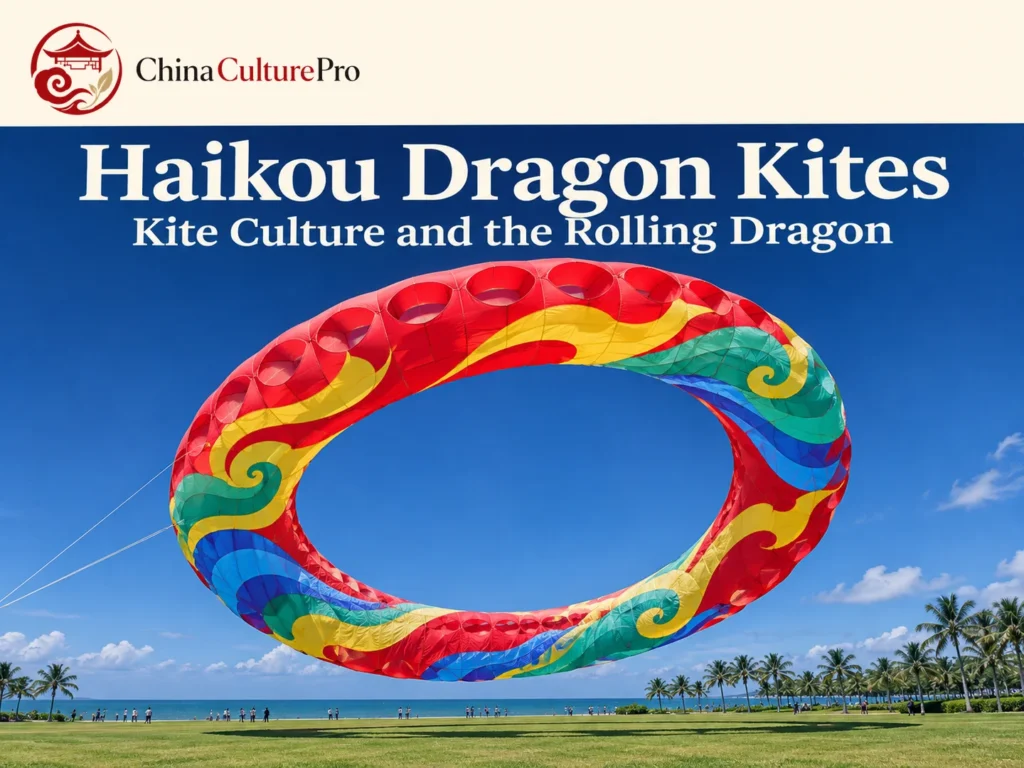
The 2025 Hainan Kite Carnival in Haikou included a competition category for the rolling dragon kite (滚地龙风筝, gǔndìlóng fēngzheng), a soft fabric form that opens into a ring. A traditional dragon-head centipede kite uses a modeled head and a train of separate sections. A Qing account documents kite flying in historical Qiongzhou on Hainan. [1][2][3][4][5]
- Haikou event: Baishamen Park hosted the carnival’s main program in October 2025.
- Rolling dragon: Wind opens a frameless fabric ring.
- Dragon-head comparison: A Weifang example has a bamboo head and linked paper-covered sections. [1][2][3]
The two kite shapes are easy to tell apart in the air. The rolling dragon turns as a ring. The dragon-head kite stretches out in a line of separate sections.

At a kite carnival, a name can describe what a kite does in the wind or what shape it carries into the sky. The rolling dragon is named for its motion. A dragon-head kite makes its image with a face and a long series of parts.
How a Rolling Dragon Takes Shape
The Haikou carnival’s rolling dragon class was listed alongside board, winged and other soft kites. A description of the same competition class on Hailing Island in Guangdong identifies a soft kite that takes shape without a rigid frame. In the wind it opens into a ring and can turn as it rolls. [1][2]
A soft ring takes much of its shape from the air inside it. The fabric can lie flat on the ground and then take on volume when it fills. A ring in motion presents changing sections of color, so the pattern can be read differently as it turns. [2]
How a Dragon-Head Kite Is Built
The Weifang dragon-head centipede kite (龙头蜈蚣风筝, lóngtóu wúgōng fēngzheng) offers an example of a dragon made from a head and a train of framed sections. A documented exhibition example has a three-dimensional head made from many bent and tied bamboo strips, with paper covering. Its head gives the eyes, mouth, horns and whiskers a clear shape. [3]
Behind that head, separate round sections repeat along connecting lines. The exhibition account describes sections of matching diameter set at regular intervals. The repeated spaces let the viewer see a long body assembled from individual pieces. It is one form among many Chinese kites. [3]
What the Qiongzhou Record Tells Us
The Qing writer Li Tiaoyuan records kite flying in Qiongzhou in Nanyue Biji (南越笔记). He reports a custom of flying in the fifth lunar month when southerly winds were strong. The account mentions bamboo, cloth and rattan line and notes that he also saw paper kites in autumn. [4]
Curator Fan Jun referred to the passage during the 2025 exhibition in Haikou. Li’s passage gives the older activity a seasonal setting and records the materials for one type. Its description is about the practice of flying kites in the region. The rolling dragon competition category comes from the much later carnival record. [1][4][5]
How Haikou Brings Kite Making to the Public
The 2025 program included a traditional kite exhibition in Qilou Old Street. Displays covered regional schools and making processes, and visitors could see objects including a paired swallow kite. Curator Fan placed Hainan’s kite culture within the broader Lingnan region. Baishamen Park hosted competitions and workshops later in the month. [1][5]
Hainan Daily also reported sessions at Hainan University, with an exhibition and flying practice for students. They encountered several shapes and modes of flight, including board kites, winged kites and illuminated kites. A museum-style display lets viewers look at how a kite is assembled. A flying session lets them see which parts move as the line takes tension. [6]
FAQs About Haikou Dragon Kites
Does a rolling dragon kite have a dragon head?
The rolling dragon competition form is described as a frameless fabric ring. Its name refers to the rolling effect. A dragon-head centipede kite has a separately built head and repeated body sections. [1][2][3]
Where is the dragon-head centipede kite documented?
A Weifang dragon-head centipede kite is described in a 2026 exhibition report from Beijing. The description records bamboo strips tied for the head and paper-covered sections linked behind it. [3]
What evidence is there for kite flying in old Qiongzhou?
The Qing text Nanyue Biji describes kite flying in Qiongzhou, including the fifth lunar month and an autumn sighting of paper kites. [4]
出典
[1] Chen Wang, Nanguo Metropolis Daily. Hainan Kite Carnival Opens in Haikou
[2] Nanfang Plus. Kite Competition Classes at Hailing Island
[3] Wang Guangyan, via the Beijing Municipal Government. Craft Objects in a Beijing Exhibition
[4] Li Tiaoyuan, Shidian Classics. Nanyue Biji, Volume One
[5] Nanhai Net and New Hainan. Traditional Kite Exhibition in Haikou’s Qilou Old Street
[6] Wang Ligang, Hainan Daily. Kite Carnival at Hainan University