


Quick Answer: What Is Guests Arriving at a Mountain Villa?
Guests Arriving at a Mountain Villa (山庄客至图, Shān Zhuāng Kè Zhì Tú) is a Ming-dynasty painting by Wen Zhengming (文徵明, Wén Zhēng Míng).
- Format: A hanging scroll in ink and color on paper, 87.5 × 27.3 cm.
- Collection: Liaoning Provincial Museum, Shenyang.
- Starting point: Find the small figure outside the entrance, then follow the buildings, trees and rising rocks.
Start with the whole vertical image, then enlarge the doorway and the surrounding brushwork.
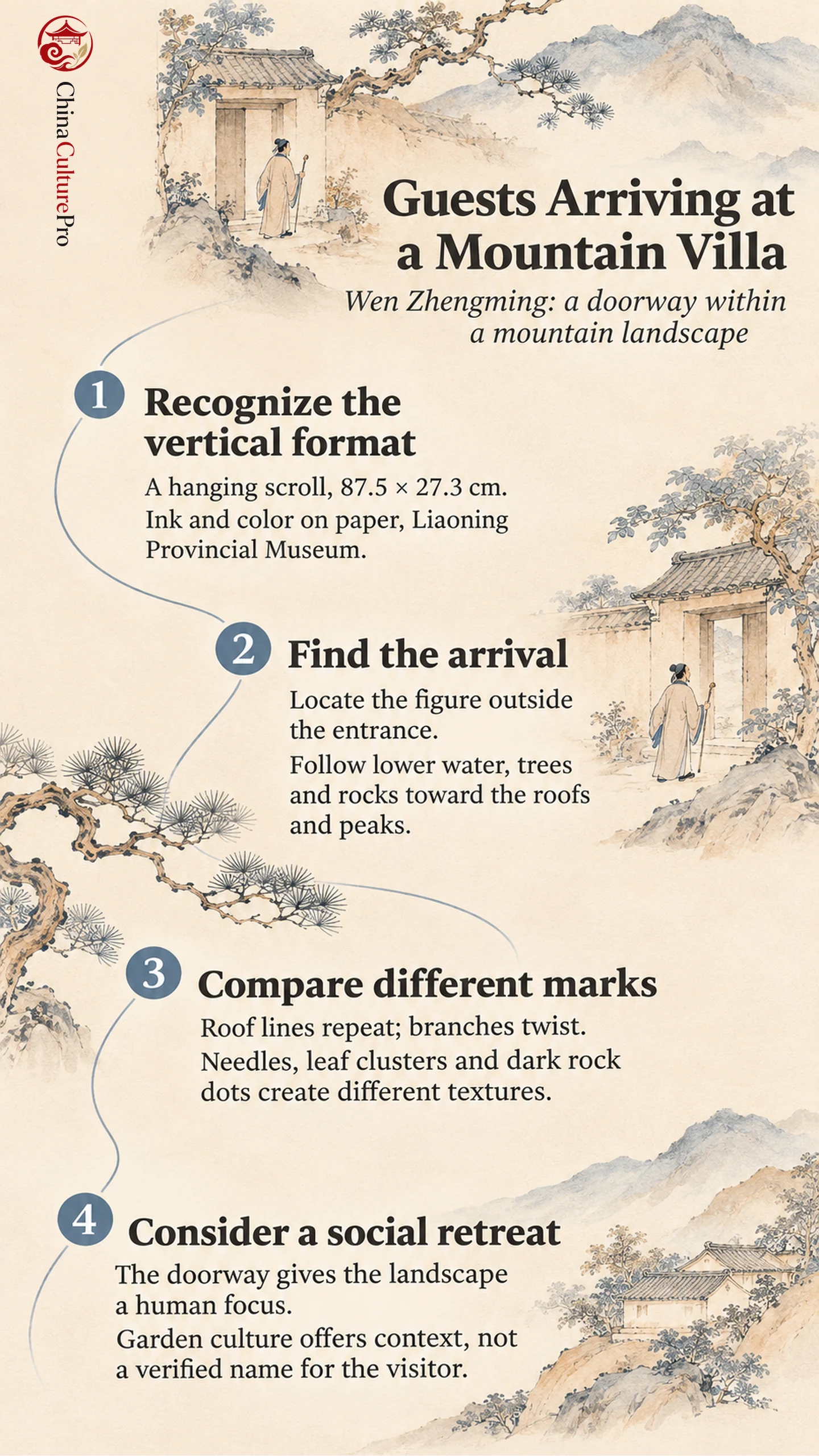
A doorway figure gives this mountainous landscape an intimate human focus. The roofs are substantial beside the people, yet both occupy only a small part of a much taller world of trees and cliffs.
Recognize the Tall, Narrow Hanging Scroll
The published caption identifies the Liaoning work as a paper painting in color measuring 87.5 × 27.3 cm. [1]
Its painted height is a little more than three times its width. That proportion provides a useful first explanation for the composition: a compact area must accommodate the low water, the villa and the peaks above.
Look at the whole image before enlarging a detail. The buildings gather toward the right, while the lower trees spread across much of the narrow field. Higher up, the landscape opens around the mountain forms.
The Chinese-painting guide introduces different formats. Here, keep the tall hanging picture in view as one composition, rather than expecting the extended horizontal unfolding of a handscroll.
Its narrowness also makes every interruption conspicuous: a pale gap beside a roof, a dark canopy or a small human mark can redirect attention.
Follow the Visitor, Water and Rising Rocks
Find the entrance beneath the principal roof group on the right. A small figure stands outside it. The figure’s small scale makes the roofed entrance a clear destination within the larger landscape.
Move down toward the lower water and its figures. Trees and rock intervene between this foreground activity and the entrance above; the visit is embedded in a larger inhabited landscape.
Now trace the diagonal edges of the middle rocks. Their changes of direction turn the eye back across the picture, instead of allowing a straight climb along one side.
Continue toward the higher crags. Notice the difference between following these painted connections with your eyes and reconstructing an actual walk. Some intervals are open, while others are screened by trees or overlap.
The landscape-painting guide develops this use of layered space. The garden-paths-and-windows guide offers a related way to think about revealing and concealing views, without turning this painting into a garden plan.
Return to the entrance after that ascent. Its human scale becomes clearer against the much larger mountain setting.
Separate Fine Roof Lines from Living Textures
Compare the repeated lines of the roof tiles with the irregular edges of a nearby rock. The roof gives the eye a measured pattern; the rock breaks into changes of angle, pale wash and dark dots.
Look next at the upright pine near the center. Its thin trunk and clustered needles make a different silhouette from the broader, twisting foreground trees.
Within those lower canopies, compare small repeated leaf marks with the larger branching framework. Dense foliage partly covers the branches without erasing their direction.
The painting-techniques guide helps distinguish outline, texture and wash. In this image, each contributes something different: a roof edge establishes a boundary, dots roughen a surface, and paler passages leave room around solid forms.
Research on Wen’s garden paintings emphasizes the spatial relationship between planting and buildings. Plants can frame architecture and guide attention as well as carry cultural associations. [1]
Test that observation here by comparing the roof group with the vegetation beside and below it. Trees overlap the approach and soften the separation between the roof group and the surrounding rocks.
Read a Mountain Retreat as a Social Place
The entrance figure makes arrival the scene’s central human event. A secluded dwelling can receive someone; distance from the city need not mean the absence of company.
The Metropolitan Museum’s garden exhibition explains that Chinese gardens supported literary gatherings and that their painted representations could express residents’ character and ideals. This supplies context for viewing an inhabited retreat, rather than evidence naming the people here. [2]
The literati-painting guide develops that connection between a setting and a preferred way of life. The Chinese-gardens guide provides a broader introduction to the relationship between buildings and landscape.
For another treatment by Wen, compare his Garden of the Humble Administrator album. Ask how a view organized around a garden feature differs from this single vertical composition with an arrival at its center.
End by looking at the door again. The small figure gives the architecture a human use, while the rising terrain gives that ordinary encounter an expansive setting.
FAQs About Wen Zhengming’s Guests Arriving at a Mountain Villa
Is this a hanging scroll or a handscroll?
It is a tall, narrow hanging scroll, measuring 87.5 × 27.3 cm.
Can the visitor at the door be identified?
The cited research does not establish a personal name for the figure. Treat it as a visiting figure rather than a verified portrait.
Is the villa a reliable map of a real estate?
The image supports close study of its painted spaces, but does not by itself establish a measured plan or an identified estate.
出典
[1] Li Yi, Artworks. Pine and Bamboo Motifs in Wen Zhengming’s Garden Paintings, excerpt from issue 86
[2] The Metropolitan Museum of Art. Chinese Gardens: Pavilions, Studios, Retreats