


Quick Answer: Where Should an Office Desk Go?
Office feng shui (风水, fēngshuǐ) commonly favors a desk position with a view of the entrance, support behind the chair and space outside the door’s direct line.
- Compare the view from the seated position, not just from the doorway.
- Keep room to use the chair, storage and exit route.
- Adjust the screen and lighting for the work you actually do.
- Treat directional and decorative associations as traditional interpretations.
A preferred compass bearing does not establish that a workstation fits its user or guarantees career success.
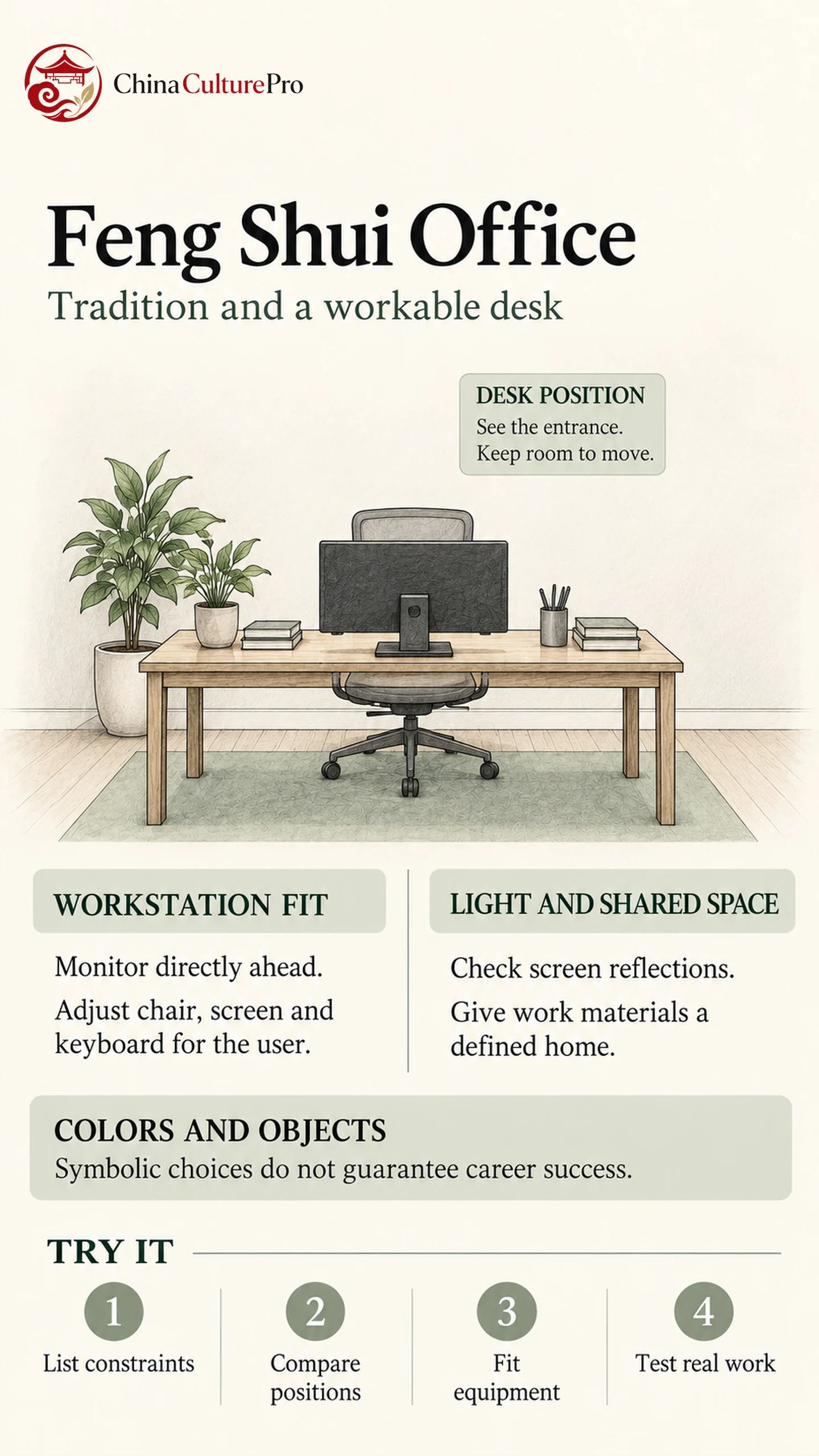
The desk is the center of most office feng shui advice, but its place in a room and its fit to a person are different questions. You can understand the traditional preference while testing the practical arrangement separately. This guide applies the wider feng shui tradition to a home office, shared room or fixed workstation.
Start by naming the main task: screen work, handwriting, video calls or a combination. A desk that works for occasional correspondence may need a different arrangement for hours of computer use.
Understand the Commanding Position
The commanding position usually means seeing the main entrance from the chair, with a settled backing and without sitting directly on the doorway’s axis. In contemporary teaching, this expresses awareness and support. It is a placement preference, not a scientifically established route to authority.[1][2]
Look at the view while seated. A tall monitor can obscure a door that appears visible on a floor plan. Equally, placing the desk diagonally is not enough by itself: check whether the chair can move and whether someone entering has a clear route past it.
The wall behind the chair is distinct from a wall in front of the desk. Confusing the two leads to advice that sounds contradictory. A conventional wall-facing desk can be efficient in a small room, even though it may not meet the preferred door-view arrangement.
Separate Desk Direction from Screen and Chair Fit
Compass-based approaches may add favorable directions calculated within a particular method. They do not supply one universal north-facing or southeast-facing rule. Identify the method before combining it with an entrance-aligned map; the directions guide および bagua map comparison explain those different reference points.
For computer work, assess the equipment independently. General workstation guidance places the primary monitor directly ahead, with the top at or slightly below eye level. It gives a generally preferred eye-to-screen distance of 20–40 inches (50–100 cm), adjusted so the text is readable with a supported, upright posture.[3] This is ergonomic guidance, not a feng shui measurement.
Check the chair and input devices too: lower-back support, supported feet, relaxed shoulders and enough room for keyboard and mouse are practical setup goals. No single arrangement fits everyone.[5] Do not twist the screen to one side merely to preserve a symbolic desk direction.
Work with Windows, Walls and Shared Rooms
Daylight from the side is often useful for screen work. A bright window behind the monitor or reflected in it can create an avoidable viewing problem. Try a different angle, blinds or curtains, and position a task lamp so it lights paper without reflecting in the display.[4]
If the only feasible desk faces a wall, start with usable work depth and lighting. Where a door view is impossible, contemporary BTB guidance suggests a small mirror that reveals the entrance.[1] That is a school-specific adaptation. Test the reflection from your actual chair and reject it if it creates glare or distraction.
In a shared living room, make the work boundary recognizable. A designated storage box, a curtain or a routine for clearing the table may be more feasible than a new partition. Consider how work ends as well as how it starts. See the living room guide when the same space also needs to welcome visitors.
Use Storage, Colors and Objects Selectively
Keep what the current task requires within reach and give other materials a defined home. An empty-looking desk is not the goal if it makes ordinary work inconvenient. Check that cables and storage do not obstruct chair movement or access.
Some contemporary practitioners use brown to symbolize grounding and red to suggest energy or passion for work.[1] Those meanings can guide a personal decorative choice; they are not evidence that changing a chair’s color will change a promotion decision. Start with an accent you like rather than replacing functional equipment.
A plant, artwork or keepsake can have a place if it fits the available space and care routine. No special purchase is required. When advice depends on a school or calculation, keep its assumptions attached instead of adding every recommended object to the same desk. The Form and Compass school comparison provides context for those differing priorities.
A Four-Step Office Layout Trial
- List the fixed constraints: Mark doors, windows, sockets, storage and the tasks that must fit.
- Compare desk positions: Try a door view and supported seat without blocking access or creating screen glare.
- Fit the workstation: Adjust the chair, monitor, keyboard and lighting for the person using them.
- Try a working session: Test actual screen work, writing and storage access before keeping the arrangement.
Judge the change by observable results: can you read the screen, reach what you need and use the room without awkward detours? Keep a change because it serves the work, rather than because it looks ideal in a diagram.
FAQs About Feng Shui Offices
Must my desk face north or southeast?
No universal direction applies to every office. Directional recommendations depend on the method, while room constraints and workstation fit still need separate checks.
What if my desk must face a wall?
Use the available space well. Check screen distance, lighting and chair movement; a school-specific mirror workaround is optional, not a requirement for a functional desk.
Can I put a desk in the bedroom?
Sometimes a shared room is the only option. Give work materials a defined place and consider how the room returns to its resting use. The bedroom guide addresses the bed separately.
Will a feng shui object improve my career?
An object can carry symbolic or personal meaning. Its placement does not establish a guarantee about income, promotion or professional success.
出典
[1] Mindful Design Feng Shui School. How to Set Up a Home Office
[2] FengShui.info. Desk placement
[3] Occupational Safety and Health Administration. Computer Workstations: Monitors
[4] Occupational Safety and Health Administration. Computer Workstations: Workstation Environment
[5] Occupational Safety and Health Administration. Computer Workstations