
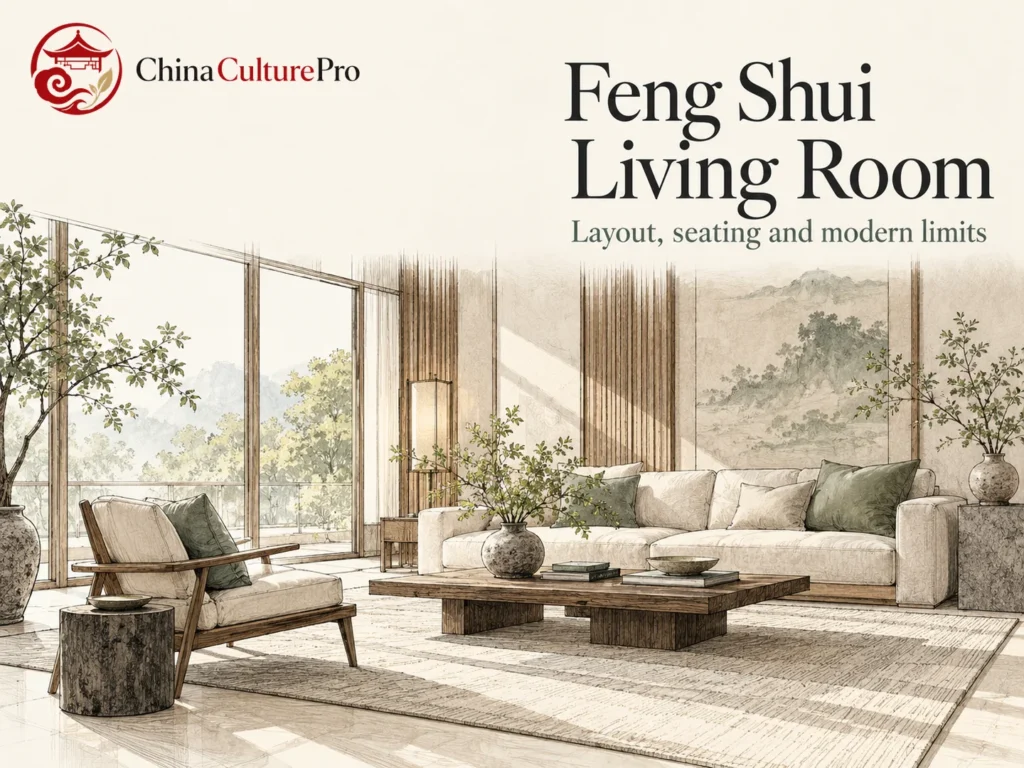

Quick Answer: What Makes a Feng Shui Living Room?
Living room feng shui (风水, fēngshuǐ) usually emphasizes supported seating, a view of the entrance, easy movement and a welcoming place for people to gather.
- Give the main sofa a settled position without blocking the room.
- Arrange seats so people can converse as well as watch a screen.
- Check daylight, lamps and reflections from the seats themselves.
- Treat colors and objects as symbolic choices rather than promises of wealth.
These are traditional and modern interpretive preferences; a workable layout depends on the actual room and its users.

Feng shui brings a Chinese tradition of interpreting places into decisions about the home. Its language of qi (气, qì), often translated as vital energy, belongs to a cultural framework rather than a measurable interior-design score.[4] A feng shui overview explains that wider setting; here the task is arranging a room where people sit, talk and share activities.
Start with what happens there: family evenings, visitors, reading, play or television. A layout that photographs neatly but leaves someone without a comfortable seat has missed the room’s purpose.
Place the Sofa Around People and the Door
A common placement preference is a main sofa with solid backing and a view toward the entrance, outside the direct doorway line. The backing may be a wall; in a floating arrangement, a stable console can suggest a boundary behind the sofa. These are interpretations of support and awareness, not guarantees about relationships.[1]
Compare feasible positions before insisting on one. A door view is less useful if achieving it traps the coffee table against people’s knees or puts the only chair in a passage. Where the window wall is the only workable location, check the sofa’s height, curtains and access to the window instead of declaring the whole room unusable.
Then turn attention to the other seats. A sofa and an angled chair can form a conversation group; facing sofas can also work when people can speak comfortably across them. Neither symmetry nor a particular furniture count is compulsory. Plan enough usable seating for the household and the guests you regularly invite, a point emphasized in contemporary practitioner guidance.[2]
Keep Routes Clear in Open and Small Rooms
Trace the trips people make: entrance to sofa, sofa to kitchen, and seating to the next room. Keep those routes recognizable. Do not force everyone to squeeze between an ottoman and a cabinet simply to preserve an idealized diagram.
In an open plan, a rug or the back of a sofa can mark the sitting area without adding a partition. A console is helpful only if it leaves room to pass and does not become another obstacle. In a compact room, one useful chair may serve better than an oversized matching suite.
Think about changing uses too. A child’s play area, a foldout guest bed or an occasional work table needs space at the time it is used. Test those arrangements, rather than measuring only the tidy daytime version. The route into the room also connects with the front-door arrangement; review the transition between the two spaces.
Check Light, Mirrors and the Television
Contemporary feng shui teaching often values daylight and considered lighting in gathering spaces.[2][3] As a practical check, sit where someone reads or watches television: is there enough light for the task, and is a window or lamp reflected in the screen? A curtain adjustment or a second lamp may solve more than moving every piece of furniture.
Mirror rules differ. BTB teaching permits mirrors to restore a door view in a commanding-position arrangement. That school’s published bedroom example shows why a blanket ban on all door reflections is misleading.[5] For a living room, examine what the mirror actually shows from the seats and doorway. A pleasant reflection is a design choice; it does not establish a causal claim about luck.
A television is not automatically disqualifying. Decide whether the room needs to support conversation while the screen is off. Turning one chair toward the sofa, or using a movable chair, can give people that option without making ordinary screen use awkward. Bedroom feng shui has a different emphasis on the bed and rest; do not apply every bedroom preference to a social room.
Choose Colors, Plants and Objects with a Purpose
Wuxing (五行, wǔxíng), the five phases, supplies many traditional associations used in decor. In contemporary practice, living green plants can represent Wood, while red accents are sometimes used symbolically for harmony or protection. Green and yellow also appear in practitioner discussions of a welcoming room.[2][3] These associations do not mean a red cushion will prevent arguments.
Choose a palette you can live with, using an accent rather than repainting on the strength of a generic luck list. Put plants where their actual light and care needs can be met. Meaningful artwork or a rug can help define how a space feels and is used; buying a special object is not a prerequisite for rearranging furniture.
If advice assigns a particular color to a corner, identify the mapping method first. Bagua maps may be aligned differently by different schools. Mixing their labels produces conflicting instructions, not a more complete assessment.
A Simple Living Room Layout Review
- Map the room: Mark doors, windows, fixed furniture and the routes people actually use.
- Place the main seat: Compare a supported position with a door view against the space required for movement.
- Add the other activities: Arrange guest seating, reading light and the screen around the room’s real uses.
- Test the result: Sit in every seat, walk the routes and inspect reflections in daylight and after dark.
Change one arrangement at a time so you can tell what improved. If the room also functions as a workplace, use the separate office layout guide for the desk rather than expecting the sofa arrangement to solve that task.
FAQs About Feng Shui Living Rooms
Must a sofa always touch a wall?
No. Wall backing is a common preference, but floating seating can be a practical solution in an open plan. Compare support, door visibility and the routes around it.
Is a television bad feng shui?
There is no universal television ban. Arrange the room for its real activities, including conversation, and check screen glare and viewing comfort.
Can a mirror face a doorway?
Interpretations differ. Identify the school behind the advice and inspect the actual reflection instead of treating every doorway mirror as unlucky.
Does every living room have the same wealth corner?
No. Entrance-aligned and compass-based maps use different reference points. See feng shui directions before applying a directional label.
出典
[1] FengShui.info. The living room
[2] Holistic Spaces. Episode 254: Feng Shui Room x Room: the Living Room
[3] Holistic Spaces. Episode 332: Feng Shui Must Haves for Your Living Room Decor
[4] Columbia University, Asia for Educators. The Chinese Cosmos: Basic Concepts
[5] Mindful Design Feng Shui School. Q&A: Mirrors in the Bedroom