

Quick Answer: What Is Family by Ba Jin About?
*Family* (家, Jiā) is the first novel in Ba Jin’s (巴金, Bā Jīn) *Torrent Trilogy*. In early 1920s Chengdu, three brothers in the Gao household come up against the power of their grandfather and other elders. They respond differently to demands about marriage, family duty and the lives they should lead.[1][2][3]
- The household: Four generations share a residence and an order in which seniority gives some people much greater authority.
- The brothers: One submits, one pushes back over his own marriage, and the youngest questions whether he can remain in the family at all.
- The stakes: Women in the household often have fewer ways to resist a decision, even when it concerns their own future.
The sequel *Spring* follows consequences that the first book leaves within the household.[2]
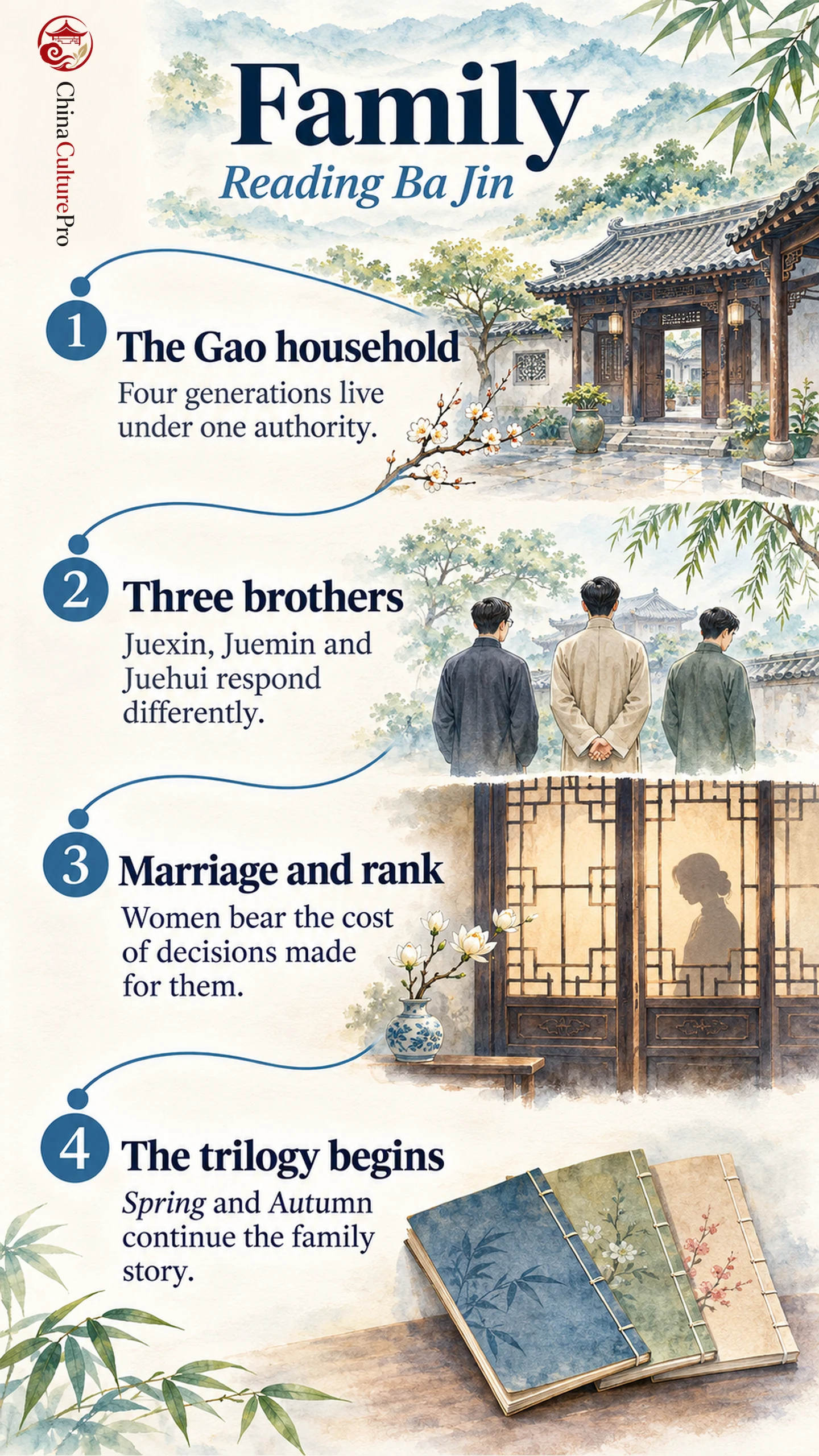
The Gao brothers grow up in the same family. How old they are and where they stand in the household give them different chances to resist it.
The Gao Household and the Three Brothers
The grandfather’s authority rests on more than his temper. His decisions affect people in four generations and the servants who live alongside them. Relatives and servants may depend on a house whose rules they cannot set. Ba Jin places that structure in a Chengdu where younger people are also encountering calls for social change. Ideas circulating after the May Fourth Movement give the brothers ways to question decisions they were raised to accept. The family’s authority is already familiar to them, so the new ideas become visible through arguments about particular marriages and choices.[2][3][2][3]
| Brother | What to follow |
|---|---|
| Gao Juexin (高觉新, Gāo Juéxīn) | The eldest brother tries to carry out family duties, even when the duties conflict with what he wants for himself and for people close to him. |
| Gao Juemin (高觉民, Gāo Juémín) | The middle brother opposes a marriage chosen for him and tries to defend the relationship he wants. |
| Gao Juehui (高觉慧, Gāo Juéhuì) | The youngest brother challenges household authority more openly and considers a life beyond the mansion. |
The first part of each given name is the same. Their positions and decisions are a better guide than the names alone. Juexin has the most immediate duty to preserve the family’s order. His younger brothers can see that sense of duty as cooperation with the elders.[2][3]
Why Marriage Becomes a Test of Authority
Juexin has feelings for his cousin Mei. He follows his elders’ choice and marries Li Ruijue (李瑞珏, Lǐ Ruìjué). Juemin wants to marry Qin, a cousin who shares his views. When the grandfather chooses someone else, he stays away from home rather than obey the order. His refusal shows that a brother in the same house can try a different response. Even then, a refusal has to be made against other people’s plans and ideas of what the family owes its elders.[2][3]
Mingfeng (鸣凤, Míngfèng), a servant who is close to Juehui, has less room to act. The grandfather treats an arrangement to send her to an older man as a decision he can make. The novel gives weight to her feelings precisely because the people who can settle her future give them so little weight. The difference between the brothers’ choices and hers shows how rank works within the same household.[3]
What Happens to Mingfeng and Ruijue?
This section reveals major plot events. Mingfeng drowns herself rather than go to the man selected for her. Ruijue dies after being sent away from the mansion to give birth. In her case, the household’s objections to a birth there matter more to the decision makers than her need for care. The family is in mourning when Ruijue is sent away. An elder invokes the danger of bloodshed in the house, and Ruijue is sent to a run-down house outside the city. The two women occupy different positions, but both are left with too little say in decisions that determine what happens to them.[3]
Juehui eventually leaves the family. His departure makes it possible to imagine another life, while the people who remain still have to live with what happened. Lu Xun’s A Madman’s Diary gives another account of how respectable language can conceal harm. Ba Jin builds that question into a series of decisions relatives make about one another.
How Family Leads to Spring and Autumn
春 moves the focus toward other young relatives whose marriages and futures are still at issue. 秋 follows the household’s wider breakup. The later novels are easier to read once you know why Juexin tries to keep the family together and what different relatives hope to gain by leaving.[2]
FAQs About Family by Ba Jin
Was Family first published in 1931 or 1933?
Both dates refer to different stages of publication. The novel began appearing in a Shanghai newspaper in 1931 under the title *Torrent*. Kaiming Book Company issued the first standalone book as *Family* in 1933.[1]
Who translated Family into English?
Sidney Shapiro translated the novel. Foreign Languages Press issued *The Family* in 1958. Catalogue records may spell Ba Jin’s name *Pa Chin*.[4]
出典
[1] People’s Daily Overseas Edition. The publication history and editions of Ba Jin’s Family
[2] Academy of Chinese Studies. Ba Jin and the Torrent Trilogy
[3] Qinghai Normal University. Ba Jin’s Family, the brothers and the Gao household
[4] CiNii Books. The Family, Sidney Shapiro’s 1958 edition