


Quick Answer: What Is Ding Ware?
Ding ware(定窑,dìngyáo)is a northern Chinese ceramic tradition associated with the Quyang kilns in Hebei. It is especially known for white porcelain developed during the Tang, Song and Jin periods. [1]
- 外観: A pale body and warm ivory glaze create the best-known look. [2]
- Decoration: Designs can be cut into the clay by hand or impressed with a patterned mould. [3][4]
- Firing traces: Many bowls and dishes have an unglazed mouth, sometimes covered with a metal band. [5]
- Reputation: Ding belongs to the later collecting category of the Five Great Wares. [6]
White glaze alone does not identify a piece as Ding ware; shape, decoration, firing evidence and the collection attribution all matter.
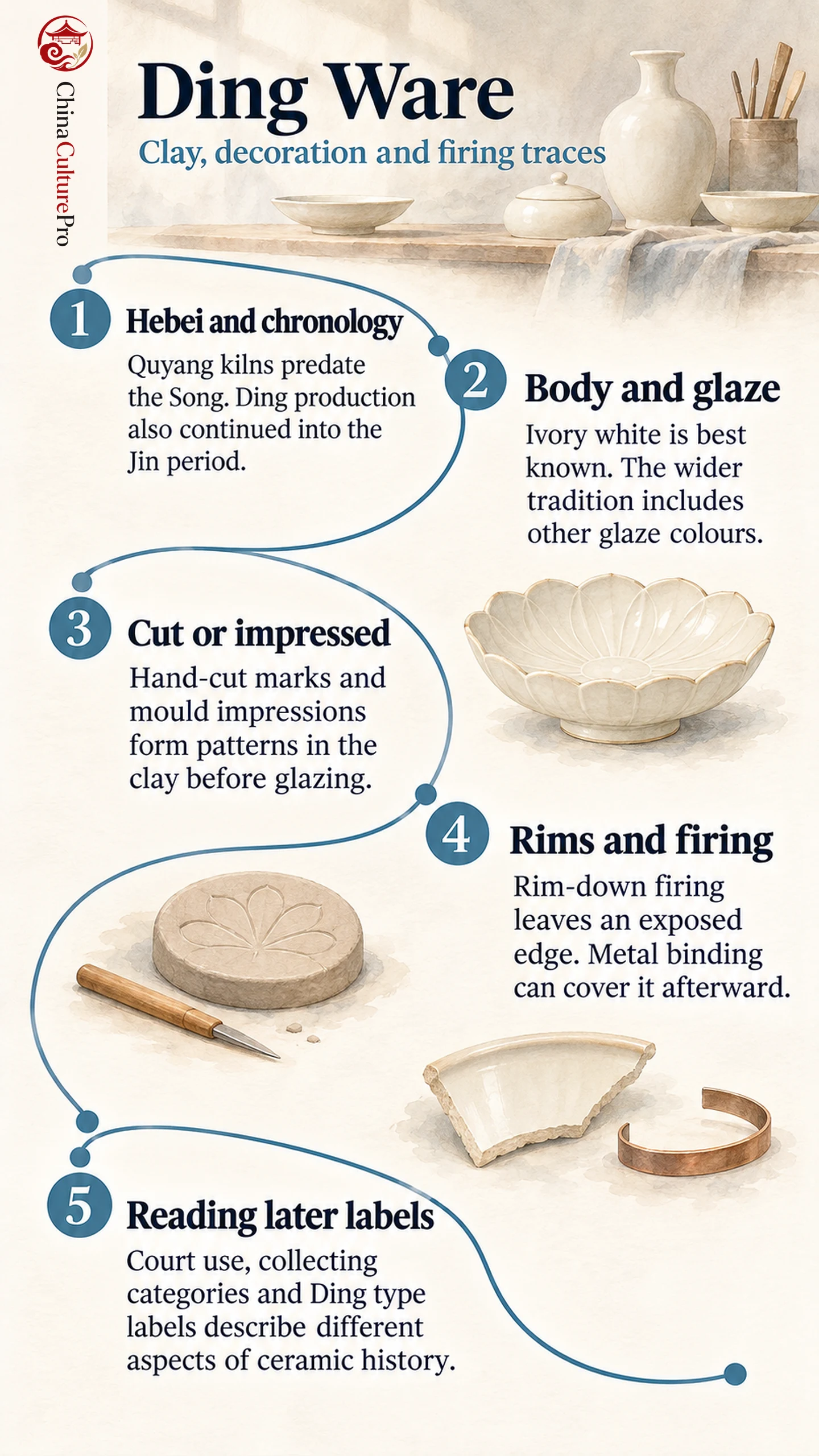
A pale dish can reveal much more than its colour. A lotus line may follow a cutting tool, a repeating border may come from a mould, and a copper edge may conceal a firing surface. Ding offers a useful way to explore how Chinese porcelain joins material and technique.
Origins in Hebei and the Song–Jin Context
The main Ding kiln sites are in Quyang County, Hebei, including Jianci village. The name comes from the historical Ding prefecture associated with the area. Production began before the Song, in the late Tang and Five Dynasties context; the kilns became particularly prominent during the Northern Song. [1][7]
The story continues into the Jin and Yuan periods. A label reading “Song” and one reading “Jin” may therefore describe objects within the same broad ceramic tradition, rather than unrelated kinds of porcelain. [1]
For chronology, separate a ware’s production history from the date assigned to one vessel. An individual bowl can receive a narrower date even when the name Ding covers a much longer sequence.
Ivory Glaze, Thin Bodies and Common Forms
The familiar Ding appearance combines pale ceramic clay with a warm, smooth white glaze. Ivory is a useful colour description, but individual examples can lean yellowish or greenish. On the Walters bowl 49.1718, a greenish cast accompanies the warm white surface and leafy lotus decoration. [2]
Thin potting is another important feature. A large carved basin in Osaka, accession 00495, has a light, thin body through which light can pass. That observation describes a particular object, rather than a requirement that every Ding vessel must be equally translucent. [3]
Bowls and dishes dominate the surviving repertoire described in the kiln overview; bottles, pillows and boxes also occur. Black, brown and green glazes broaden the tradition beyond its famous white wares. [1]
The distinction between body and glaze is worth keeping: the ceramic body supports the vessel, while the fired glaze forms its surface. Our guide to pottery and porcelain explains that material vocabulary.
Reading the Decoration: Incised, Carved and Moulded
The three descriptions below identify how a pattern is formed. They do not simply name different subjects: a lotus can appear through more than one technique.
| 方法 | How the design is formed | 注目する点 |
|---|---|---|
| Fine incising | A pointed tool draws comparatively narrow lines into the clay. | Line direction, curved stems and delicate interior detail. |
| Carving, or kehua(刻花,kèhuā) | A cutting tool removes or lowers clay, sometimes held at an angle. | Broader cuts, shallow relief and the contrast between a motif and its background. |
| Moulding, or yinhua(印花,yìnhuā) | A patterned mould impresses decoration into the still-workable body before glazing. | Closely arranged motifs, repeated borders and consistent detail. |
Carving and fine incising can work together. The Osaka basin combines angled outlines with combed detail on lotus petals, giving the decoration more than a single kind of mark. [3]
Mould-impressed designs became increasingly important in the later Northern Song and Jin periods. A large peacock-and-peony dish uses a coordinated interior composition: birds and flowers occupy different zones separated by a border. The pattern was impressed into the clay before the glazed vessel was fired. [4]
Moulding moved much of the pattern-making work to the creation of a reusable model. Pressing the body against that model transferred the design, while glazing and firing followed afterward.
Why Many Ding Vessels Have Bare or Metal-Bound Rims
Fushao(覆烧,fùshāo)means firing a vessel upside down, resting on its mouth. In Ding production, stepped firing supports and protective containers helped accommodate more vessels within the kiln. The mouth was cleared of glaze so that it would not stick to its support. [5]
The resulting bare rim is called mangkou(芒口,mángkǒu). A metal binding could cover this exposed edge after firing; copper was common, while silver or gold could also be used. The binding changed both the feel of the mouth and the appearance of the vessel. [5]
These are separate operations: the firing method produces the exposed rim, and metalworking supplies a later finish. For a rim-bound object, distinguish the exposed ceramic mouth, the metal covering and the catalogue’s attribution; each supplies a different part of the object’s description.
The wider relationship between supports, stacking and the firing chamber belongs to Chinese ceramic kiln types.
Museum Examples and the Meaning of Ding Type
Two collection descriptions show how different details deserve attention. The Osaka lotus basin has carving on both its interior and exterior and a silver rim. The Ashmolean dish EA1989.193 combines hand-incised lotus decoration with copper binding. Their decoration and finishing overlap without being identical. [3][6]
Labels also preserve different levels of attribution. The Metropolitan Museum’s eleventh-century bowl 17.175.6 is catalogued as “Ding type ware.” That wording should be retained when discussing the object rather than silently replaced with a more specific kiln attribution. [8]
“Type” keeps the comparison visible while leaving the label’s attribution intact. The word is not a manufacturing date, and it does not by itself identify a modern reproduction. Read it alongside the stated period, material and place.
Court Use, Collecting and Later Influence
Ding wares were supplied as tribute to the Song court. Their inclusion among the Five Great Wares belongs to later connoisseurship: the group brings Ding together with Ru, Jun, Guan and Ge. It is a collecting framework, rather than evidence that five identical production systems operated under one rule. [6]
Ding’s decorated white wares continued to provide models for later ceramics, including works made during the Ming and Qing dynasties. A later vessel can therefore refer back to Ding without sharing the date of a Song or Jin original. [7]
For further comparison, Ru ware, Jun ware および Cizhou ware offer separate traditions within the larger history of Chinese ceramics.
FAQs About Ding Ware
Is All Ding Ware White?
No. White porcelain is its best-known production, but black, brown and green glazes also appear in the kiln tradition. The ware name is broader than a single glaze colour. [1]
Why Does Ding Ware Have a Metal Rim?
On many rim-fired vessels, the mouth was left unglazed to prevent sticking in the kiln. A metal band could subsequently cover the bare edge and provide a finished surface. [5]
Is Moulded Decoration Painted onto the Glaze?
No. The design is impressed into workable clay using a patterned mould before glazing and firing. The resulting relief is part of the ceramic body’s surface. [4]
Does Ding Type Mean the Same as Ding Ware?
Retain the collection’s exact wording. “Ding type” signals a comparison or classification that should not automatically become a more specific kiln attribution. It also does not, by itself, mean a modern copy. [8]
出典
[1] 故宮博物院。 Ding kiln
[2] Walters Art Museum. Bowl with Notched Rim, 49.1718
[3] Museum of Oriental Ceramics, Osaka. Basin, white porcelain with carved lotus design, 00495
[4] Han Qian / Palace Museum. Ding white-glazed dish with moulded peacocks and peonies
[5] British Museum. Ding porcelain dish with copper-bound mouth rim, PDF.184
[6] Ashmolean Museum(アシュモレアン博物館)。 Ding Ware Dish, EA1989.193
[7] National Palace Museum. The Decorated Porcelains of Dingzhou: White Ding Wares
[8] Metropolitan Museum of Art. Bowl, 17.175.6