


Quick Answer: What Is a Chinese Ginger Jar?
A Chinese ginger jar typically has a rounded body, short collar and cap or domed cover. The English name reflects a traditional association with preserved ginger. In collections it can also name the shape when the contents are unknown.[1][2]
- Shape: A broad body narrows toward the opening and often toward the foot.
- Decoration: Examples range from simple glazes to painted flowers and birds.
- Evidence: A lid, maker’s mark and museum date each describe a different part of an object’s history.
Read “ginger jar” as an object label. Confirm any statement about the original contents separately.[3]
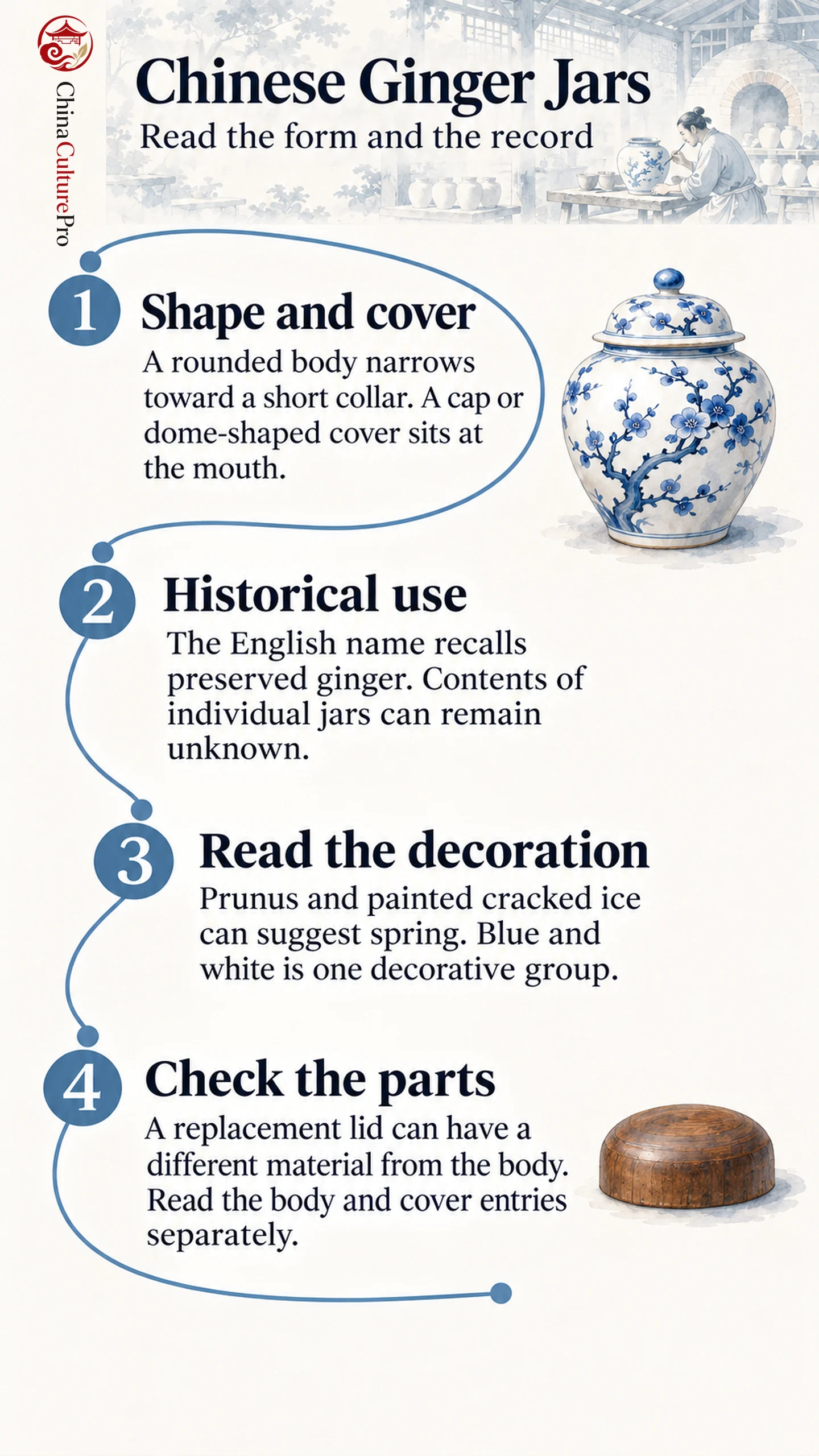
The cover of a Chinese jar can be as informative as the painting on its body. A lid may fit the mouth, echo the decoration or belong to a later repair. A collection record can show how the two parts belong to the history of the assembled object.
How to Recognize the Jar Shape
Look at the profile from the side. The widest part of an ovoid jar gives it volume, and the shoulder draws in toward the mouth. The short collar provides a place for a lid to sit. Compare the shoulder, mouth and foot together to describe the jar’s full profile.[1]
| 項目 | What to observe |
|---|---|
| Body and shoulder | A rounded body and sloping or flatter shoulder create the characteristic silhouette. |
| Mouth and collar | The shape and height of the collar help describe how the cover sits. |
| Cap or domed cover | Record the cover separately when it is present. Its material and fit can differ from the body. |
In museum use, the label can include vessels that now have no cover. Also read the material. Fine Chinese porcelain is one possibility, while excavators also use the term for some stoneware jars.[3][5]
What the Name Can Tell You About Historical Use
For the large baluster vase catalogued as C.710 & A-1991, ginger preserved in syrup is one possible cargo. The exhibition label leaves the contents unresolved.[2]
A different kind of record comes from an archaeological catalogue. The fragment labeled CER060 is stoneware with a blue-green exterior glaze. Its identification leaves two possibilities, a ginger jar or another small jar. That wording preserves the limit of what a body fragment can establish.[3]
By the late eighteenth century, it had become fashionable to display jars of the kind represented by the baluster vase. The storage association and display history can coexist. For how vessels traveled and acquired new uses, see Chinese export porcelain.[2]
Blue and White, Prunus and Other Decoration
Painted blue-and-white jars use cobalt decoration below a clear glaze. Patterns can cover the whole body or be organized by shoulder, middle and foot. Birds and flowering plants appear on some early examples, alongside the later floral patterns described below.[2]
Two jars in the Dresden catalogue are attributed to the Kangxi (康熙, Kāngxī) period, 1662–1722, and to Jingdezhen (景德镇, Jǐngdézhèn). Their prunus flowers stand out against a painted cracked-ice design. Read that phrase as the name of a painted motif. Surface crackle describes a different feature, a network of lines in the glaze itself. The catalogue associates this decoration with spring and the jars with New Year gifts. It also records a later wave of collecting and imitation. The motif therefore carries both a seasonal association and a history of reuse on new objects.[4]
A Qianlong (乾隆, Qiánlóng) reign jar dated 1736–95 in another collection has a dense blue floral pattern. Comparison helps you see the range of blue-and-white porcelain designs applied to similar rounded forms. A pattern is worth describing alongside the object’s date and provenance.[5]
How to Read the Body, Lid and Catalogue Together
Start with the material and date of the body. Then read the cover field. The baluster vase C.710 & A-1991 has a Chinese porcelain body dated about 1600–44 and a replacement wooden cover. The date of the body and the status of the cover occupy separate fields in its record.[2]
Look for the accession number in museum collection records when a short caption leaves out the cover or provenance. If the cover has its own material, date or restoration note, keep that detail attached to the cover. Record any base inscription separately, using the guide to Chinese porcelain marks for the kinds of evidence a mark can supply.
FAQs About Chinese Ginger Jars
Were Chinese ginger jars used only for ginger?
The term recalls an association with preserving ginger. For an individual jar, a label or archaeological context may offer more information, and in many cases the original contents are uncertain.
Is every ginger jar blue and white?
Blue and white is one decorative group. The label also occurs in archaeological records for some green-glazed stoneware jars.
Can a ginger jar be identified without its lid?
The body can still be described by its profile, shoulder and collar. A missing cover leaves one part of the object unavailable for comparison.
Does a matching pattern show that the lid is original?
A matching pattern is one clue. Check whether the record describes the cover as original, associated or a replacement. Its fit, material and documented history are also relevant.
出典
[1] The Fitzwilliam Museum. Ginger Jars
[2] The Fitzwilliam Museum. Baluster Vase (“Ginger Jar”), C.710 & A-1991
[3] Smithsonian National Museum of American History. Cleopatra’s Barge Artifact Catalog
[4] The Metropolitan Museum of Art and Dresden State Art Collections. The Splendor of Dresden: Five Centuries of Art Collecting, Catalogue Entries 342–343
[5] Cleveland Museum of Art. Ginger Jar, 1939.206