
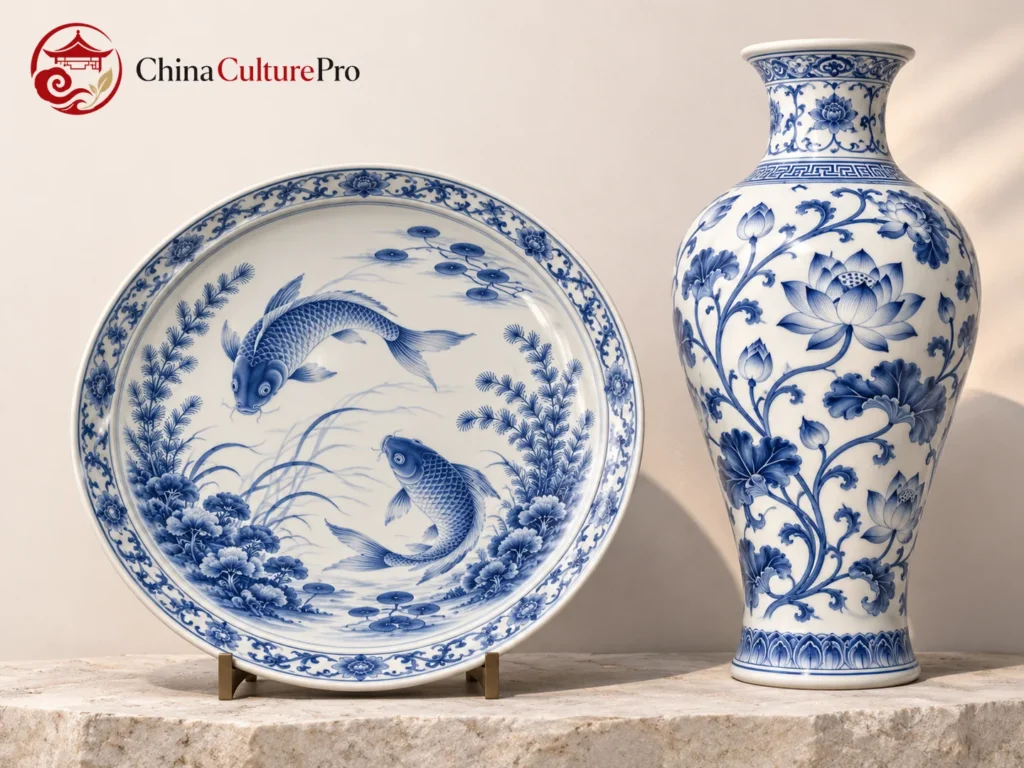

Quick Answer: What Is Chinese Blue-and-White Porcelain?
Chinese blue-and-white porcelain (青花瓷, qīnghuā cí) typically has cobalt blue decoration painted on a pale porcelain body under a clear glaze. Early Chinese blue-painted ceramics date to the Tang period. The dated David Vases show that Jingdezhen was producing accomplished blue-and-white porcelain by 1351. [1][2][3][4]
- The blue belongs beneath the glaze. The clear surface covers the cobalt design and lets it remain visible after firing. [1][4]
- One palette can produce different effects. Dark outlines, pale washes and areas left white give designs different kinds of contrast. [1][5]
- The wares had several markets. They served religious and domestic uses in China and traveled to buyers across Asia, the Middle East and Europe. [1][3][6][7]
Look at the design, then check what the label says about the body, glaze and place of manufacture.
A brushstroke under a glaze can remain crisp at one edge and soften at another. Notice the line before turning to the label. It can help you understand how the maker used cobalt and why similar colors can appear on very different vessels.
How Cobalt Goes Under the Glaze
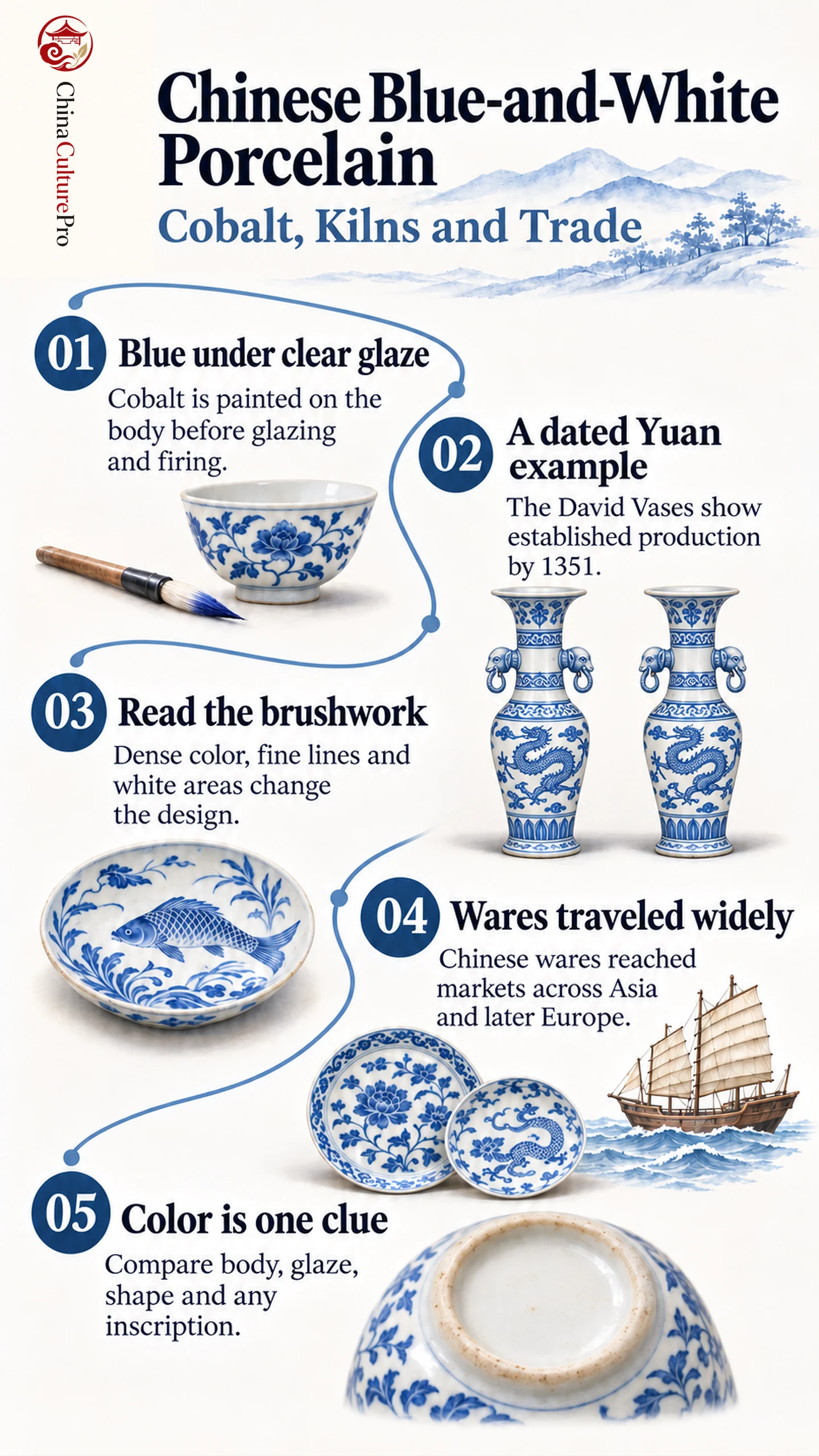
In much Chinese blue and white, the painter applies cobalt pigment to a formed, dry or partly dried porcelain body. A transparent glaze covers the design before the piece is fired. The glaze can make the finished surface glossy while letting the blue show through. The design sits between the body and the transparent coating. [1][4]
This matters when looking across different kinds of Chinese porcelain. A blue motif may appear to sit within a continuous shiny surface, while another object carries painted colors applied after glazing and fixed with another firing. A pale blue glaze can also tint an entire surface without producing a brushed cobalt design. [1][4][7]
Cobalt sources and working methods varied. The Victoria and Albert Museum notes both imported and Chinese sources of pigment. A dark spot, a soft edge and a pale wash are different effects to notice in the painting. The shade alone gives limited evidence about the source of the cobalt or the date of the piece. [1][4]
From Tang Experiments to the David Vases
Early Chinese blue-painted ceramics survive in small numbers. The ninth-century Belitung shipwreck contained three dishes with blue designs on pale surfaces. These were already traveling by sea. Their bodies and methods differed from those associated with later Jingdezhen porcelain. They show an early use of the combination before it became established on a large scale. [1][2]
The David Vases carry inscriptions with a date that can be checked. The texts record that Zhang Wenjin gave the pair and an incense burner to a Daoist temple in 1351. The vases have blue bands of decoration and a form based on bronzes. Their size, execution and inscriptions show that accomplished production was already in place by the mid-fourteenth century. The inscription dates the dedication and establishes a point by which the vases had already been made. [3][4]
Yuan makers expanded what Jingdezhen porcelain could do by combining developments in body recipes, pigments and firing. The town had already produced qingbai (青白, qīngbái) porcelain with a pale blue-white glaze. Cobalt painting offered another way to use a light body, by giving it detailed, dark and light designs. [1][4][7]
Patterns, Painting and White Space
A design can change character where the painter moves from a thin line to a wash. Some pieces have cobalt spread across much of the surface, with light forms left unpainted. Others give a subject room to stand out on a broad pale background. A white space can describe part of the motif or separate one band of decoration from another. [1][4]
A Yuan plate in the Met’s collection uses fish as its main motif. The museum notes patches where the cobalt has concentrated into a darker blue. They make a visible contrast with the paler lines and washes elsewhere on the dish. The broad center of a plate gives the painter a different field from the shoulder of a vase, where decoration can wrap around the vessel in bands. Look at how a design fits its surface as well as what it depicts. In Ming porcelain, painters continued to vary the size and placement of motifs to suit bowls, dishes and taller vessels. [1][4][5]
Blue and White for Different Markets
Large blue-and-white vessels made in the Yuan period traveled to buyers in the Middle East. Chinese wares also reached East and Southeast Asian markets. Some were used in China, as the David Vases’ temple dedication shows. Looking at an object’s size and subject may suggest a context, and an inscription or findspot can help identify a particular use. [1][3][6][7]
In early trade with Europe, a recognizable style known as Kraak appeared on export porcelain. The V&A’s example from Jingdezhen, dated 1573–1620, has a central design and patterned borders. Dividing the broad rim into panels gave painters a way to repeat and alternate smaller motifs around the central scene. That pattern could travel beyond the vessel itself. The Met compares a Chinese Kraak design with examples made in Japan and in Delft that adapt a related arrangement. [1][6][8]
What the Color Can Tell You
Begin with the layers. Is the blue part of an all-over glaze, or can you follow separate brush marks beneath it? Compare the design with overglaze enamel traditions, where color is applied onto an existing glaze. Some wares use several techniques together. [1][4][7]
Then look at the overall shape, borders and any writing. Chinese porcelain marks and dedicatory inscriptions have different jobs. The David Vases carry a named, dated offering in long inscriptions. A reign name or a decorative mark elsewhere on a vessel supplies a different kind of evidence. Read the label and recorded context alongside the color. [1][3][4]
FAQs About Blue-and-White Porcelain
Is the blue color painted under the glaze?
In the classic Chinese technique, a painter applies cobalt to the body before glazing and firing. The transparent glaze covers the design. [1][4]
Were the David Vases the first blue-and-white ceramics?
Chinese makers had used blue painting on pale ceramics centuries earlier. The David Vases are important because their inscriptions date the offering to 1351 and document a highly developed Yuan technique. [1][2][3]
Was all blue-and-white porcelain made in Jingdezhen?
Jingdezhen was a major center. Other Chinese centers also made blue-and-white wares, and makers abroad produced their own versions using local materials and techniques. [1][7][8]
出典
[1] Victoria and Albert Museum. Chinese Blue-and-White Ceramics
[2] Regina Krahl, Smithsonian Institution. Tang Blue-and-White
[3] The British Museum. Chinese Ceramics Gallery Guide
[4] The British Museum via Smarthistory. Chinese Porcelain: Decoration
[5] The Metropolitan Museum of Art. Plate with Fish
[6] The Metropolitan Museum of Art. East and West: Chinese Export Porcelain
[7] National Museum of Asian Art. Jingdezhen
[8] The Metropolitan Museum of Art. Blue and White: Early Japanese Export Ware