

Quick Answer: What Are Chinese Wife Cakes?
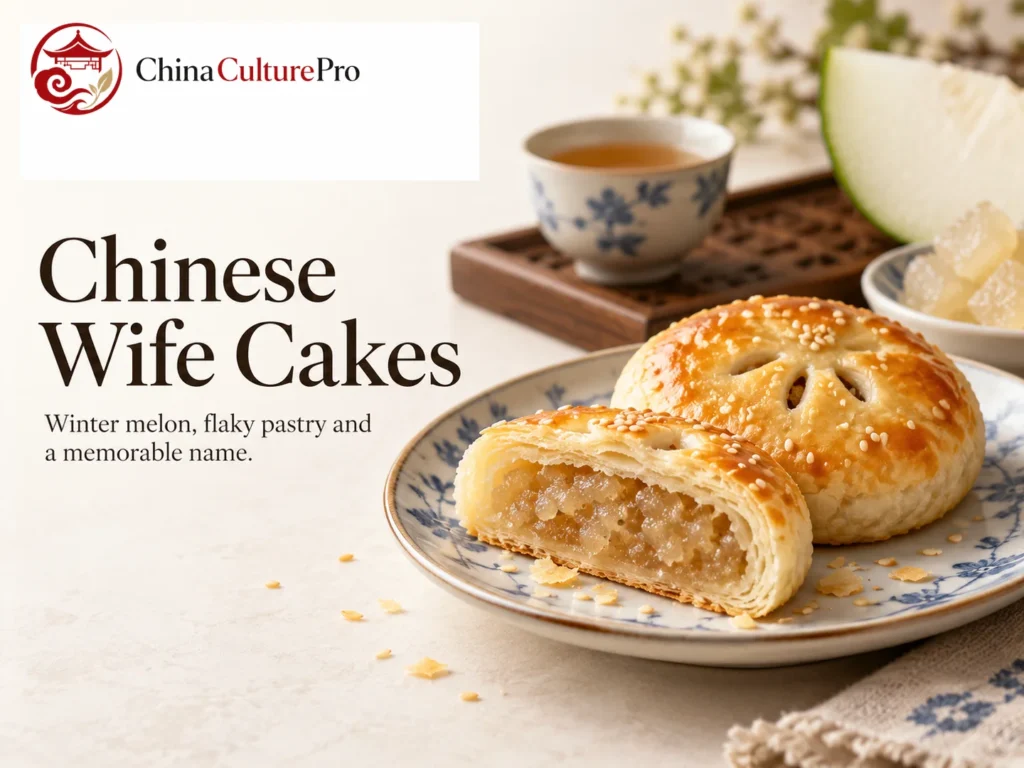
Chinese wife cakes, lao po bing(老婆饼,lǎopó bǐng), are Cantonese-style pastries with a flaky shell and a sweet, often chewy winter melon filling. English menus also call them sweetheart cakes.
- Outside: Thin layers of wheat-based pastry, sometimes finished with egg wash and sesame.
- Inside: A cohesive sweet filling whose formula varies by bakery.
- Setting: A bakery snack to enjoy with tea or share, rather than a cake reserved for married people.
Despite the English name, the familiar wife cake is a small filled pastry, not a sponge cake. Winter melon, the pastry fat and any added seeds or nuts should be checked separately.

A thin golden surface gives way to pale flakes and a soft, slightly sticky center. The filling is quite different from the airy crumb the English word “cake” might suggest. Among traditional Chinese desserts, wife cakes show how a mild vegetable and carefully layered pastry can create a distinctive sweet.
Winter Melon Filling and Its Chewy Texture
Winter melon, donggua(冬瓜,dōngguā), is also known as wax gourd. In a wife cake, it is transformed into a sweet filling rather than served as a juicy piece of fresh fruit. Candied winter melon can be chopped and combined with other ingredients, giving a little texture within the soft center.[1]
Another approach starts with fresh gourd, cooks it and removes excess liquid before sweetening and thickening it. These two routes explain why descriptions may mention either winter melon paste or candied pieces. They need not describe an identical filling, but both use the gourd as part of the sweet preparation.[2]
Cooked glutinous rice flour is used in some fillings to create cohesion and chew. Sesame, coconut, melon seeds or almond paste may contribute aroma and texture, depending on the version. None should be assumed to appear in every bakery’s cake.[1][2]
| 構成要素 | Main role | 見分けるポイント |
|---|---|---|
| Winter melon | Provides the characteristic sweet center | Fresh and candied preparations differ |
| Cooked rice flour or another thickener | Helps the filling hold together | An ingredient in the center, not proof of a rice-only crust |
| Seeds, coconut or nuts | Add aroma and texture where used | Optional additions that require checking |
| Wheat pastry | Forms the layered outer shell | Separate from the chewy filling |
The contrast matters: a slightly sticky center is intentional, while the outer pastry supplies the fragile flakes. The two textures come from different mixtures.[3]
How the Flaky Pastry Is Built
Two doughs commonly form the shell. A water dough contains flour, water and fat, giving enough flexibility to enclose the second mixture. The fat-rich dough combines flour and fat with little or no added water. Working the two mixtures together establishes the layers.[4]
The baker wraps, rolls and coils or folds the dough, then shapes it around the filling. Baking develops a light, flaky structure rather than the uniform crumb of a risen cake. This is related to the technique used in Suzhou mooncakes, even though the named pastry and filling traditions differ.[1][4]
Surface cuts may allow steam to escape, and an egg wash can add golden color. Some versions carry sesame seeds; others emphasize a plain finish. These touches affect the surface, while the layering remains a separate part of the construction.[2][3]
Lard is familiar in Chinese flaky pastry, but recipes may use other fats. A pale shell does not reveal which one was used. The practical question is the composition of both doughs, rather than whether the finished pastry looks rich or plain.
Cantonese Bakeries, Tea and Everyday Sharing
Wife cakes belong to Cantonese bakery culture and are strongly associated with Hong Kong pastry counters. A bakery may offer them alongside other familiar sweets without restricting them to a festival or formal meal. Winter melon and almond paste appear together in one familiar Hong Kong version, while other recipes use different additions.[5]
Tea is a familiar accompaniment, especially when the pastry is served as an afternoon snack. The loose flakes and chewy center make a plate useful. A small cake can be eaten individually or cut for sharing; its name does not dictate one ceremonial serving procedure.[1]
The category also leaves room for different proportions and textures. One bakery may emphasize a thin shell and generous filling, while another produces a flatter cake. These visible differences are more useful to a diner than a single mandatory diameter or thickness. Ask what the filling contains and whether the pastry is intended to be especially crisp or tender.
Why the Name Means Wife Cake
The literal name invites stories. One legend tells of a pastry chef who takes fine bakery sweets home, only for his wife to say that her own winter melon pastries are better. After tasting them, he shares them with his colleagues, and the pastries become known by a name honoring the wife.[6]
Another popular version centers on a poor couple and a husband’s efforts to raise money through selling cakes. These stories explain affection and family devotion through food; they are not documentary proof of a specific inventor, dynasty or founding year.[1]
“Sweetheart cake” carries that affectionate tone in English. It does not mean that every cake is a wedding gift, that it contains a special marriage ingredient or that only couples may eat it. The food remains a sweet bakery pastry with a memorable name.
Choosing a Cake and Checking Ingredients
Start with the filling description. “Winter melon” does not tell you whether the recipe also includes coconut, sesame or almond. If you are comparing pastries, Chinese pineapple cakes provide another example in which a fruit-named filling and the surrounding shell need separate attention.
For dietary needs, check the pastry fat, center and surface finish. Lard changes vegetarian suitability; butter or other dairy ingredients and egg wash matter for vegan diners. Wheat is present in the usual pastry even when glutinous rice flour helps bind the filling.[3][7]
For allergies, confirm nuts, sesame, egg, milk and any other relevant ingredients, together with shared-equipment practices. Picking seeds off the top cannot remove ingredients mixed into the filling or dough. A plain-looking cake is not an ingredient guarantee.[7]
Packaged and freshly baked cakes can have different handling requirements. Use the maker’s storage and serving instructions, especially after opening the pack. Do not infer a fixed room-temperature shelf life from the dryness of the shell: the sweet center is another part of the product.
FAQs About Chinese Wife Cakes
Do wife cakes contain winter melon?
Winter melon is the characteristic filling ingredient in familiar versions. Formulas vary, and seeds, coconut, almond or other additions should be confirmed separately.
Are wife cakes the same as mooncakes?
No. Some share a layered pastry technique, but wife cakes are a distinct bakery sweet and are not defined by the Mid-Autumn mooncake occasion.
Are wife cakes vegan?
Not automatically. Lard, butter or egg can occur in the pastry, filling or finish. Check the complete preparation rather than just its winter melon center.
Do you have to be married to eat wife cakes?
No. The affectionate name belongs to the pastry and its stories. It imposes no marriage requirement on the person eating it.
出典
[1] Michelle, Sift & Simmer. Wife Cakes
[2] China Today, via ChinaCulture. Sweetheart Pastry
[3] Judy Leung. Wife Cake: Lao Po Bing
[4] Shanghai Information Office. Chinese Pastry’s Delicious Layers
[5] Hong Kong Tourism Board. Traditional Bakery and Wife Cake Description
[6] Foundation of Chinese Dietary Culture. The Origin of Wife Cake: A Recorded Legend
[7] U.S. Food and Drug Administration. Food Allergies: What You Need to Know