

Quick Answer: What Are Chinese Tea Tasting Faults?
Chinese tea tasting faults are unwanted sensory characteristics assessed in relation to a tea’s intended style, preparation and condition. A disappointing cup does not automatically identify a manufacturing error.
- First check: Water, vessels and brewing conditions can change what you perceive.
- Describe precisely: Separate aroma, taste and mouthfeel rather than calling everything “bad.”
- Consider context: Deliberate smoke, roast or aged character differs from unwanted off-notes.
Tasting can help assess quality, but cannot certify food safety or pinpoint every cause. Suspected spoilage calls for a different response from adjusting a merely over-strong infusion.
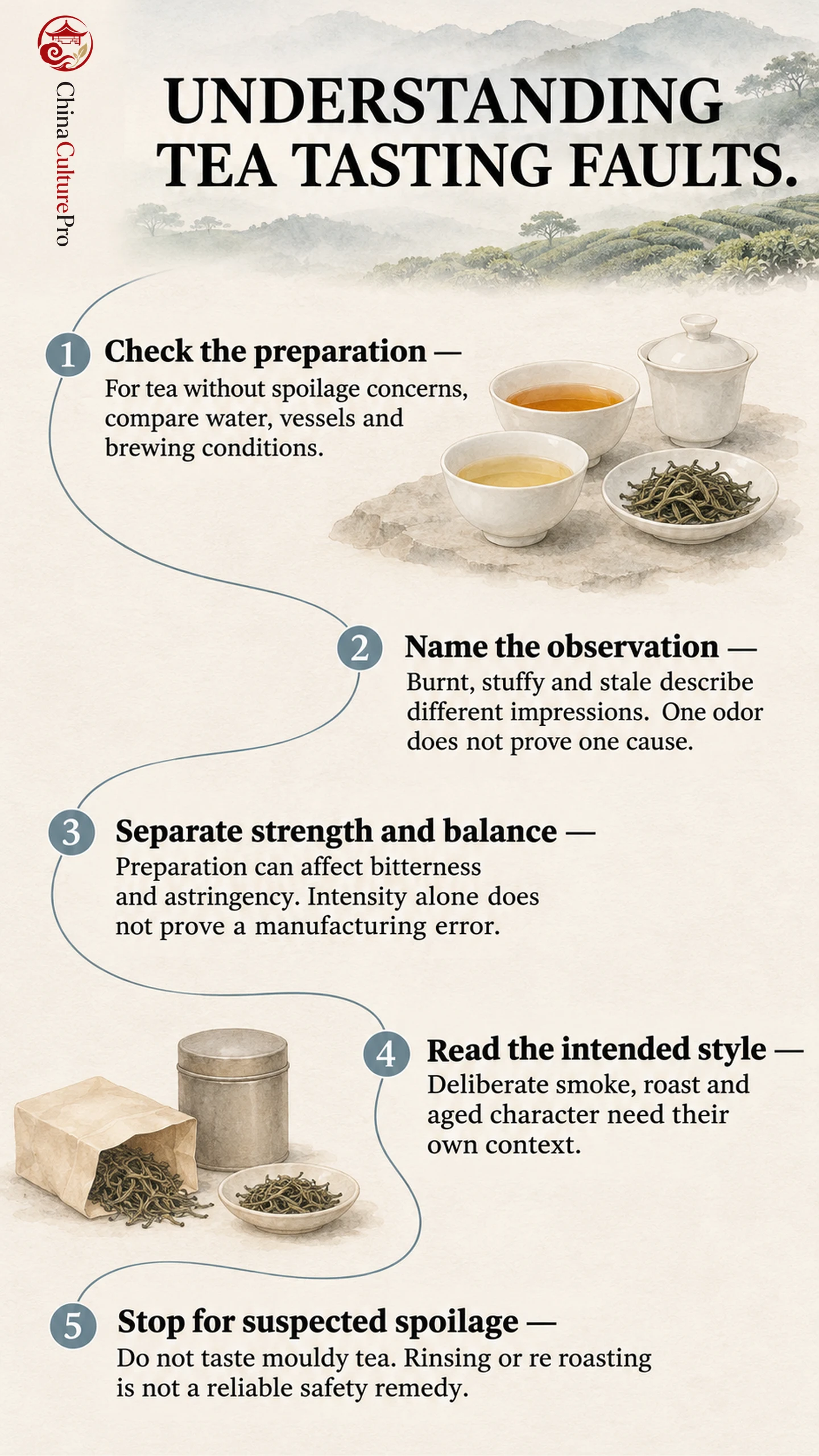
A flat or harsh cup raises more than one possibility: the leaf may have lost freshness, the brewing may be unbalanced, or the style may simply be unfamiliar. Naming the observation and checking its context gives you a better starting point than deciding immediately that the maker made a mistake.
Check Water, Vessels and Brewing Before Blaming the Leaf
For tea showing no signs of spoilage, begin with a controlled comparison. Professional sensory teaching emphasizes a clean, odor-free environment, neutral equipment and a consistent preparation method. It assesses dry appearance, liquor, aroma, taste and infused leaves as separate observations.[1]
At home, smell the empty vessel, check the brewing water and keep track of the leaf amount, water amount, temperature and contact time. Repeat with one deliberate change rather than changing everything at once. Record whether the unwanted impression follows the tea or appears with a particular preparation.
Water is a genuine variable. A Tea and Beverage Research Station account reports differences in infusion color, aroma and taste with different water qualities, and differing responses to brewing temperature across tea styles.[2] A thin or harsh cup therefore needs more context than the packet’s name.
This comparison may help narrow a question. It is not a laboratory method for identifying a contaminant or proving the exact factory operation that went wrong.
Common Aroma Faults and What the Words Mean
A technical account of fragrant-style Taiwanese oolong describes several unwanted notes and their possible production or storage contexts.[3] Its vocabulary is useful, but its style-specific judgments should not become universal rules for every Chinese tea.
| 用語 | Meaning in this assessment context |
|---|---|
| Burnt aroma(焦味,jiāowèi) | An unwanted scorched character, associated in the account with poorly controlled heating during fixation |
| Stuffy aroma(闷味,mènwèi) | A dull, enclosed impression; the account discusses trapped steam or failure to loosen clumps during processing |
| Stale aroma(陈味,chénwèi) | Loss of fresh character during storage, potentially accompanied by flatness or oxidized, rancid notes |
The same source gives several possible origins for an unwanted raw-green character, including problems with moisture movement and processing. It also notes the leaf’s ability to absorb other odors.[3] A descriptor is a clue, not proof of one cause.
Use tea-aroma vocabulary to keep your description consistent. “Burnt,” “stuffy” and “stale” should identify different observations rather than serve as interchangeable criticisms.
Bitterness, Astringency and Brewing Imbalance
Bitterness is a taste; astringency concerns drying or puckering mouthfeel. They need separate notes, even when they occur together. The distinction in bitterness versus astringency is more useful than treating either sensation as automatic evidence of defective leaf.
A 2022 experiment on Tieguanyin(铁观音,Tiěguānyīn)changed the water-to-tea ratio, brewing temperature and time. These factors affected the study’s combined bitterness-astringency score, while consumer preferences and trained-panel assessments were not identical.[4]
The authors scored the sensations together, so the result is not a separate measure of each. It supports checking preparation, without supplying one best brewing method for all teas.
If there is no concern about spoilage and the cup is unpleasantly strong, compare a less concentrated or shorter extraction, changing one variable at a time. Record whether the balance improves.
Intentional Smoke, Roast and Aged Character
An aroma can be expected in one tea and unwanted in another. Original research on smoked Lapsang Souchong identified smoke-derived compounds introduced during withering and drying, alongside aromas developed from the tea itself.[5] Its deliberate smoke-drying route is a clear counterexample to calling all smoke a defect.
Likewise, read a roasted tea in relation to its intended treatment. An expected roast character and an unwanted scorched smell are different judgments; neither can be resolved merely by seeing a dark leaf.
An official discussion of aged oolong distinguishes stale odor from mould-related odor and describes other aroma changes during storage.[6] This does not mean that every old-smelling tea is desirable. It means aged tea, loss of freshness and spoilage should not be collapsed into one category.
Ask what style was intended, how the tea was processed and what is known about its storage. The same descriptive word can need different interpretation in those different contexts.
When to Stop Tasting and Check Storage
Do not continue sampling a tea that appears mouldy or damaged in order to settle a quality debate. Hong Kong’s Centre for Food Safety advises discarding mouldy or damaged food and notes that most mycotoxins withstand ordinary home cooking.[7] Rinsing, boiling or re-roasting is not a reliable safety remedy for suspected mould contamination.
A stale aroma is a sensory observation; it cannot establish the presence or absence of mould or toxins. Intended microbial processing does not make unknown growth in a damp packet acceptable.
Check the product’s instructions and actual storage conditions. Set aside an uncertain product and contact the supplier. Record the observation, preparation and storage concern separately.
FAQs About Chinese Tea Tasting Faults
Does one disappointing cup prove a manufacturing fault?
No. Preparation, water, storage and intended style all need consideration before assigning a cause.
Is bitterness always a tea fault?
No. Its intensity and balance depend on the tea and the way it was brewed.
Is a smoky tea always defective?
No. Smoke is an intended feature of particular manufacturing styles.
Can rinsing or re-roasting make mouldy tea safe?
Do not rely on either method. Discard mouldy tea rather than trying to rescue it through tasting or heating.
出典
[1] Tea and Beverage Research Station. 茶葉感官品評簡介
[2] Dai Jiaru, Tea and Beverage Research Station. 水質及水溫對茶湯品質之影響
[3] Chen Guoren, Tea and Beverage Research Station. 優質清香型烏龍茶十大忌
[4] Qing-Qing Cao et al. Optimization of brewing conditions for Tieguanyin oolong tea by quadratic orthogonal regression design
[5] Weiying Su et al. Insight into aroma dynamic changes during the whole manufacturing process of smoked Lapsang Souchong tea
[6] Tea and Beverage Research Station. 漫談凍頂烏龍老茶(二)
[7] John Lum, Centre for Food Safety. Moulds on Food – Potential Health Risks?