


Quick Answer: What Is a Leaking Window?
A leaking window (漏窗, lòuchuāng) is an opening in a Chinese garden wall partly filled with decorative openwork. The open spaces let light and glimpses of the garden pass through, while the solid parts interrupt the view.
- Frame: The outer shape sets the edges of the scene.
- Openwork: A grille splits the scene into smaller views and can be ornamental in its own right.
- Placement: Along a corridor, a sequence of windows reveals the space on the other side in stages.
The double corridor at Suzhou’s Canglang Pavilion is a good example. From inside the garden, walkers see glimpses of the water outside through the corridor wall.[1]
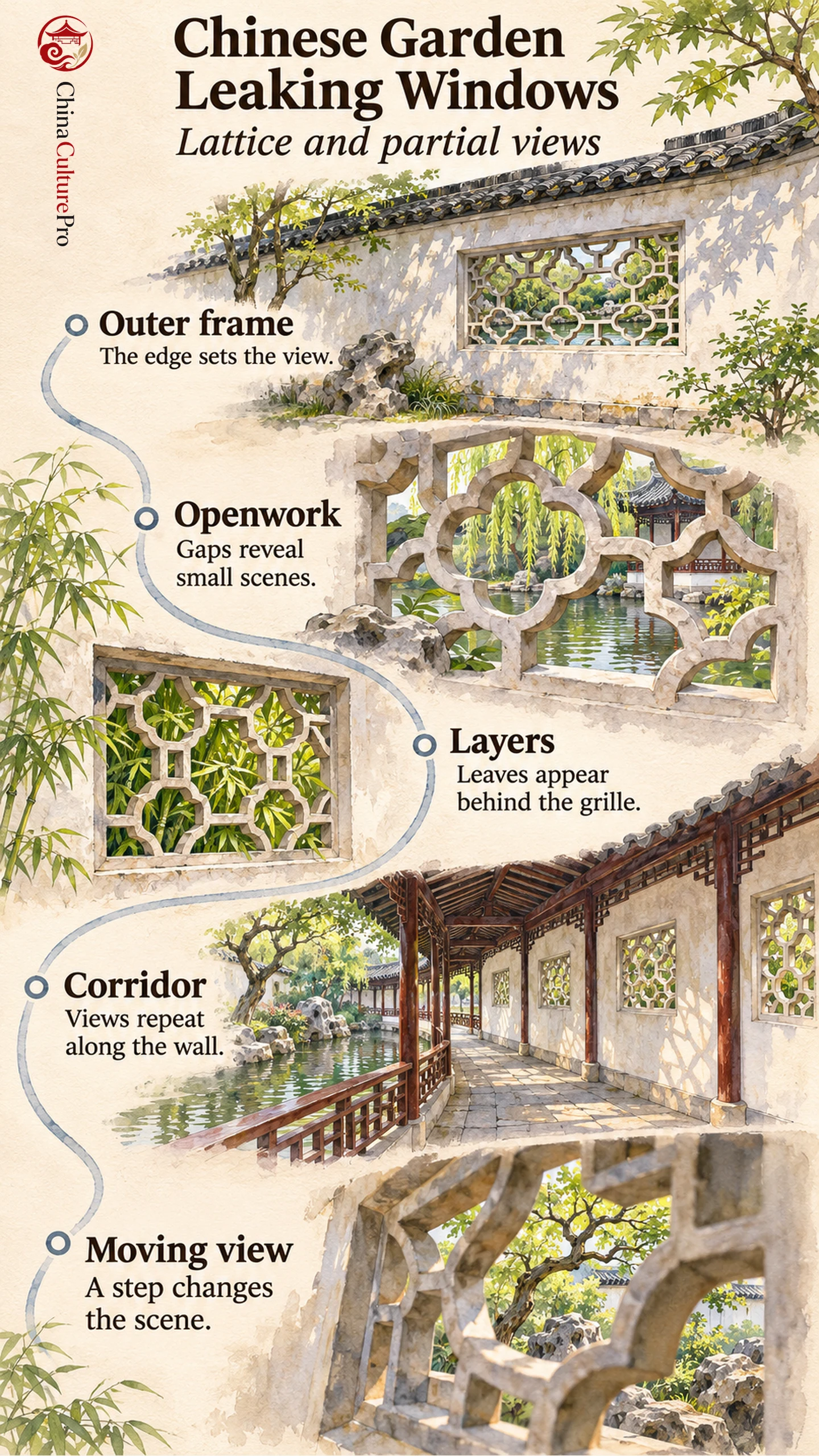
From one step back, a garden window can look like a drawing against a white wall. Take a step closer and the little shapes fill with leaves, stones or moving water. Both views help explain why gardeners left gaps in the pattern.
What Makes an Opening a Leaking Window?
Read the window in three layers. The wall creates a broad area of solid white. The outer border gives the aperture its outline. Inside, the bars and voids divide the view again. A silhouette of bamboo behind a lattice can belong to both the garden scene and the visible pattern of the window.
Suzhou’s local gazetteer documents octagonal patterns and other combinations of straight and curving lines. It describes variation even within a single series of windows.[2] The boundary and the pattern inside it are separate design decisions. Two similarly shaped frames can offer very different amounts of open space.
The grid is worth comparing with chessboard paving in Chinese gardens. A paving pattern organizes solid surfaces underfoot. A window pattern organizes both the wall material and the view through the spaces left open.
Canglang Pavilion: Two Sides of One Wall
Canglang Pavilion sits beside a waterway. The Suzhou garden authority describes a double corridor along the water, with openings in the dividing wall allowing views across it. The water outside the garden thus contributes to views from within. The same account records 108 window designs at the garden.[1] The corridor shows how several patterns can work together within that larger collection.
Look at the sequence as well as the individual openings. A narrow glimpse of water establishes that something lies beyond the wall. At the next opening you may see a different portion of the bank. The solid intervals matter because they interrupt the scene before it reappears. In an uninterrupted opening, you would see more of the water at once and have fewer reasons to look again.
The Huntington’s Liu Fang Yuan provides a modern example of the tradition outside Suzhou. The garden’s fact sheet describes bringing openwork windows made in Suzhou into walls built in California.[3] The new setting gives the windows different plants and light to frame.
How the View Changes as You Walk
From a few steps away, look for the outline and repeat pattern. Close to the opening, pick out one object beyond the grille, then shift sideways. A nearby branch moves across the opening more quickly than a farther wall seems to move. That difference helps the eye read depth. At an oblique angle, the reveal of the wall itself can block parts of the scene.
Compare a view from a stop in the corridor with one from a garden seat or threshold. A pause gives you time to notice texture and changing light. Movement shows how successive views are related. Both are part of the wider practice of framing views in Chinese gardens.
FAQs About Chinese Garden Leaking Windows
Is a leaking window a moon gate?
A moon gate is a round opening sized for people to walk through. A leaking window gives the eye a way through the wall while the grille stays in place.
Do all leaking windows have the same pattern?
Patterns vary within individual gardens. Canglang Pavilion has many designs, including geometrical patterns with different proportions of solid and open space.[1][2]
Does a leaking window need a large view behind it?
A small view can work well. A leaf, a wall in different light or a sliver of water can give the eye enough information to sense the space beyond.
出典
[1] Suzhou Gardens and Landscaping Administration. Canglang Pavilion
[2] Suzhou Local Gazetteer Office. The Art of Leaking Windows
[3] The Huntington. Chinese Garden Fact Sheet