

Quick Answer: What Are Jiaobei?
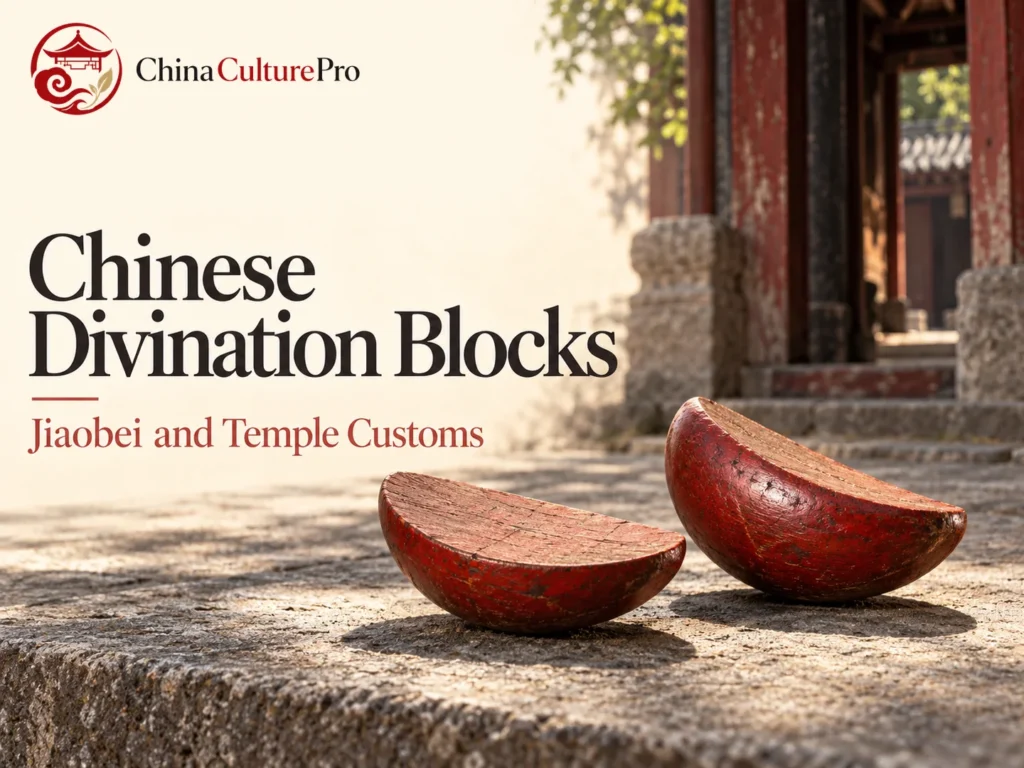
Jiaobei (筊杯, jiǎobēi), often called moon blocks, are paired divination objects with a flat face and a rounded face. Worshippers cast them and interpret the way the pair lands as a response within a religious ritual.
- Recognize the pair: The two pieces commonly have a crescent shape.
- Read both faces: One block alone does not supply the usual paired result.
- Ask within a ritual: The practice involves addressing a deity or ancestor.
- Follow local rules: Repetition and confirmation depend on the temple and purpose.
The landing patterns have traditional meanings. They do not establish that a future event will happen.

Two crescent-shaped blocks may look like simple wooden objects, but their use belongs to a conversation between a worshipper and the sacred figure being addressed. Recognizing the objects is only the beginning; understanding the setting prevents a visitor from treating an active ritual as a game.
This guide explains common physical results and gives specific examples of different temple rules. It does not assume that every Chinese temple uses the blocks or follows the same procedure.
Recognize the Objects and Their Names
Each block has one relatively flat face and one rounded face. Wood and bamboo root are documented materials, while some contemporary temple descriptions also mention plastic. Size and finish vary; a bright red pair is recognizable, but red paint is not the definition of the object.[2][3][4]
The name’s dictionary explanation connects the practice with earlier shell-shaped implements and later curved objects made from bamboo or wood. That lexical history should not be turned into an exact invention date.[1]
A catalogued example makes the material history more concrete: a wooden pair made in China in 1900–1925 is held by Powerhouse, object 2007/43/2. Its crescent pieces are connected by a short string. One surviving pair illustrates a form of the object, rather than proving that every pair looked or was used exactly the same way.[2]
Moon blocks occur within Chinese folk religion, and documented uses include households, temples and consultation of ancestors. They should not be assigned exclusively to a single institutional religion or to one location.[2] Ancestor worship provides context for the family side of that practice.
Read the Three Common Landing Patterns
For the three results below, “up” means the visible face after the blocks have settled. These are the physical patterns described in Xingtian Temple’s published guidance, presented as ritual interpretations rather than factual predictions.[3]
| Result | Visible faces | 伝統的な読み方 |
|---|---|---|
| Shengjiao (圣筊, shèngjiǎo) | One flat face up and one rounded face up | An affirmative or sacred result within the ritual |
| Yinjiao (阴筊, yīnjiǎo) | Both rounded faces up | A negative result within the ritual |
| Xiaojiao (笑筊, xiàojiǎo) | Both flat faces up | A laughing or noncommittal result within the ritual |
The last result is not simply another yes. It may invite clarification or express that the question is not being answered in the way the worshipper expected. The specific explanation belongs to the tradition and temple involved.[3]
Polarity vocabulary can be confusing here. Yin (阴, yīn) and Yang (阳, yáng) are traditional paired classifications, but published descriptions do not consistently assign the same label to the same physical face. One official heritage dictionary calls the rounded face yang and the flat face yin, while Xingtian’s guidance reverses those labels. Using “flat” and “rounded” avoids that naming conflict.[3][4]
If you cannot see how a block landed, ask rather than guessing. Do not report a result you could not identify.
What Happens during a Temple Consultation
A consultation commonly includes identifying oneself, stating one matter and casting the pair. The temple’s instructions determine what follows.
At Longshan Temple in Taipei, the published fortune-lot procedure begins with asking permission to receive a lot. After an affirmative result, the worshipper draws a numbered stick and uses the blocks again to confirm the particular number.[5] The blocks and the lot therefore perform different jobs: one supplies a paired result, while the other leads to a text.
That distinction connects moon blocks with Chinese fortune sticks without making the two objects interchangeable. A container of sticks, a numbered verse and a pair of blocks are parts of a larger consultation, not three names for the same device.
Longshan’s procedure addresses Guanyin, while other settings address other sacred figures. Recognize the local setting instead of assuming that a familiar-looking object means every ritual around it is identical.[5]
Why Repetition Rules Differ
“Do you need three yeses?” has no single answer across all uses. You need to know what is being confirmed and which institution’s rule is being followed.
Xingtian Temple’s guidance for seeking a decision says to accept one determination rather than repeatedly casting until an affirmative result appears. Longshan’s fortune-lot instructions, by contrast, require three consecutive affirmative throws to confirm that a particular drawn number is the intended lot. A negative or laughing result during that confirmation sends the worshipper back to draw another lot.[3][5]
These examples concern different temples and different ritual tasks. The three-throw confirmation should not be imposed on every ordinary question, while the one-determination instruction should not be used to rewrite a different temple’s lot procedure.
For a visitor, the practical approach is straightforward: read the posted guidance or ask a temple volunteer what this stage requires. Do not coach another person to keep trying merely because you have seen a different practice elsewhere.
Observe or Participate Respectfully
Give worshippers room to hold and cast the blocks. Avoid crossing directly through the casting space, picking up another person’s pair or photographing a private consultation without permission. Shared ritual objects should be returned as directed.
You can observe quietly without performing the ritual yourself. If you wish to participate, ask whether visitors may use the objects and which local instructions apply. Do not assume that someone standing nearby has volunteered to interpret your result or translate a personal question.
The Chinese temple etiquette guide covers broader conduct, while Chinese fortune-telling traditions places this method beside other practices. Keep the distinction between learning about a belief and accepting its claim to reveal an outcome.
Describe the custom without presenting a ritual result as evidence that a consequential real-world outcome is assured.
FAQs About Jiaobei Divination Blocks
Are moon blocks used only in Taiwan?
No. Taiwan offers well-documented examples, but museum records also describe use in China and in household as well as temple settings. Practices vary between communities.
Do two flat faces mean yes?
In the common pattern explained here, two flat faces up are the laughing or noncommittal result. One flat face up and one rounded face up form the affirmative pattern. Describe the physical faces clearly, since polarity labels can differ.
Must everyone obtain three affirmative throws?
No. Some lot-confirmation procedures require three consecutive affirmative results, while other consultations use a different rule. Follow the instruction for that temple and that ritual stage.
Are divination blocks the same as fortune sticks?
No. Blocks produce a paired landing pattern. A fortune stick carries a number linked to a verse or other text. They can be used together while retaining different functions.
出典
[1] Taiwan Ministry of Education. Revised Mandarin Chinese Dictionary: 筊杯
[2] Powerhouse. Chinese divination blocks, object 2007/43/2
[3] Xingtian Temple. Block-divination procedure and results
[4] Taiwan Historica. Taiwan Folk Artifacts Dictionary: 筊杯
[5] Longshan Temple. Official ritual guide: drawing and confirming a fortune lot