


Quick Answer: What Was a Chinese Community Compact?
A Chinese community compact, or xiangyue (鄉約, xiāngyuē), set out shared expectations for people in a locality. A famous Song example encouraged good conduct, correction, social observance and mutual help. Later compacts could also serve as tools of local administration.[1][2][3][4]
- Participants: Some early models emphasized people joining a local association.[1][2]
- Rules: A compact could spell out how people met, guided each other or gave help.[2][3]
- Authority: A Ming official might sponsor a compact as part of governing a region.[3][4]
To understand one compact, ask who made it, whom it addressed and how its rules were to be carried out.[1][2][3]
A list of promises can tell you what people expected from a neighbor. Rules about registers and meetings show who was meant to organize the work.[2][3]
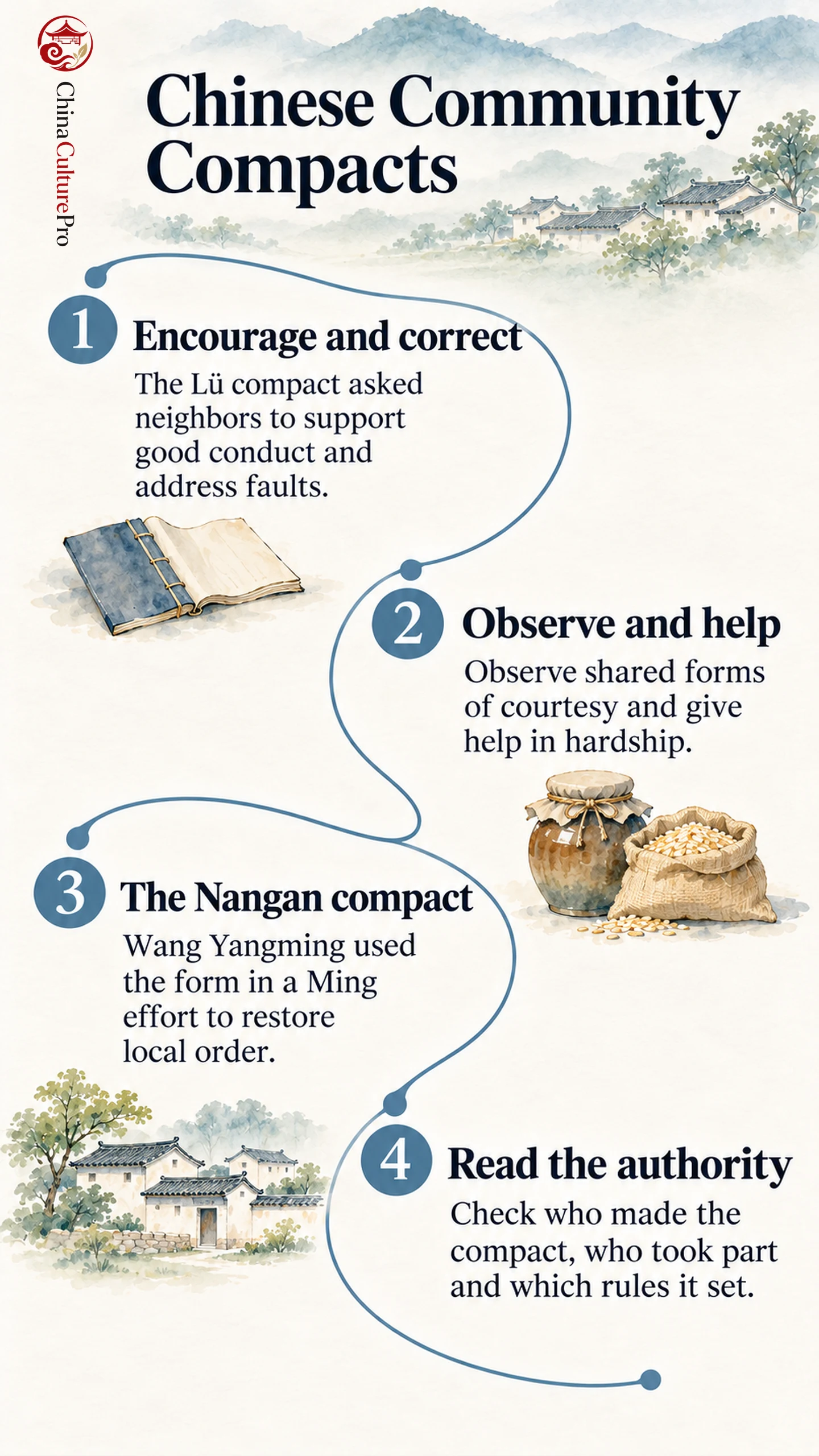
The Lü Compact and Its Four Commitments
The Lü family compact (呂氏鄉約, Lǚshì Xiāngyuē) is associated with Lü Dajun and Northern Song Lantian. Zhu Xi later revised the text. His version retains four broad commitments and gives practical details such as named organizers, a rotating role and registers.[1][2]
| Commitment | What it entailed |
|---|---|
| Encourage good conduct and worthwhile pursuits | Recognize and support behavior or work worthy of emulation.[2] |
| Correct faults | Address lapses through advice and correction within the group.[2] |
| Observe social forms | Organize reciprocal conduct in visits, greetings and occasions.[2] |
| Help in hardship | Assist others facing misfortune or need.[2] |
These provisions connect moral expectations to practical arrangements. They are one source for the broader history of Chinese neighborhood mutual aid.[1][2]
Read Wang Yangming’s Nangan Compact
In 1518, the Ming official Wang Yangming promoted the Nangan Community Compact (南贛鄉約, Nángàn Xiāngyuē) in the area he administered. Its preamble addresses local residents directly. It calls for mutual help in hardship and mourning, and asks people to reduce disputes. The provisions describe organizers, registers and gatherings.[3][4]
The document shows how an official could adapt an existing form of association to a local effort at restoring order. Read the preamble for Wang’s aims and the meeting provisions for what he asked residents to do.[3][4]
Distinguish a Compact from Family and Government Rules
A village agreement may address relations among people from multiple households. Chinese family instructions can discuss similar virtues while addressing a family or its descendants. A compact backed by an official, such as Wang’s, can also carry administrative aims beyond those of the participants.[1][2][3][4]
When citing a compact, record its place, sponsor and version. The text documents an intended arrangement. How a community used its meetings and registers is a further question for local records.[2][3][4]
FAQs About Chinese Community Compacts
Was every community compact voluntary?
Some compacts were organized by local participants. Officials promoted other versions, including Wang Yangming’s Nangan compact. Membership and enforcement depended on the example and period.[1][2][3][4]
How did xiangyue differ from family instructions?
A compact set expectations for participating people in a locality. Family instructions addressed conduct within a family or lineage, even where topics overlapped.[1][2][3]
Can a compact tell us what villagers actually did?
A text shows the behavior and meetings it prescribed. To assess what happened, compare it with other evidence, such as local records and accounts of particular disputes or meetings.[2][3][4]
出典
[1] University of Washington Libraries. Historical discussion of xiangyue and local self-governance
[2] Chinese Wikisource. Zhu Xi’s revision of the Lü compact, transmitted in Changbian Tongkao, juan 26
[3] Wang Yangming, Chinese Wikisource. Nangan Community Compact, Collected Works, juan 17
[4] Guangxi Transport Vocational and Technical College. The 1518 compact and its sixteen provisions