

Quick Answer: What Did Cobalt Do in Chinese Porcelain?
In Chinese blue-and-white (青花, qīnghuā) porcelain, a cobalt pigment (钴料, gǔliào) usually supplied the blue painted design beneath a transparent glaze. The technique became especially important at Yuan Jingdezhen. Scientific analysis can sometimes separate pigments that look alike on the surface.[1][3]
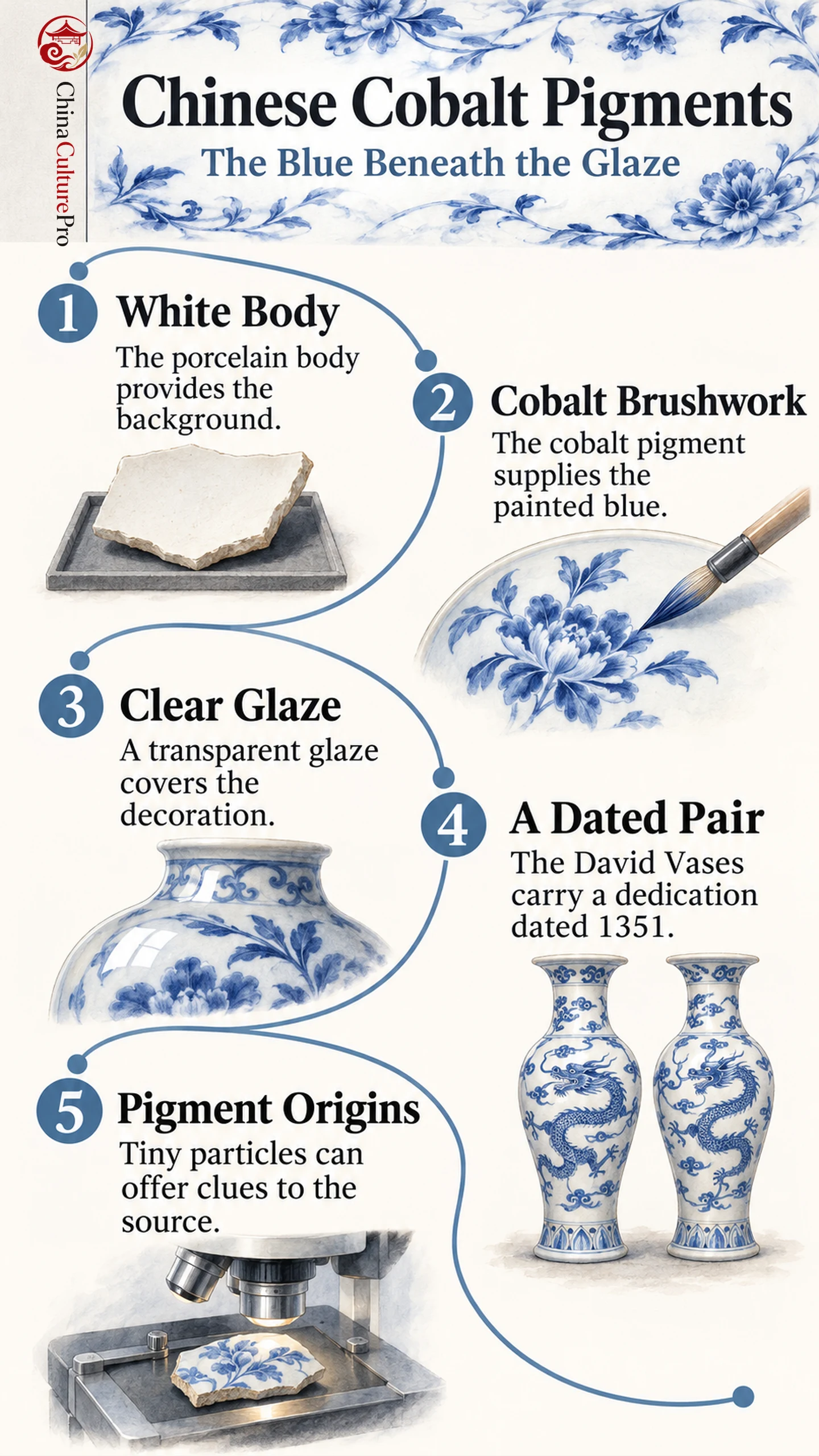
- The white ceramic body forms the background and the clear glaze covers the painting.[1]
- The David Vases carry a dated dedication from 1351.[2]
- Analysis of selected Ming fragments found evidence of more than one pigment source.[3]
Blue color can help identify a type of decoration. It cannot establish the mine that supplied the cobalt.
Look closely at a blue flower on porcelain. The blue brushwork and the glossy surface are two parts of the object. Distinguishing them helps explain both how potters made the vessel and what scientists can learn from a broken piece.
Where the Blue Sits on the Porcelain
For typical blue-and-white porcelain, the potter paints on the body, beneath the clear glaze. The white body provides the background when the piece is fired. A painter could vary the strength of the blue to draw an outline, fill a broad area or create a lighter wash.[1]
Earlier ceramics could also use cobalt to color the glaze itself. That use belongs alongside other glaze traditions. An overall blue glaze and a painted image beneath a clear glaze place the color in different parts of the ceramic surface.[5]
A Dated Example from Yuan Jingdezhen
The two David Vases bear a dated dedication recording their presentation to a Daoist temple in 1351. The date and the cobalt-blue designs give a fixed reference point for well-established production at Jingdezhen by the mid-fourteenth century.[2]
The dedication tells historians when the vases were presented. Evidence for the origin of a pigment may come from another source, such as an analysis of a kiln-site fragment. That distinction matters for objects that traveled far beyond their place of manufacture.
How Researchers Investigate Pigment Sources
Historical references to names such as Sumali blue are evidence of how some materials were described. The names and their variants are themselves subjects of historical research.[4]
In a study of selected porcelains from the Xuande reign, researchers analyzed tiny surviving pigment particles in the blue areas. They identified evidence consistent with the use of both imported and domestic materials. That conclusion applies to the objects studied and complicates a simple story of one supply replacing another throughout Ming porcelain production.[3]
What a Blue Pattern Can Tell You
A photograph can reveal that an artist varied the depth of blue or left some areas white. Questions about pigment source and firing need other evidence. The wares, coloring materials and firing practices can be studied together with the history of Chinese kilns. The different results of copper-based reds give a useful comparison.[1][3]
FAQs About Chinese Cobalt Pigments
Was all Chinese cobalt pigment imported?
Domestic and imported colorants both appear in the evidence. A study of selected Xuande-period shards found indications of both.[3]
Does every blue surface mean underglaze painting?
Cobalt could color a glaze itself or be used for brushwork beneath a transparent glaze. The layer matters when describing the technique.[1][5]
Why are the David Vases so important?
Their dedication gives a date of 1351 for an established type of Jingdezhen blue-and-white porcelain.[2]
出典
[1] Victoria and Albert Museum. Chinese blue-and-white ceramics
[2] British Museum. Room 95 Chinese ceramics gallery guide
[3] Proceedings of the National Academy of Sciences. Early globalized industrial chain revealed by residual pigment particles
[4] Palace Museum. Study of the term Sumali blue
[5] University College London Discovery. European cobalt sources identified in early Qing blue and white porcelain