
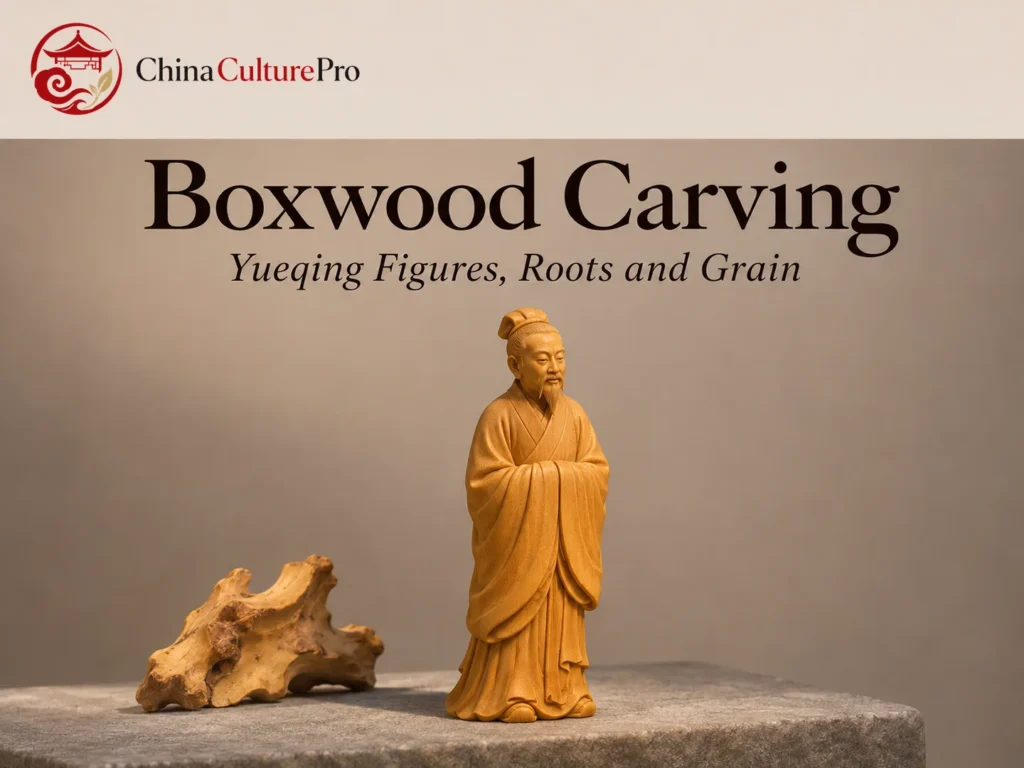

Quick Answer: What Is Chinese Boxwood Carving?
Chinese boxwood carving (黄杨木雕, huángyáng mùdiāo) uses hard, fine-grained yellow wood to make sculpture. Yueqing in southeastern Zhejiang is a major center. Its tradition includes carefully finished figures and works that let a root’s shape or the grain of a split block guide the design. [1][2][5][7]
- Material: Fine grain supports small carved details.
- Forms: Yueqing makers work with solid blocks, irregular roots and split wood.
- Evidence: The Palace Museum holds a boxwood figure inscribed with a date corresponding to 1342. [1][2][3][5]
The dated figure documents early use of boxwood. The precise origin of Yueqing’s regional tradition remains unknown. [1][3]
Some boxwood sculptures ask you to notice a carved fold or eyelid. Others leave ridges and breaks visible. Both are ways of working with the same wood, but the carver starts with a different idea of what the finished piece should show.
Why Boxwood Suits Small Sculptures
Boxwood grows slowly and usually does not provide large blocks. The Palace Museum describes it as hard and notably yellow. The Shanghai Museum points to the close grain and smooth appearance, which make the wood suitable for carving. Those characteristics matter on a small figure, where the surface has to retain details such as a face or a narrow fold. [1][2][4]
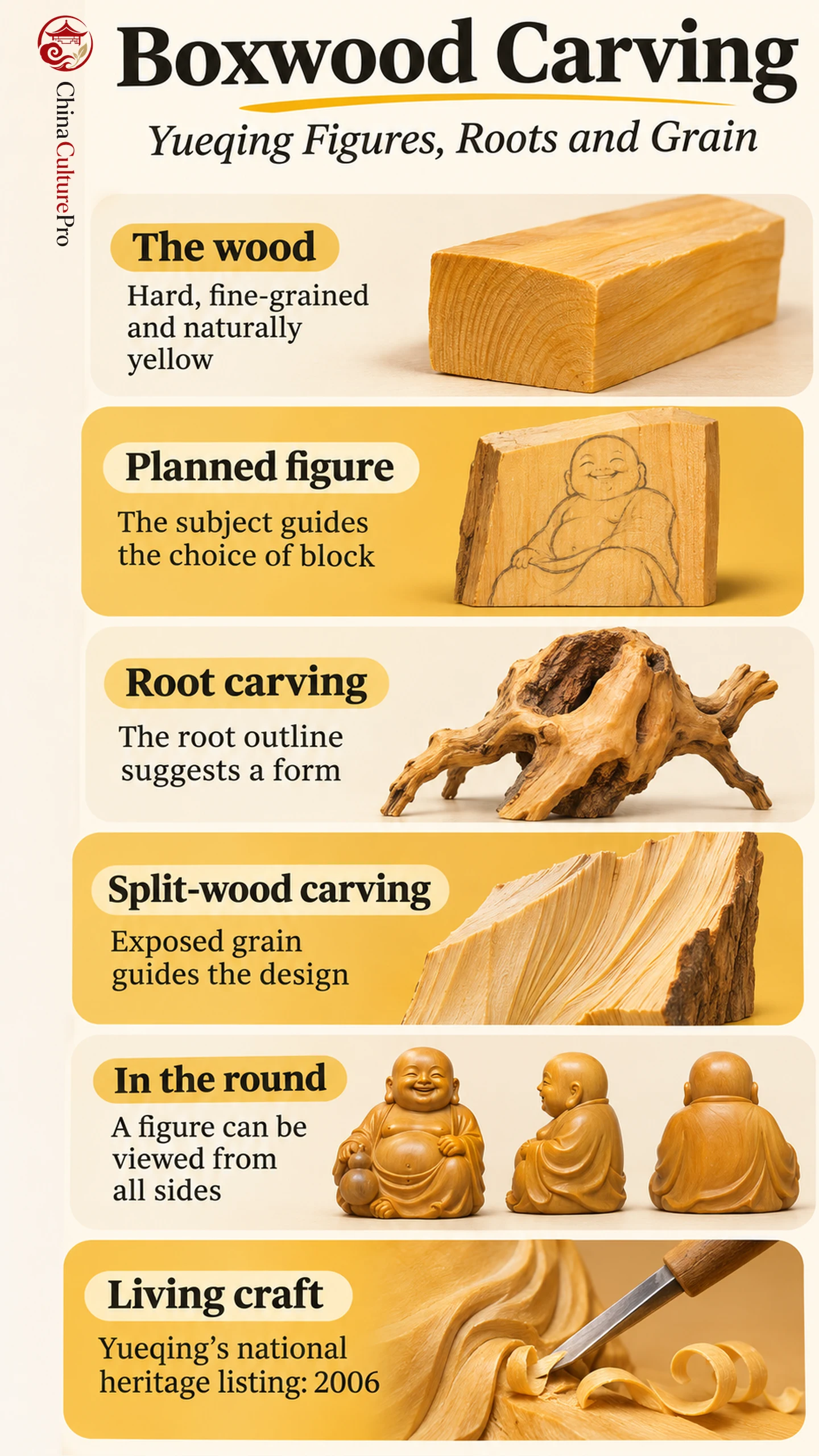
Many figures use carving in the round (圆雕, yuándiāo). The carver has to carry the subject’s posture and the fall of a garment around the entire body. Details at the back belong to the sculpture as much as the face. Boxwood was also used for seals and inlay, so the material appears beyond freestanding figures in Chinese woodcarving. [1][2][3][4]
Three Ways Yueqing Carvers Work with Wood
The national heritage record distinguishes three approaches in Yueqing. In one, the maker starts with a subject. In the other two, the natural shape or grain of the wood contributes more to the design. [1][5]
| Approach | What guides the design | 見分けるポイント |
|---|---|---|
| Planned figure | A block chosen to suit the intended subject | A freestanding figure or group |
| Root carving | The irregular outer shape of a boxwood root | A form that retains recognizable contours of the root |
| Split-wood carving | The grain revealed when a block is split | A design that uses the newly exposed texture |
The heritage entry describes clay modeling as part of some planned figure work, followed by selecting wood and roughing out the form. A natural root can supply an overall outline before the maker chooses a subject. A split block may have an ordinary outer shape but reveal an interior surface that suggests a way to place the subject. [1][5]
Two Museum Pieces and What They Establish
The Palace Museum’s 35.7-centimeter figure of Li Tieguai (李铁拐, Lǐ Tiěguǎi), one of the Eight Immortals, bears an inscription that corresponds to 1342. A crutch supports the figure, a gourd hangs from the shoulder, and a raised hand holds a spider. The figure stands on one leg with the other drawn up. The crutch and lifted hand balance that uneven stance, showing how the accessories work as part of the sculpture. [3]
Shanghai Museum’s Ji Gong by Zhu Zichang (朱子常, Zhū Zǐcháng) is 17.3 centimeters tall including its base. The museum places it in the Yueqing school and identifies Zhu as a prominent carver from the Wenzhou area. The inscription on Li Tieguai documents an early date for the material. The museum attribution of Ji Gong ties a particular figure and a named maker to the Yueqing tradition. [1][3][4]
How Yueqing Boxwood Carving Continues
Yueqing boxwood carving entered China’s national intangible cultural heritage register in 2006. The national account connects the local tradition with earlier makers of carved figures for ceremonial dragon structures and religious images. It also describes a wider market for boxwood pieces after Wenzhou opened to foreign trade in the late nineteenth century. The Zhejiang government groups it with Dongyang wood carving and Qingtian stone carving when describing major provincial traditions. The group is a regional classification of crafts with separate histories. It does not make Yueqing and Dongyang names for the same woodcarving tradition. [1][7]
Representative practitioner Gao Gongbo (高公博, Gāo Gōngbó) has explored ways of using root shapes and the grain of split wood. In a published account, he describes the root’s natural outline and the split block’s exposed grain as different sources of form. The result can leave parts of the wood visually rough while carving a face or another feature more clearly. Gao’s work shows how a named practitioner can add to the repertoire while continuing to work with the material that gives the tradition its name. Other Chinese traditional crafts also depend on how artisans respond to their materials. [5][6]
FAQs About Chinese Boxwood Carving
Why are many boxwood carvings small?
Boxwood grows slowly and typically yields blocks of limited size. Its fine grain can still carry considerable detail in a small figure. [1][2][4]
How is root carving different from split-wood carving?
Root carving draws on the outside shape of a root. Split-wood carving draws on texture exposed inside a block after splitting. Both can leave natural features visible. [1][5]
Does boxwood carving only come from Yueqing?
No. Yueqing is an important regional center and a separately registered tradition. The Palace Museum’s early Li Tieguai figure shows that boxwood also has a broader history as a sculptural material. [1][3]
出典
[1] China Intangible Cultural Heritage Digital Museum. Yueqing Boxwood Carving
[2] The Palace Museum. Boxwood
[3] The Palace Museum. Li Tieguai Carved in Boxwood
[4] Shanghai Museum. Ji Gong in Boxwood by Zhu Zichang
[5] China Intangible Cultural Heritage Digital Museum. Gao Gongbo on Innovation in Yueqing Boxwood Carving
[6] China Intangible Cultural Heritage Digital Museum. Representative Practitioner: Gao Gongbo
[7] Zhejiang Provincial Government. Yueqing Boxwood Carving