


Quick Answer: What Is Autumn Moon over the Han Palace?
Autumn Moon over the Han Palace (Han Gong Qiu Yue, 汉宫秋月, Hàn Gōng Qiūyuè) is a traditional instrumental title heard on the pipa (琵琶, pípá), erhu (二胡, èrhú) and zheng (筝, zhēng), among other settings.[1][2][5]
- Score: A Chongming-school pipa collection records the piece in 1916.[1]
- Bowed version: A published account associates the erhu adaptation with Liu Tianhua around 1929.[2]
- Zither version: The Smithsonian’s Bing Xia recording begins the piece at 5:51.[5]
Find the instrument and performer before using an English title to identify the version.
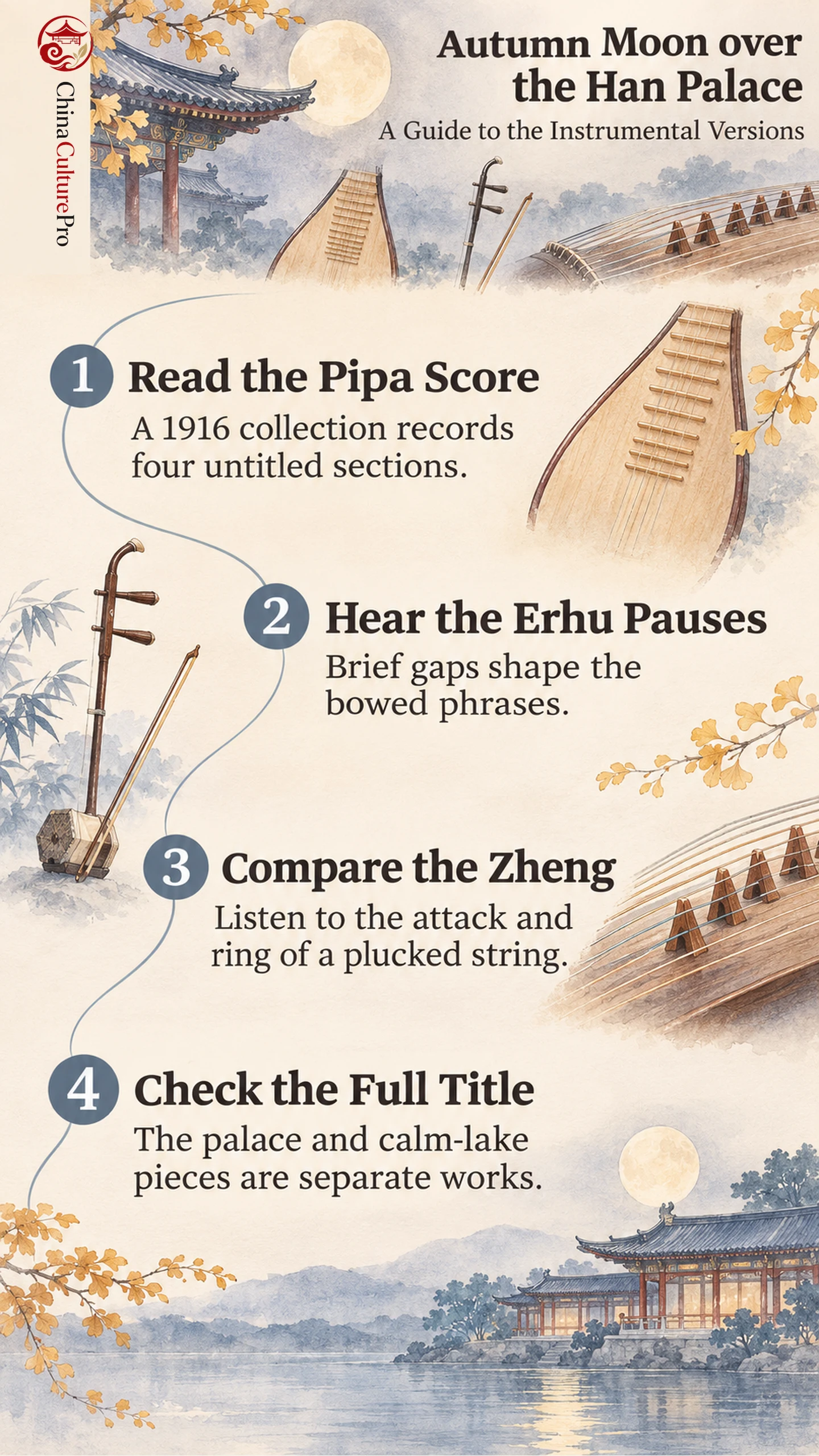
The title suggests a palace in moonlight. In the music, the image can come through the spacing of short plucks, a bowed phrase that pauses, or the lingering sound of a zither string.
The Palace Story and the Early Pipa Score
A Hong Kong recital program identifies a 1916 version in Shen Zhaozhou’s Ancient Tunes of Yingzhou, a Chongming-school pipa collection. Its four sections have no individual titles. The program describes loneliness in the palace and a passage evoking court entertainment.[1]
The Han in the title supplies the setting. Use the Han dynasty guide for the period and the score record for the piece’s documented circulation. The Hong Kong recital itself used Lin Shicheng’s later Pudong-school version, played by Fung Tung.[1]
The Erhu Version and Its Pauses
ChinaCulture.org associates Liu Tianhua with adapting a Cantonese recording for erhu around 1929. The Chinese Music Archive lists erhu recordings by Jiang Xun-feng and Zhang Zun-lian under the same Chinese title.[2][3]
On erhu, listen for the brief spaces between bowed phrases. A pause can leave one pitch hanging in the ear before the next phrase enters. Small slides and changes in tone can matter as much as the arrival on a new note.[2]
How the Zheng Changes the Sound
The Chinese Music Archive credits the Shandong musician Gao Zicheng with arranging and playing a solo zheng version. On a guzheng, listen for the sharp beginning of a pluck followed by the softer sound of the same string.[4]
The Smithsonian’s recorded Bing Xia recital gives a second named zheng example at 5:51–9:32. The same program includes Fisherman’s Song at Dusk and a zheng High Mountains and Flowing Water, which offer different phrases and pacing on the same instrument.[5]
Recognize Ensemble and Moonlit Titles
The Macao International Music Festival presented a Jiangnan ensemble version of Autumn Moon over Han Palace. Its program notes describe the different instruments coming forward in the middle and a closing passage that returns to a quieter mood.[6]
The same program lists Autumn Moon over a Calm Lake separately as a Cantonese piece. If an album shortens both English titles, compare the Chinese names: Han Gong Qiu Yue および Pinghu Qiuyue.[5][6]
FAQs About Autumn Moon over the Han Palace
Was the piece composed in the Han dynasty?
The Han palace is the subject. One documented early pipa score appeared in 1916, and the title alone supplies no date of composition.[1]
What instruments play Autumn Moon over the Han Palace?
Recorded and programmed examples include pipa, erhu, zheng and Jiangnan ensemble versions.[1][3][5][6]
Is it the same as Autumn Moon over a Calm Lake?
They are separate works. The Macao program lists the palace piece in Jiangnan ensemble repertory and the lake piece under Cantonese music.[6]
出典
[1] Hong Kong Leisure and Cultural Services Department. Autumn Moon in the Han Palace: Recital Programme
[2] ChinaCulture.org. Autumn Moon over Han Palace
[3] Chinese Music Archive. A04s Erhu Audio Collection
[4] Chinese Music Archive. Legacy Audio: Gao Zicheng
[5] Smithsonian National Museum of Asian Art. Chinese Music of the Seasons: Bing Xia, Zheng
[6] Macao Cultural Affairs Bureau. Macao International Music Festival: Cloud Celebration