
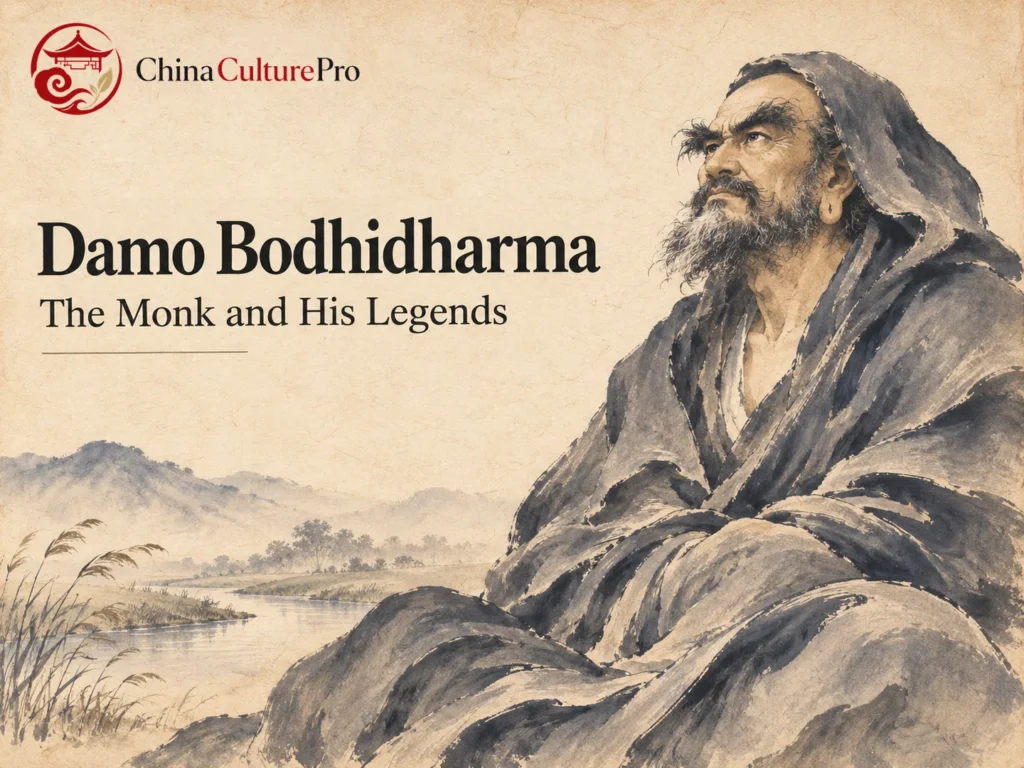

Quick Answer: Who Was Damo Bodhidharma?
Bodhidharma (菩提达摩, Pútí Dámó), commonly called Damo (达摩, Dámó), was a Buddhist teacher associated with China around the sixth century. Chan traditions remember him as their first patriarch in China. The early records leave parts of his biography uncertain.[1][2][3]
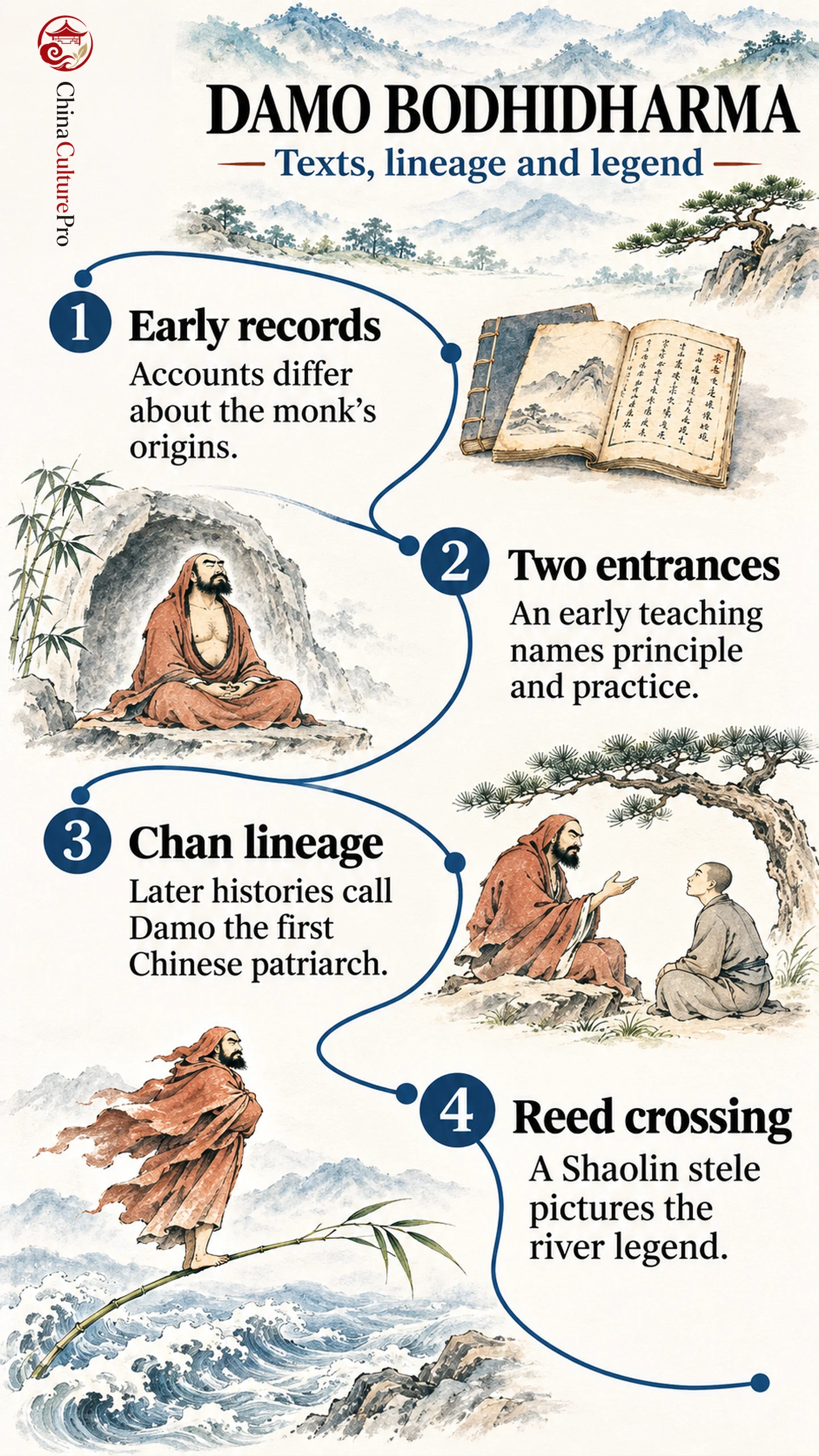
- Early teaching: Texts associated with him distinguish entry through principle from entry through practice.[1][2]
- Later stories: He is said to have crossed a river on a reed and meditated at Shaolin.[4][5]
- Images: A cowl, an intense expression or a reed over water can point to his identity.[4]
A dated image can show that a story was known by then. The date of the image and the date of the event it depicts are separate questions.
A rubbing from a Shaolin stele shows a cowled monk standing on a reed over waves. The monk is Bodhidharma (菩提达摩, Pútí Dámó), known as Damo (达摩, Dámó) in Chinese. The Ming carving portrays a teacher associated with China about a thousand years earlier.[2][4]
What the Earliest Accounts Tell Us
The sixth-century account of Luoyang’s monasteries describes a monk named Bodhidharma as Persian. Daoxuan’s seventh-century collection of monks’ biographies gives the teacher a South Indian origin. Scholars have questioned whether the two records refer to the same individual. The two accounts give limited grounds for reconstructing his birthplace or route.[2][3]
The Two Entrances and the Chan Lineage
The Two Entrances and Four Practices (二入四行论, Èr Rù Sì Xíng Lùn) belongs to the early texts associated with Damo. Entry through principle involves recognizing that beings share the same true nature. Entry through practice concerns the way one responds to circumstances, refrains from seeking gain and acts on that recognition.[1]
Later histories of Chan Buddhism (禅宗, Chánzōng) placed Damo at the start of a Chinese succession. Teachers such as Hongren acquired a defined place in that lineage. The Platform Sutra gives another view of how stories of succession helped shape Chan identity.[1]
How to Recognize Damo in Art
Princeton University Art Museum holds a rubbing taken from a Shaolin stone whose inscription dates it to 1544. Damo wears a hooded robe and stands on a reed in swirling water. A halo frames his head. The reed and waves identify the episode. The halo is a broader feature of Buddhist art.[4]
The Shaolin Association
A traditional account puts Damo in a cave near Shaolin for nine years of meditation. The story was familiar to Ming visitors, including the scholar Du Mu. Claims that the monk originated Shaolin martial training depend on much later attributions. A seventeenth-century exercise manual is evidence for the circulation of such claims long after his lifetime.[5][6]
FAQs About Damo Bodhidharma
Are Damo and Bodhidharma the same name?
Damo is the common short form of the Chinese rendering of Bodhidharma. The full Chinese rendering is Puti Damo.
Did Bodhidharma cross a river on a reed?
It is a miracle story preserved in later religious art. The Shaolin stele shows that the legend was depicted there by the Ming period.
Why is he called the first Chan patriarch in China?
Chan lineage histories trace the Chinese succession back to him. The title reflects his place in the tradition’s account of its origins.
出典
[1] Stanford Encyclopedia of Philosophy. Chan Buddhism
[2] Nanzan Institute for Religion and Culture. Review of The Bodhidharma Anthology
[3] Brill. Sino-Iranian and Sino-Arabian Relations in Late Antiquity
[4] Princeton University Art Museum. Bodhidharma Crossing the River on a Reed
[5] Academia Sinica, Institute of History and Philology. Meir Shahar, Epigraphy, Buddhist Historiography, and Fighting Monks
[6] University of Freiburg Research Repository. Shaolin Martial Arts Heroes in Industrial Hong Kong