

Quick Answer: Who Was Hongren?
Hongren (弘忍, Hóngrěn) was a seventh-century Chinese Buddhist teacher linked to the East Mountain Teaching (东山法门, Dōngshān Fǎmén) at Huangmei (黄梅, Huángméi). Later Chan lineage histories count him as the fifth patriarch.[1][4][5]
- Community: Hongren carried on a tradition associated with the teacher Daoxin (道信, Dàoxìn).[5][6]
- Practice: A text attributed to Hongren describes cultivating the mind through an image of sunlight obscured by clouds.[1][3]
- Later story: The Platform Sutra tells how Hongren transmitted the teaching to Huineng, with a robe as a sign of succession.[4]
The monastery, the practice text and the robe story preserve different aspects of Hongren’s legacy.

Hongren (弘忍, Hóngrěn) is often introduced through a story about whom he chose to succeed him. His place in Chinese Buddhism also comes from the community at Huangmei (黄梅, Huángméi) and the meditation teachings later associated with it.[1][5]
Hongren and the East Mountain Community
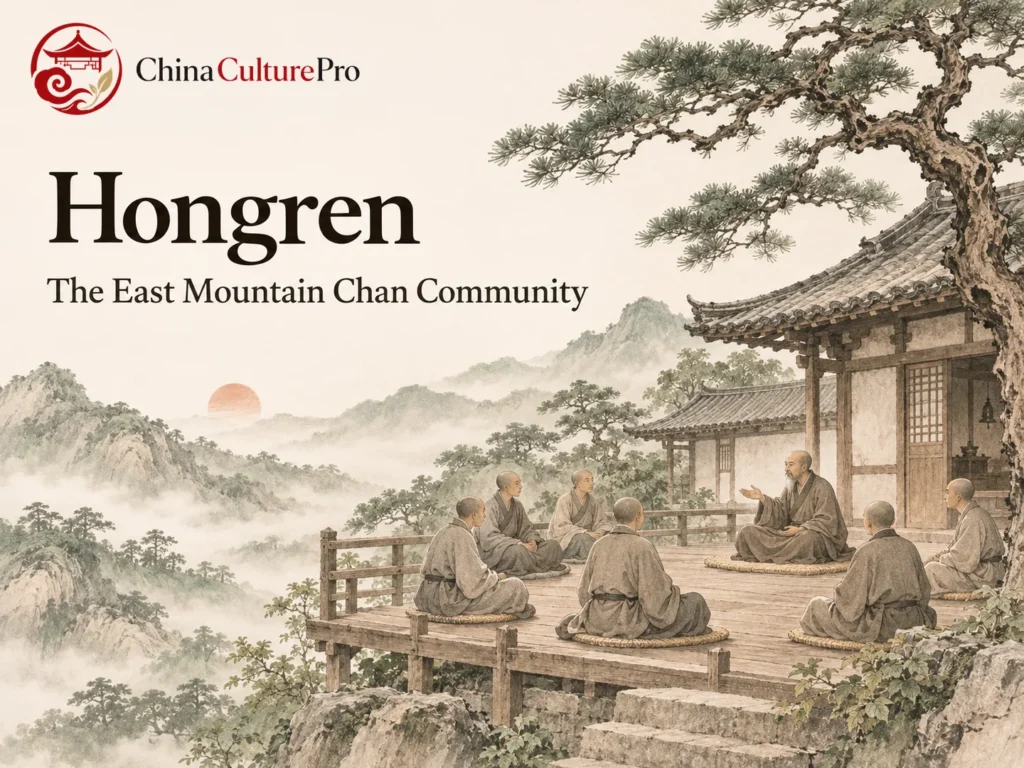
Hongren studied with Daoxin (道信, Dàoxìn). Their communities at Huangmei helped shape the East Mountain Teaching (东山法门, Dōngshān Fǎmén), an early stream of Chan Buddhism. A shared place of training gave students a community from which to carry the teaching elsewhere. Later lineage accounts linked this community to a succession that reached back to Bodhidharma.[1][2][6]
What a Text Linked to Hongren Teaches
The Treatise on the Essentials of Cultivating the Mind is traditionally associated with Hongren. It compares the clarity of mind to sunlight hidden by clouds. The clouds obstruct the light without extinguishing it. The analogy helps explain why practice can involve recognizing clarity that ordinary habits can obscure. Its attribution also shows how later readers connected a set of teachings to the East Mountain master.[3]
Students, the Robe and Later Images
Shenxiu studied with Hongren and went on to become an influential teacher. A different kind of succession appears in the Platform Sutra, which tells how Hongren passed a robe and the teaching to Huineng. The narrative places the authority to teach in an encounter between a master and a disciple.[4][6]
An early version of the story also describes a plan for a portrait of Hongren bestowing the robe. A painting could make transmission visible by showing a robe pass between two people. The narrative tells us how Chan writers represented transmission. The historical details of the episode remain uncertain.[2][4]
FAQs About Hongren
Why is Hongren called the fifth patriarch?
Later Chinese Chan lineage records place him fifth in the succession that begins with Bodhidharma in China.
What is the East Mountain Teaching?
It is a name for an early Chan tradition associated with the monastic communities of Daoxin and Hongren in Huangmei.
Did Hongren write the cultivation treatise?
The text has been attributed to him retrospectively. It is evidence of teachings associated with his community, with authorship a separate historical question.
出典
[1] University of California Press, Oxford Academic. John McRae, Beginnings: Differentiating/Connecting Bodhidharma and the East Mountain Teaching
[2] Stanford Encyclopedia of Philosophy. Chan Buddhism
[3] Bukkyō Dendō Kyōkai. Zen Texts, translated by John R. McRae
[4] Religions. Consecrating the Peripheral: On the Ritual, Iconographic, and Spatial Construction of Sui-Tang Buddhist Corridors
[5] Hokun Trust. Record of the Transmission of the Lamp
[6] Nature Story, Hong Kong. The Development of the Northern School and Southern School of Chan Buddhism in Tang Dynasty China