
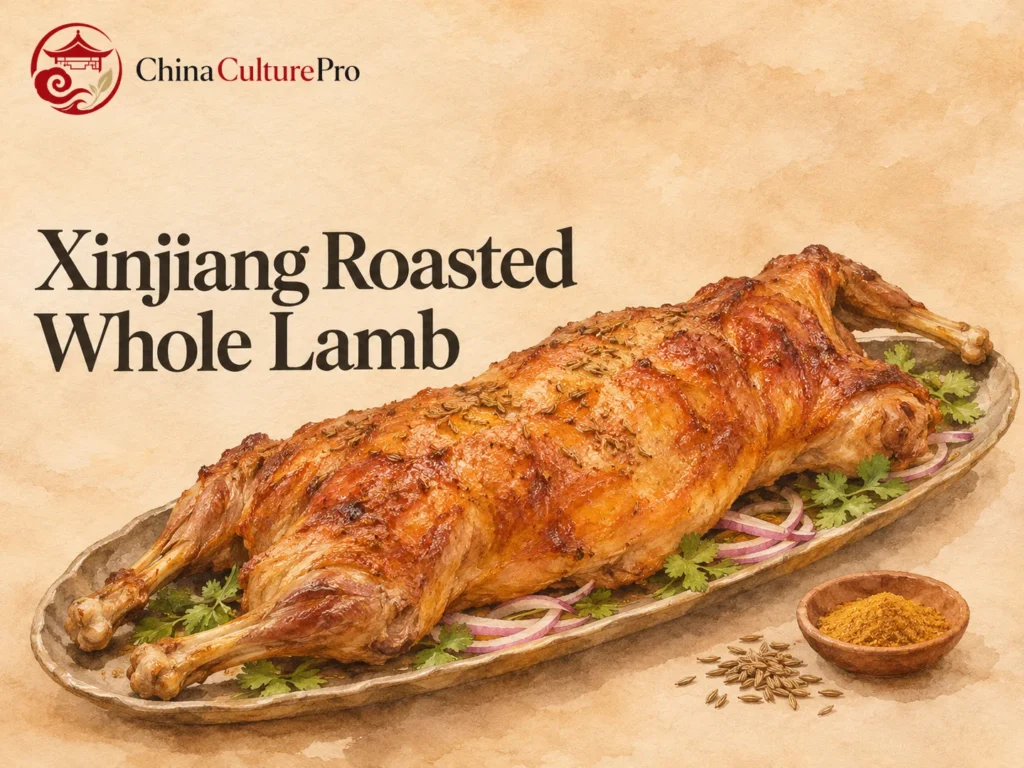

Quick Answer: What Is Xinjiang Roasted Whole Lamb?
Xinjiang roasted whole lamb (烤全羊, kǎo quán yáng) is a seasoned lamb carcass roasted as one piece. In a traditional Xinjiang method, the cook lowers it into a heated naan pit oven (馕坑, nángkēng), where the thin coating browns while the meat cooks on the bone.[1][2]
- Coating: Documented versions use flour and egg with salt and spices such as cumin and turmeric.[1][3]
- Oven: A support holds the lamb in the hot chamber, away from the oven wall.[2]
- Serving: The whole roast can be presented to guests before the meat is cut for sharing.[1][2]
Menus may also list pit-roasted lamb pieces. The oven can be the same, so look for the word “whole” when ordering.

A whole lamb, burnished gold from the oven, makes a striking centrepiece. Its scale helps explain why it appears at occasions where many people eat together. Among Chinese food traditions, it is a particularly visible example of pit roasting for a shared table.
What Goes on the Lamb?
Start with the distinction between the meat and its coating. The cook uses a dressed lamb carcass and brushes on a thin savoury paste. Regional accounts give versions with flour, egg, salted water, turmeric, pepper and cumin. Flour and egg give the mixture enough body to cling. Turmeric brings a yellow cast and cumin gives the browned surface its warm, earthy scent.[1][3]
The finish can run from gold to deep brown. The seasoning is concentrated at the surface, so a slice from the outside offers more toasted spice than a piece cut deeper into the roast.
How the Pit Oven Roasts a Whole Lamb
Cele County describes mounting the lamb lengthwise on a support and lowering it into a preheated oven. Aheqi’s account describes a covered pit. Heat reaches the exposed outside through the chamber, allowing the coating to set while the carcass stays intact.[2][3]
The same kind of oven can bake bread or Xinjiang samsa. For the little lamb pastries, the hot wall is a baking surface. For the whole roast, the space inside the chamber accommodates the carcass on its support.
Local Traditions and Serving at the Table
Cele, in southern Xinjiang’s Hotan area, records the dish as a way for Uyghur hosts to welcome honoured guests. Its account describes roasting a dressed carcass with the head removed. A separate regional food profile describes an elaborate display for the finished roast. Presentation therefore depends on the cook and the occasion.[1][2]
Xinjiang’s regional heritage list includes a whole-lamb roasting technique under traditional meat preparation, with Xinjiang Kunlun Hotel as the named applicant.[4] In the context of Uyghur culture, the act of sharing the roast matters as much as how it is displayed. A host or server can portion the meat after guests have seen the roast.
Whole Roast, Pit-Roasted Cuts or Skewers?
All three can taste of lamb and cumin. A whole roast starts with a carcass and is carved for sharing. Pit-roasted cuts begin as separate pieces, which gives each piece more coated surface relative to its size.[5] Skewers are smaller portions of meat threaded onto sticks, typically grilled over coals.
Ask how the meat is portioned if the English menu says only “roast lamb.” Some restaurants can serve a plate cut from the larger roast. That gives a small group the chance to try the whole-lamb preparation without ordering the entire centrepiece.
FAQs About Xinjiang Roasted Whole Lamb
Does the Roast Always Include the Head?
Presentation varies. Cele County describes roasting a prepared carcass with the head removed. Other regional accounts describe dressing the finished roast for display.
Does the Coating Contain Wheat or Egg?
Both are documented in common coatings. If you need to avoid an ingredient, ask about the paste before ordering. The coating may have been applied to the entire lamb.
Is Xinjiang Whole Lamb Cooked on a Spit?
A traditional pit-oven method uses a long support to hold the intact lamb inside the chamber. Ask how a restaurant prepares it if the menu gives only the English dish name.
Sumber
[1] See Xinjiang. Roasted sheep
[2] Cele County People’s Government. Roasted whole lamb (烤全羊)
[3] Aheqi County People’s Government. Roasted whole lamb (烤全羊)
[4] Xinjiang Uyghur Autonomous Region People’s Government. Notice publishing the sixth regional list of representative intangible cultural heritage projects
[5] Cele County People’s Government. Pit-roasted meat (馕坑烤肉)