
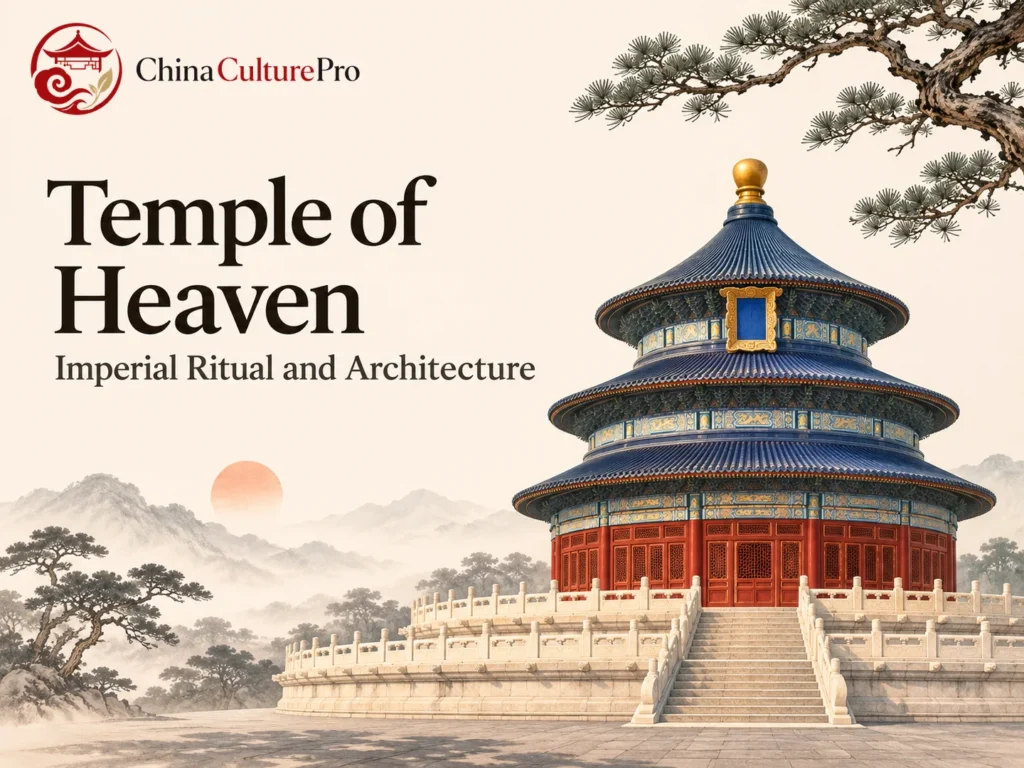

Quick Answer: What Was Beijing’s Temple of Heaven Used For?
The Temple of Heaven (天坛, Tiāntán) in Beijing was a site where Ming and Qing emperors offered sacrifices to Heaven and prayed for good harvests. Its best-known blue-roofed hall belongs to a larger ritual complex with an open altar, a vault for ceremonial tablets and a raised connecting route.[1][2]
- Prayer for harvests. The northern Hall of Prayer for Good Harvests was used in the first lunar month.[2]
- Sacrifice to Heaven. The Circular Mound Altar served winter solstice rites.[1][3]
- Visible cosmology. Round forms and blue roof tiles evoke Heaven. The rounded north and square south of the enclosure express a larger heaven-and-earth relationship.[1][2]
The original complex dates to 1420. Later building phases shaped the buildings and ritual route visible today.[1][2]

The round blue roof is often used as an image of Beijing. Read it within the whole complex and the other structures become equally important. The buildings were set out to distinguish religious duties, and the route between them made those distinctions visible.
How the Ming and Qing Shaped the Complex
In 1420, the Ming Yongle emperor’s altar complex south of the palace was dedicated to Heaven and Earth. Under the Jiajing emperor, the court established separate rites for Heaven and Earth in 1530 and added the Circular Mound Altar to the south. The northern hall later acquired a circular form.[1][2]
The Qing continued to alter and repair the site. In 1749, the Circular Mound was enlarged. Qing-era work changed the northern hall as well. The 1420 date marks the origin of the ritual complex. Later Ming and Qing work accounts for the present layout.[1][2]
Three Structures on the Ritual Axis
| Structure | Posisi | Ritual purpose |
|---|---|---|
| Circular Mound Altar | Selatan | Open-air altar for sacrificing to Heaven, especially at the winter solstice |
| Imperial Vault of Heaven | Between the altar and the raised route | Stored spirit tablets used for altar ceremonies |
| Hall of Prayer for Good Harvests | Utara | A place to pray for good harvests during the first lunar month |
The Danbi Bridge (丹陛桥, Dānbì Qiáo) is the raised sacred way connecting the northern hall with the Imperial Vault of Heaven. It links parts of the complex along an axis. It also directed movement during ceremonies, with separate lanes assigned to the deity, the emperor and officials.[1][2][3]
How Shape, Color and Number Expressed Cosmology
The north of the enclosure is rounded, and the south is square. The northern hall repeats the circular form, while its blue tiles evoke the sky. The same general round-and-square symbolism could be redeployed in a modern setting, as the engineers responsible for Beijing’s Bird’s Nest stadium described the stadium and the adjacent Water Cube.[1][2][4]
At the Circular Mound, repetitions of nine appear in stone components and stairs. Number was one way the builders expressed the ceremony’s relationship to Heaven. On Mount Tai, imperial sacrifices tied the ruler to a sacred mountain instead. Each site uses a different built and natural setting to address the relation between the ruler and the cosmos.[1][3][5]
FAQs About the Temple of Heaven
Is the blue-roofed hall the whole Temple of Heaven?
It is the Hall of Prayer for Good Harvests, one part of a complex with other buildings, altars and landscape features.[1][2]
What is the difference between the Circular Mound and the Hall of Prayer?
The Circular Mound was an open-air altar used for sacrifice to Heaven. The northern hall hosted prayers for abundant harvests.[1][2][3]
Why does the Temple of Heaven use both round and square forms?
The forms express a traditional cosmological relationship. A rounded north evokes Heaven, while the square southern enclosure refers to Earth.[1][2]
Sumber
[1] UNESCO World Heritage Centre. Temple of Heaven, an Imperial Sacrificial Altar in Beijing
[2] Beijing Municipal Government. Tiantan Park, the history and building arrangement
[3] Beijing Municipal Government. Temple of Heaven, description of altar and vault functions
[4] Arup. Chinese National Stadium and the round-square relationship
[5] UNESCO World Heritage Centre. Mount Taishan