


Quick Answer: What Does Ren Mean?
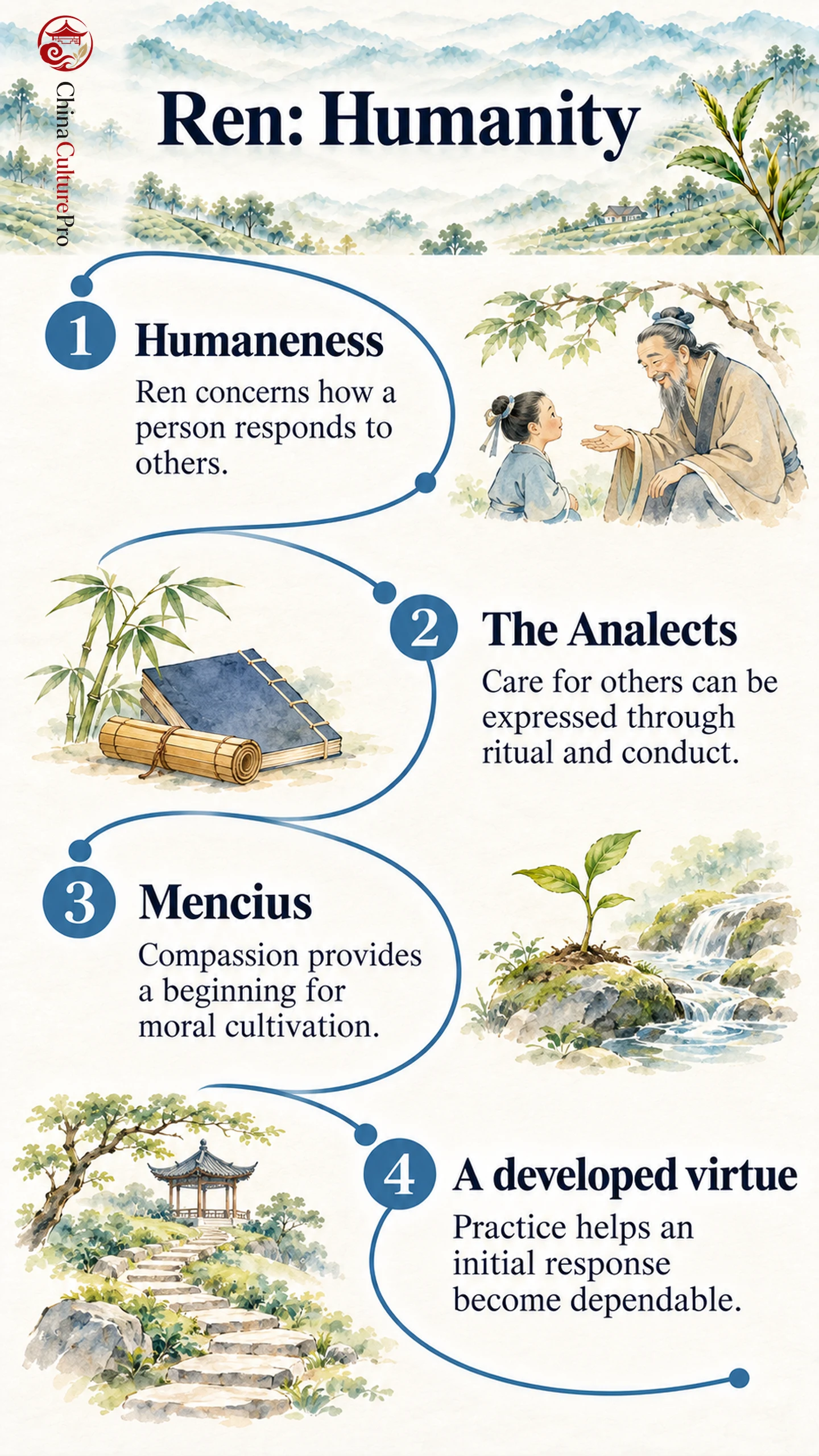
Ren (仁, rén), often translated as humaneness or benevolence, is a Confucian virtue concerned with how people regard and respond to one another. The Analects (论语, Lúnyǔ) associates it with care for people and disciplined conduct. Mencius (孟子, Mèngzǐ) treats an immediate response to suffering as one beginning of the virtue.[1][2][3][4]
- Regard: Other people’s circumstances matter to a person who acts humanely.
- Practice: Forms of conduct can express and help cultivate that regard.
- Growth: An initial response can become a more dependable disposition.[1][2][3][4]
Some passages use the term narrowly for care and others give it a wider role in describing an admirable character.
One person asks about care for others. Another needs to understand what makes self-discipline morally significant. The Analects addresses both through the same term. Reading the answers alongside the questions helps show what each passage emphasizes.
Two Answers About Ren in the Analects
When Fan Chi (樊迟, Fán Chí) asks about humaneness in 12.22, the reply turns to caring for people. He then asks a separate question about knowledge. The questions receive different replies, yet both answers concern how a person regards or judges others. The subsequent advice about elevating the upright puts that judgment in a setting where it can affect other people.[1]
In 12.1, Yan Hui (颜回, Yán Huí) asks about the same virtue and receives a reply connecting it with governing oneself and returning to ritual propriety (礼, lǐ). The details of looking, listening, speaking and acting matter in the ensuing exchange. The answer attends to the habits that make a person able to express regard consistently. Read together, the passages show the connection between a disposition toward others and ways of learning to give it form.[1][2][4]
How Mencius Describes the Beginning of Humaneness
In 2A.6, Mencius asks readers to imagine suddenly seeing a child about to fall into a well. The alarm and compassion that arise in that instant supply evidence, within his argument, of a capacity that precedes calculation. He explicitly sets aside motives such as gaining favor with the child’s parents or winning a reputation among neighbors.[3][4]
Mencius calls such a response a beginning of humaneness. The passage then asks what becomes possible when people develop their moral beginnings. The immediate recognition of another person’s distress is one part of an account of character, and a lasting ability to recognize and respond to needs takes cultivation. This is one point in the broader Confucian debate about human nature.[3][4]
How Humaneness and Ritual Work Together
Consider someone receiving a guest who is visibly tired. A familiar greeting gives the host a way to acknowledge them. The host can also attend to whether the guest needs a place to sit or a chance to rest. The gesture and the concern expressed through it can support each other. The example is an illustration of how ritual and care can meet in one case.[2][4]
One reading of the Analects treats ritual as a means of cultivating a regard people already have in an unrefined form. Another places more weight on the way shared practices constitute recognizable expressions of respect. Both help explain why the question of care cannot be settled by repeating a word for the virtue. What a gesture communicates and whether it helps cultivate regard depend in part on how the gesture is used.[2][4]
FAQs About Ren Humanity
Why do translations use benevolence and humaneness?
“Benevolence” emphasizes concern for others. “Humaneness” can also suggest the quality of character cultivated through conduct. An edition’s choice often reflects the role of the term in the passage.[1][2][4]
Is an initial feeling enough to show the virtue?
Mencius describes the immediate response to the child as a beginning. The fuller virtue involves developing that responsiveness and carrying it into other circumstances.[3][4]
Does ren mean exactly the same thing in every passage?
The passages emphasize different aspects. Caring for others is prominent in the reply to Fan Chi, while the answer to Yan Hui focuses on self-discipline and practice.[1][2]
Sumber
[1] The Analects, Book 12. Passage 12.22: Fan Chi Asks About Humaneness
[2] The Analects, Book 12. Passage 12.1: Yan Hui Asks About Humaneness
[3] Mencius, Book 2A. Gongsun Chou Shang, Passage 6
[4] Stanford Encyclopedia of Philosophy. Chinese Ethics