


Quick Answer: What Is Penglai?
Penglai (蓬萊, Pénglái) is an island mountain inhabited by immortals in Chinese mythology. The Records of the Grand Historian places it among three sacred mountains in the sea and describes rulers sending expeditions to find them. The Liezi gives it a different setting among five floating mountains.[1][2][3]
- The quest: The island tradition promises access to immortals and a drug of deathlessness.
- The other islands: Fangzhang and Yingzhou (瀛洲, Yíngzhōu) complete the trio in the historical account.
- The name today: Penglai also names a coastal pavilion in Shandong.
The sea mountain, expeditions and coastal architecture each have their own evidence.[1][2][5]
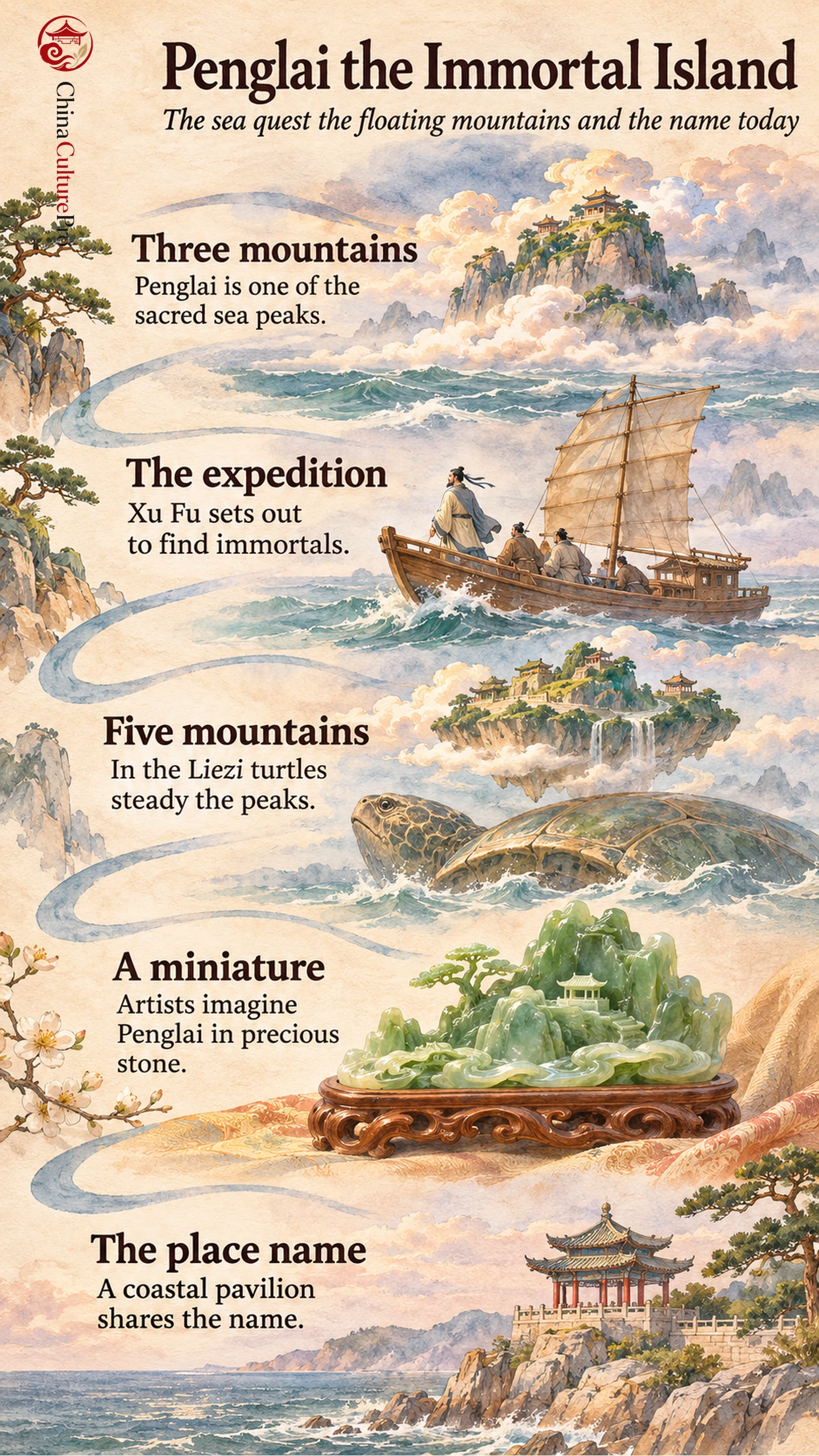
Penglai is near enough to see and hard enough to reach that wind can keep ships away. That tension makes it a different kind of destination in each account.
Three Sea Mountains in the Records of the Grand Historian
The Treatise on the Feng and Shan Sacrifices tells of expeditions sent by rulers of Qi and Yan to find Penglai, Fangzhang and Yingzhou. The mountains are said to be in the Bohai Sea. Immortals and a drug of deathlessness are found there in the account, along with white birds and beasts and palaces of precious metals.[1]
Seen from afar, the mountains look like clouds. As a ship approaches, they seem to be beneath the water, or the wind carries the ship away. The First Emperor’s annals name Xu Fu (徐福, Xú Fú) in the account of a mission to seek the immortals. The annals record the aim of the mission: finding the immortals.[1][2]
Penglai Among the Five Mountains of the Liezi
In the Liezi’s Questions of Tang, Penglai is one of five mountains in the sea near the immense abyss called Guixu. The account gives the mountains terraces of gold and jade and fruit associated with deathlessness. Because the mountains have no fixed roots, they move with the waves.[3]
Giant turtles steady the mountains. When a giant from Longbo takes away six turtles, Daiyu and Yuanjiao are lost. Penglai remains in the group of surviving mountains. In this story the problem is how to keep a home for immortals in place, whereas the imperial account focuses on why human travelers struggle to reach it.[1][3]
How Artists Imagined Penglai
The Metropolitan Museum of Art catalogues a group of miniature Qing mountains in emerald as representations of Penglai. A collector could encounter the island realm in a small object rather than as a distant view at sea. The jewel material fits the richness ascribed to the setting in the museum’s description.[4]
A carving that presents a whole landscape as a miniature can emphasize the island’s peaks and precious materials. The catalogue name identifies the subject, while the material and scale show how the artist presented it. The object also shows how an artistic rendering can choose a few recognizable features from a much longer tradition.[4]
Penglai Pavilion and the Place Name Today
The Penglai Pavilion is a cliffside architectural complex in Yantai, Shandong. The real coastal buildings and their histories can be described on their own terms. The legendary account speaks of offshore mountains that ships struggle to approach. The shared name gives a reader a reason to compare their settings.[1][5]
Like mythic Kunlun, Penglai can be read as part of an imagined geography. The sea and the repeated failure of ships to arrive distinguish the island quest from classical descriptions of ascent at a mountain.
FAQs About Penglai
Was Penglai a real island?
Penglai is a mythic sea mountain in the ancient accounts. The pavilion in Yantai is a documented coastal complex that shares the name.[1][5]
Did Qin Shi Huang send people to find Penglai?
Yes. The Records of the Grand Historian describes the First Emperor sending Xu Fu out to look for the immortals of the three mountains, including Penglai.[1][2]
What is the difference between Penglai and Yingzhou?
The historical account names them as separate mountains in the same sea. The Liezi also lists both separately among its five floating mountains.[1][3]
Sumber
[1] Shidian Classics. Records of the Grand Historian, Treatise on the Feng and Shan Sacrifices
[2] Chinese Wikisource. Records of the Grand Historian, Annals of the First Emperor
[3] Chinese Text Project. Liezi, Questions of Tang, passage two
[4] The Metropolitan Museum of Art. Miniature Mountains Representing the Mythical Realm Penglai
[5] China Daily Government Portal. Penglai Pavilion, Yantai