

Quick Answer
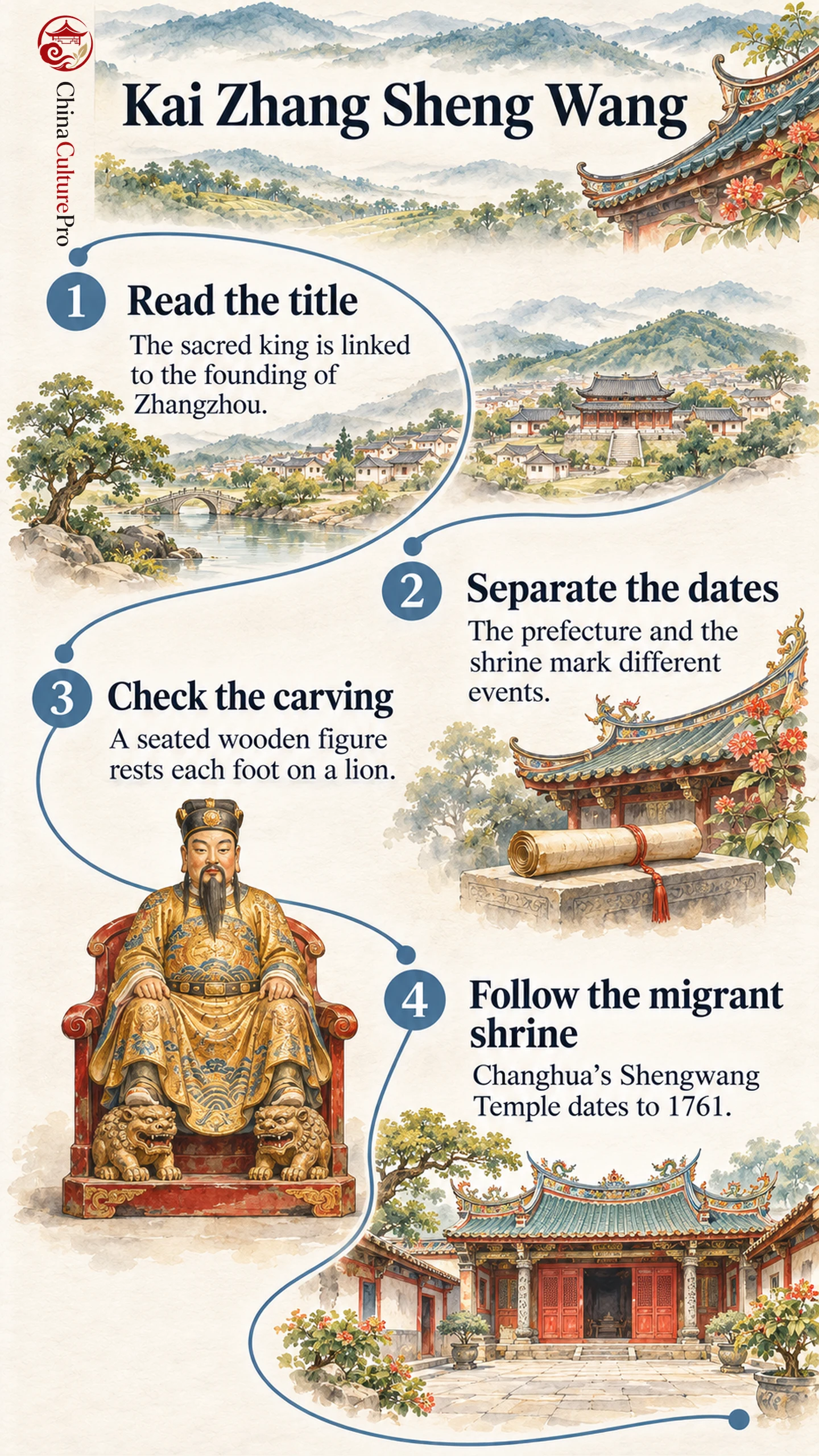
Kai Zhang Sheng Wang (開漳聖王, Kāizhāng Shèngwáng), the Sacred King Who Opened Zhangzhou, is the title under which Chen Yuanguang (陳元光, Chén Yuánguāng) is worshipped. Local accounts connect him with the establishment of Zhangzhou in Tang China. In Taiwan, the deity became a guardian of communities whose families came from that part of Fujian.[1][2][3]
- Name: The title links the deity to the founding of Zhangzhou.
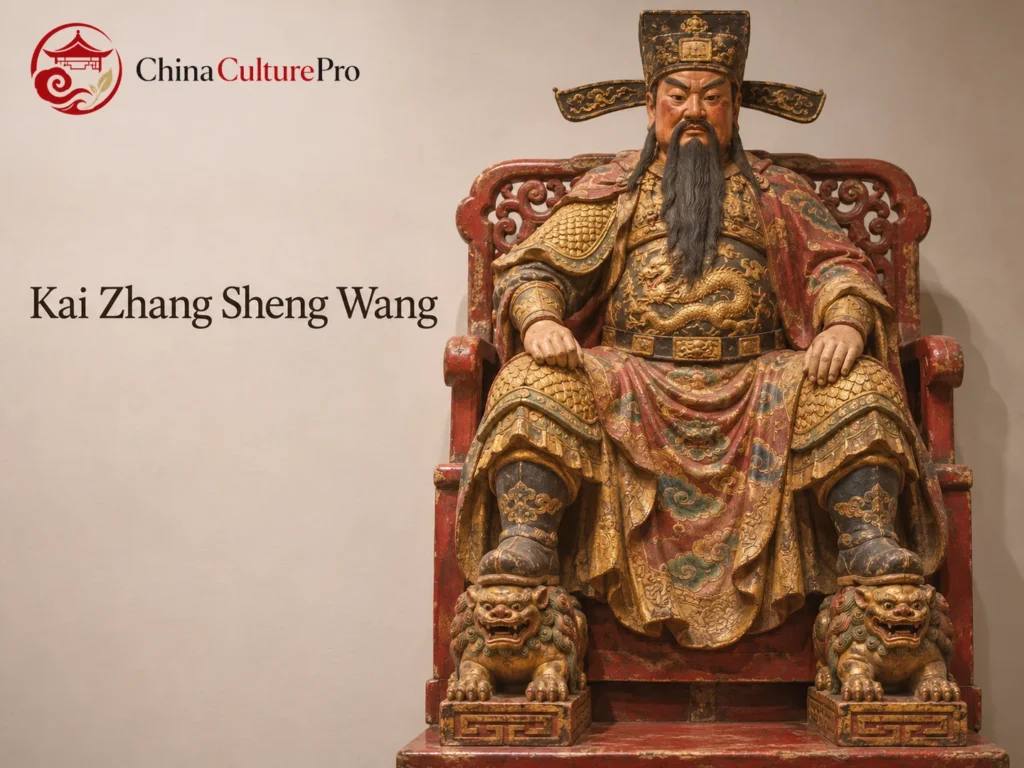
- Images: A wooden figure shows him as a seated official in military dress.
- Temples: A shrine founded in Changhua in 1761 served migrants from Zhangzhou.
Read local histories alongside the objects and institutions that document later worship.[1][2][3]
A painted wooden figure in a Taiwanese collection sits in a decorated red chair. He wears an official cap and gold-colored military clothing. A small lion rests beneath each foot. The details make a remembered commander visible as a deity in an image.[2]
Why the Title Names Zhangzhou
In the traditional account, Chen Yuanguang succeeded his father Chen Zheng in command and later petitioned for the establishment of Zhangzhou. The religious heritage entry for the temple in Changhua places the creation of the prefecture in 686 and names Chen as its first prefect. The title “Who Opened Zhangzhou” preserves that association with place and government.[1][3]
The same heritage account records a shrine in his honor in 716 and the award of the plaque name Weihui in 1113. “Sacred King” is the title by which he came to be worshipped. The dates concern different events: the establishment of a prefecture, the founding of a shrine, and the recognition of that shrine.[1]
How to Recognize Him in a Wooden Image
In the Taiwan Historica carving, the seated figure has a long beard, a formal cap, military clothing, and two lions under his feet. The chair is painted red and decorated with gold leaf. These details describe a particular image, whose maker and date are unknown.[2]
The National Taiwan Museum holds a smaller seated figure, 18.8 centimeters tall. Its record discusses a 1930s display inventory of local customs under Japanese rule, in which devotional images appeared alongside figures depicting everyday life. The inventory offers a view of how religious objects entered a museum display of everyday culture.[4]
How the Worship Took Root in Taiwan
Shengwang Temple (聖王廟, Shèngwáng Miào) in Changhua was established near the city’s west gate in 1761. Its heritage entry identifies the temple as a center for migrants from Zhangzhou. The deity’s name carried the connection to their place of origin into a shared institution.[1]
The Taiwan Historica catalogue also records the deity’s place in Chen lineage shrines. Those family settings and a city temple preserve different scales of devotion. The guide to Chinese folk religion explains how a protective deity can belong to several communities at once.[1][2]
FAQs About Kai Zhang Sheng Wang
Is Kai Zhang Sheng Wang another name for Chen Yuanguang?
It is a religious title associated with Chen Yuanguang. The title identifies him through his connection with the founding of Zhangzhou.[1][3]
When was Changhua’s Shengwang Temple founded?
The official heritage entry dates the founding to 1761, near the west gate of the old city.[1]
Do all images show lions under his feet?
The pair of lions belongs to the documented Taiwan Historica figure. Check a particular object’s label, setting, and other details to identify it.[2][4]
Sumber
[1] Taiwan Ministry of the Interior. Changhua Shengwang Temple
[2] Taiwan Historica. Wooden Kai Zhang Sheng Wang figure, 19800010244
[3] Hugh R. Clark, University of Hawaiʻi Press. The Sinitic Encounter
[4] National Taiwan Museum. Seated wooden Kai Zhang Sheng Wang figure