


Quick Answer: What Is Hundun?
Hundun (混沌, hùndùn) means chaos or an undifferentiated state. In the Zhuangzi it is also the name of a hospitable ruler who dies when two guests try to give him ordinary human features. Related spellings occur in other early works, where the context gives the name a different force.[1][2][3]
- Zhuangzi: Hundun rules the center and has no openings for sight, hearing, eating or breathing.
- Classic of Mountains and Seas: Dijiang (帝江, Dìjiāng) is a faceless spirit who knows song and dance.
- Zuozhuan: Hundun is a name for a figure associated with misconduct and banishment.
Guo Pu’s commentary connects the first two accounts, which helps explain why their details sometimes appear together.[2]
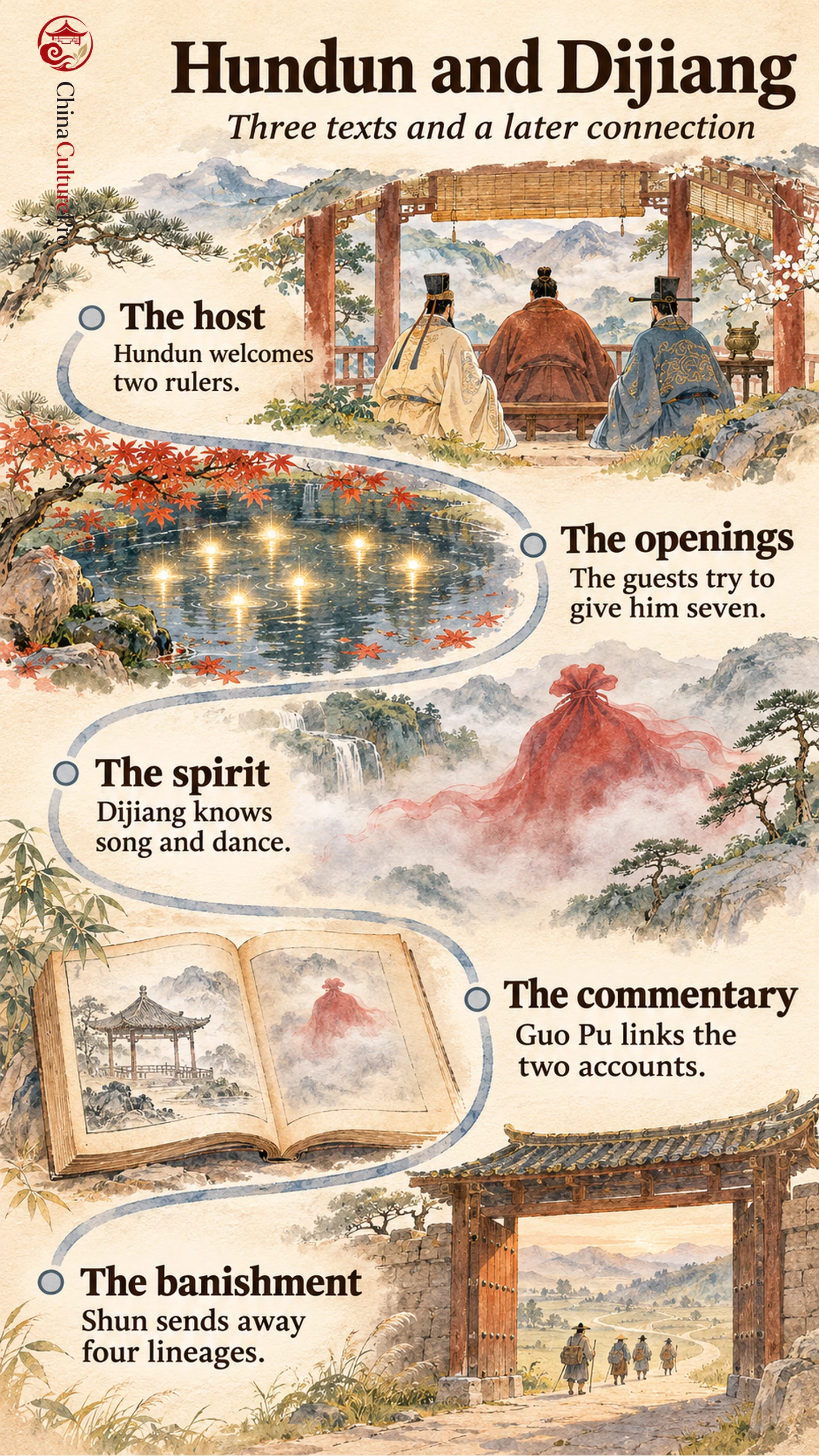
The source matters when a description of Hundun moves from a courteous host to a winged creature or a banished wrongdoer. Those traits come from passages with different purposes.
Why Hundun Dies in the Zhuangzi
The last episode in the Zhuangzi’s “Responding to Emperors and Kings” brings together Shu of the South Sea, Hu of the North Sea and Hundun of the center. The first two often meet in Hundun’s territory, where he receives them kindly. They decide to repay him by giving him the seven openings they expect a person to have. They add one opening each day. Hundun dies on the seventh day.[1]
The guests begin with gratitude. The harm comes from their assumption that the way their own bodies work is the measure of a good life for someone else. That makes the tale especially pointed at the end of a chapter concerned with rulership. A reader can see a warning against imposing an apparently beneficial order on someone who already lives well in a different way.[1]
How Dijiang Became Associated with Hundun
The Western Mountains section of the Classic of Mountains and Seas describes a spirit on Mount Tian. The description compares its shape to a yellow sack and its color to cinnabar-red fire. It has six feet and four wings, lacks a face, and knows song and dance. The line ends by naming the being Dijiang.[2]
The descriptive wording uses a form of hundun. In the transmitted commentary, Guo Pu explicitly brings in the Zhuangzi’s central ruler and reads the story of his death as a parable. That comment supplies a textual reason to compare the figures. The creature’s body and its ability to dance come from the mountain account, while the visit and the seven openings come from the Zhuangzi.[1][2]
Hundun Among the Four Perils
In the Zuozhuan account for the eighteenth year of Duke Wen, Hundun is the popular name of an unworthy descendant of Dihong. Here the charges concern conduct: the figure conceals wrongdoing and keeps company with people of similar character. A speech groups his lineage with those of Qiongqi, Taowu and Taotie among the Four Perils. It credits Shun with sending the four lineages away.[3]
Banishment in this story restores order. That role gives Hundun almost the reverse function of the figure in the Zhuangzi, where the guests’ attempt to set things right ends in loss.[1][3]
What Chaos Means in These Stories
English “chaos” can suggest turmoil or confusion. In the Zhuangzi, the central figure begins whole in his own way. “Undifferentiated” helps convey that reading of the parable. The action in each scene identifies the source more reliably than the spelling. When reading an illustration or retelling, ask whether the scene concerns hospitality, a mountain spirit or Shun’s banishments. Each clue points to a different passage.[1][2][3]
FAQs About Hundun
Is Hundun the same as Dijiang?
Guo Pu links Dijiang’s faceless form to Hundun’s parable. The Classic of Mountains and Seas names its own figure Dijiang and supplies the wings, feet, song and dance.[1][2]
What are Hundun’s seven openings?
The story describes openings for seeing, hearing, eating and breathing. The guests try to give Hundun the usual two eyes, two ears, two nostrils and mouth.[1]
Is Hundun a creator god?
The Zhuangzi casts him as ruler of the center. That short story deals with hospitality and change, and ends with his death. It gives him no act of creation.[1]
Sumber
[1] ChineseStudy. Zhuangzi, Responding to Emperors and Kings
[2] Chinese Wikisource. Classic of Mountains and Seas, Western Mountains, with Guo Pu’s commentary
[3] Chinese Text Project. Collected evidence for the Spring and Autumn commentaries, Duke Wen year eighteen