
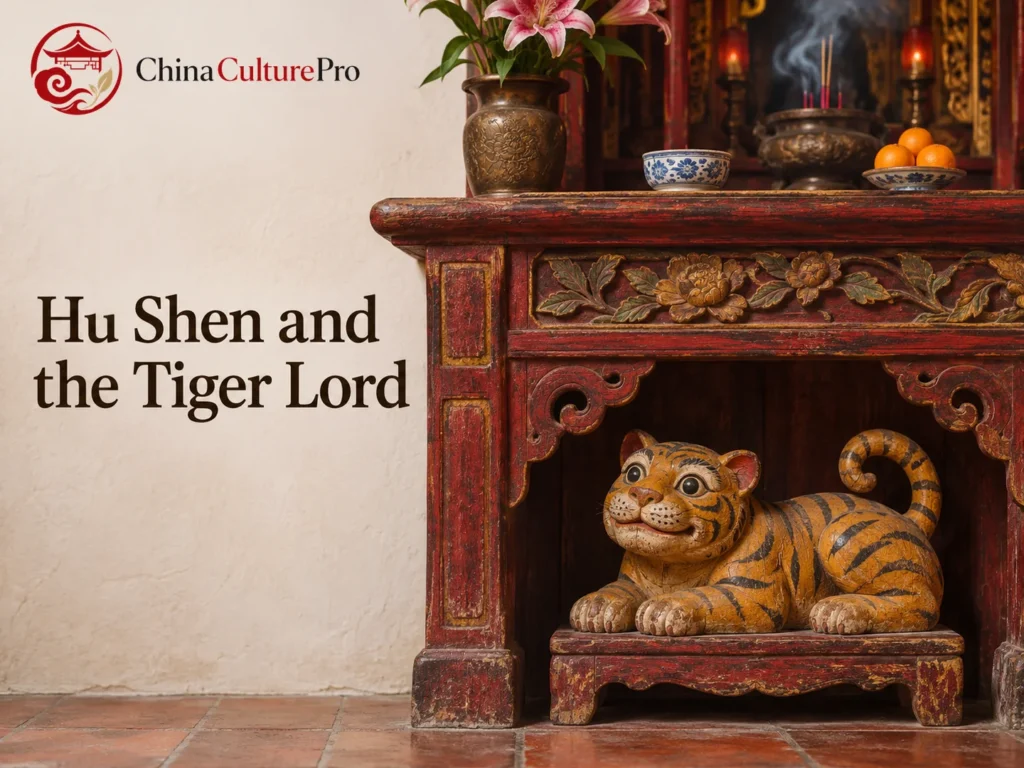

Quick Answer
Hu Shen (虎神, Hǔshén) means “tiger deity.” In Taiwanese temples, the Tiger Lord (虎爺, Hǔyé) is often a guardian worshipped below the main altar. Other tiger images serve different roles. A directional tiger emblem, for example, represents the west in a system of four directional creatures.[1][2][3]
- Temple guardian: A small tiger image may sit beneath the altar of a principal deity.
- Local exception: Xingang Fengtian Temple places its honored tiger image on top of the altar.
- Directional figure: A tiger on a bronze mirror can belong to a set of four cosmic emblems.
The name, placement, and neighboring figures help establish what a tiger image represents.[1][3][4]

A stone tiger in the National Museum of Taiwan History lies with its body low and its tail carved in relief. The image is about nineteen centimeters across at its widest. It shows why a temple guardian can be easy to overlook if a visitor only looks at the main figures above the table.[1][5]
Why the Tiger Lord Is Often Below the Altar
The title General of the Lower Altar (下壇將軍, Xiàtán Jiāngjūn) refers to a familiar place for a Tiger Lord image. In one Taiwanese tradition the tiger serves as the mount of the Earth God (土地公, Tǔdìgōng). In temples devoted to Baosheng Dadi (保生大帝, Bǎoshēng Dàdì), a tiger can be honored as the Black Tiger General.[1][2]
The layout pairs a guardian with the deity it serves. At Songshan Fengtian Temple in Taipei, the Tiger Lord is listed in the first-floor east wing, beneath the Earth God. See the overview of Chinese folk religion for the role of local protective figures.[1][7]
How Local Temples and Objects Differ
A painted wooden tiger in a Taiwanese museum sits with black stripes on its yellow body, its tail curling up onto its back. The stone figure lies down, its tail worked into the surface. Both use the animal’s shape, although posture and material differ.[5][6]
At Xingang Fengtian Temple in Chiayi, the Tiger Lord is honored above the altar table with a gold floral ornament. The local story says an emperor granted the ornament after the tiger helped him. The temple’s raised arrangement gives that local story a visible form.[4]
How to Distinguish the White Tiger of the West
The White Tiger (白虎, Báihǔ) appears with three other directional creatures on a seventh-century bronze mirror. The tiger stands for west, while the dragon, bird, and entwined tortoise and snake stand for east, south, and north respectively.[3]
The group gives the tiger its meaning in that design. At a temple altar, the position and name can instead show a guardian’s relationship with a principal deity. The same kind of animal can represent a direction in one object and receive offerings as a guardian in another setting.[1][3]
FAQs About Hu Shen and the Tiger Lord
Is Hu Shen the same as Hu Ye?
Hu Shen is a general expression for a tiger deity. Hu Ye is a familiar Taiwanese title for the Tiger Lord honored in temples.[1][2]
Is the Tiger Lord always beneath the altar?
That placement is common. Xingang Fengtian Temple is a documented example where the tiger is placed above.[1][4]
Do all Tiger Lord statues look alike?
The posture, paint, and material vary. The stone and wooden objects here show a lying tiger and a seated one.[5][6]
Sumber
[1] Taiwan Historica. Taiwan Folk Objects Dictionary, Tiger General
[2] Academia Sinica, Museum of the Institute of Ethnology. Tiger God
[3] Metropolitan Museum of Art. Mirror with symbols of the four cardinal directions
[4] Taiwan Ministry of the Interior. Xingang Fengtian Temple and its local worship traditions
[5] National Museum of Taiwan History. Stone Tiger Lord, 2003.019.0061
[6] National Museum of Taiwan History. Wooden Tiger Lord, 2018.010.0073
[7] Songshan Fengtian Temple. Tiger Lord in the first-floor east wing