

Quick Answer: When Is the Hokkien Tiangong Birthday?
In Hokkien communities, the birthday of the Heavenly Lord (天公生, Tiāngōng Shēng) falls on the ninth day of the first lunar month. Tiangong (天公, Tiāngōng) is a name for the Jade Emperor (玉皇大帝, Yùhuáng Dàdì). Some observances begin on the eighth evening and continue into the ninth day. Sugarcane is a distinctive offering in documented Hokkien practice. [1][2][3][4]
- Lunar date: Day nine of the first lunar month. [1][2]
- Offerings: Sugarcane is associated with giving thanks. [2][3]
- Places: Penang and Singapore have distinct community and temple observances. [2][4]
A notice for the eighth evening can refer to the start of the ninth-day observance.

At Penang’s Chew Jetty, crowds gathered on the eighth night in 2026. Prayers and performances continued as the community welcomed the ninth day. [4]
What the Ninth Day Means in Hokkien Communities
The Fujian government’s traditional calendar for the Minnan cultural region lists the ninth of lunar month one as the birthday of the Kaisar Giok. In Singapore, a Hokkien temple account describes offerings to thank him. The act of worshipping Tiangong (拜天公, bài Tiāngōng) gives the celebration its name Pai Ti Kong in Penang. [1][2][3][5]
On the Hong Kong Observatory calendar, the ninth day fell on February 25 in 2026 and falls on February 14 in 2027. A celebration that begins on the eighth night may be advertised for the preceding Gregorian day. Use the village, temple or public event’s notice for the gathering time. [4][6][7]
Why Sugarcane Appears at the Altar
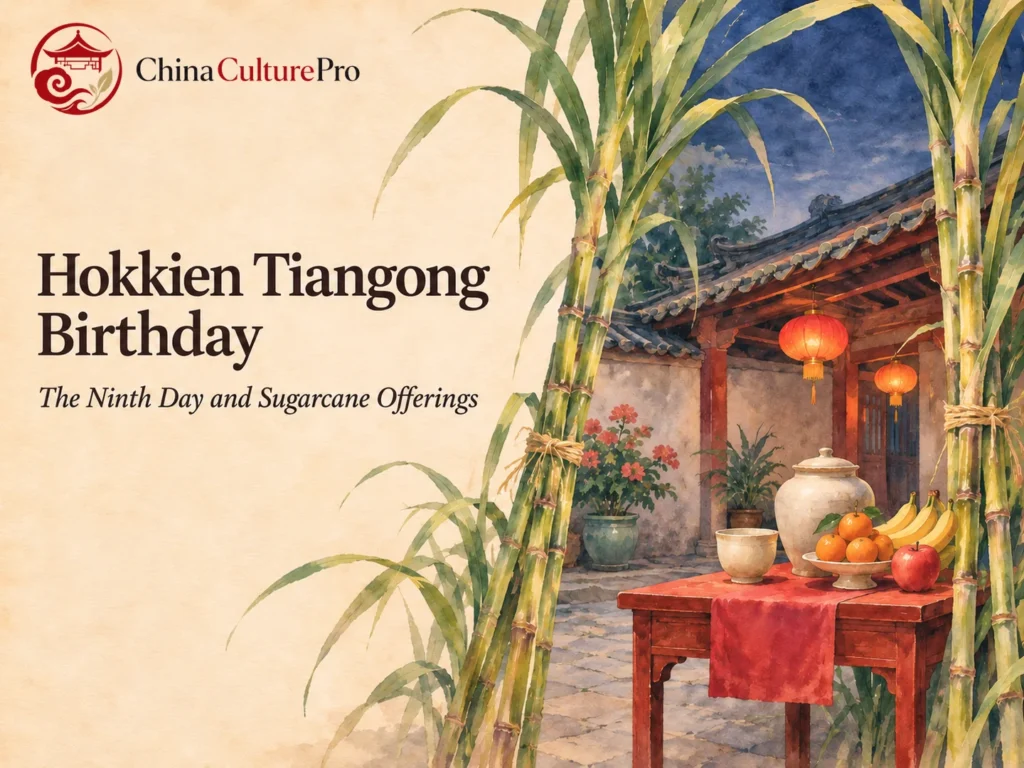
Singapore’s National Library Board recounts a Hokkien legend in which people hid in a sugarcane field to escape attackers. After coming out on the ninth day, they offered sugarcane in thanks. In that telling, the cane recalls the place that sheltered them. [3]
Singapore’s Thian Hock Keng temple offers another explanation for the association with gratitude. Its account connects the sound of the Hokkien word for sugarcane with an expression of thanks. The story and the wordplay each give a reason that the stalks can express gratitude. [2][3]
From Home and Temple to the Jetty
Taiwan Historica’s folklore dictionary describes worship at home around the transition from the eighth night into the ninth day. It also records households going to a nearby temple after praying at home. [5]
Thian Hock Keng describes a temple celebration with song-stage performances. At Penang’s Chew Jetty, the public program has included song, dance and a countdown. The settings show how New Year traditions in Singapore and Malaysia give a community setting to the same lunar birthday. [2][4]
FAQs About the Hokkien Tiangong Birthday
Is Hokkien New Year on the first or ninth day?
The first day opens the Lunar New Year. In Penang, Hokkien New Year is also a name for the ninth-day celebration honoring Tiangong. [1][3][4][8]
Why do some listings give the eighth day?
The birthday is on the ninth lunar day. An observance can start on the preceding evening, as the Chew Jetty gathering did in 2026. [4][5]
Sumber
[1] Fujian Provincial Government. Minnan Cultural Ecology Protection Plan
[2] Thian Hock Keng. Temple Traditions and Cultures
[3] Singapore National Library Board. Hokkien Community
[4] Buletin Mutiara. Chew Jetty’s 2026 Jade Emperor Birthday Celebration
[5] Taiwan Historica. Tiangong’s Birthday
[6] Hong Kong Observatory. 2026 Gregorian–Lunar Calendar Conversion Table
[7] Hong Kong Observatory. 2027 Gregorian–Lunar Calendar Conversion Table
[8] Visit Penang. Chinese New Year in Penang