

Quick Answer: How Can You Recognize Hexi Painting?
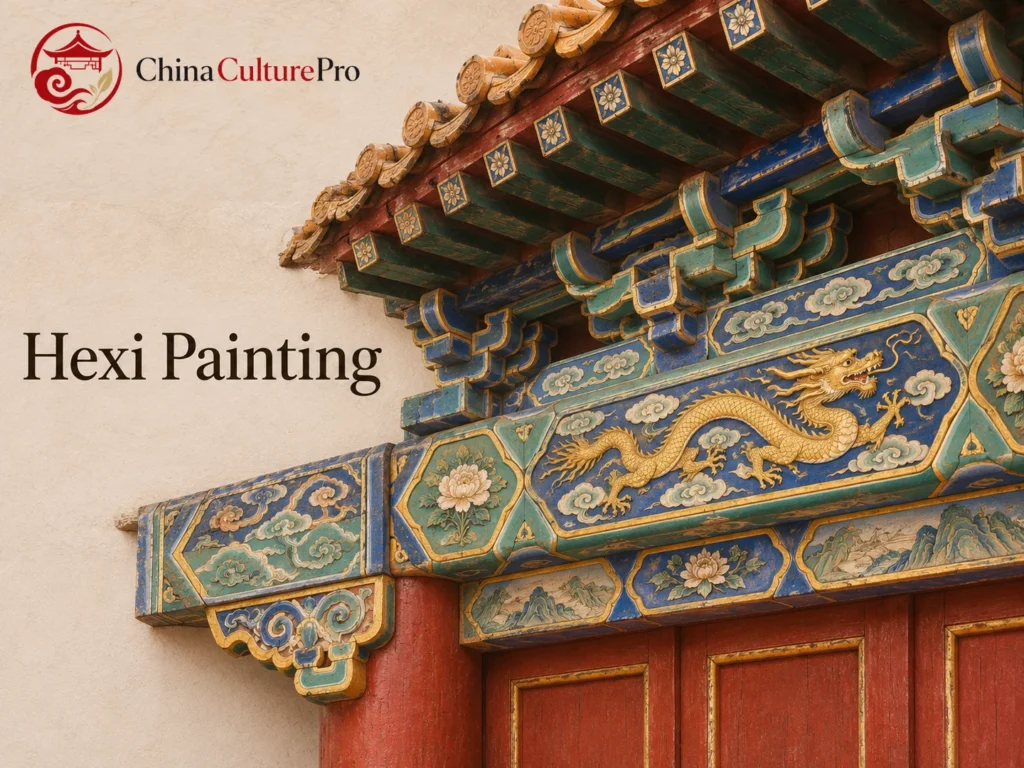
Hexi painting (和玺彩画, héxǐ cǎihuà) is the highest-ranking category of Qing architectural painting in the Palace Museum’s classification. It divides horizontal timbers into patterned zones and uses gilded outlines and dragon or phoenix motifs against strong colors. Look beneath the eaves and along the beam faces.[1][2][3]
- Structure: Curved divisions separate the long painted center from the smaller areas toward either end.[1]
- Surface: Raised lines with gold leaf make some patterns catch the light.[1][2]
- Motifs: Golden-dragon and dragon-and-phoenix designs use the layout differently.[2][3]
Read the composition and the motif together. Gold can also appear in other categories of architectural painting.[1][4]
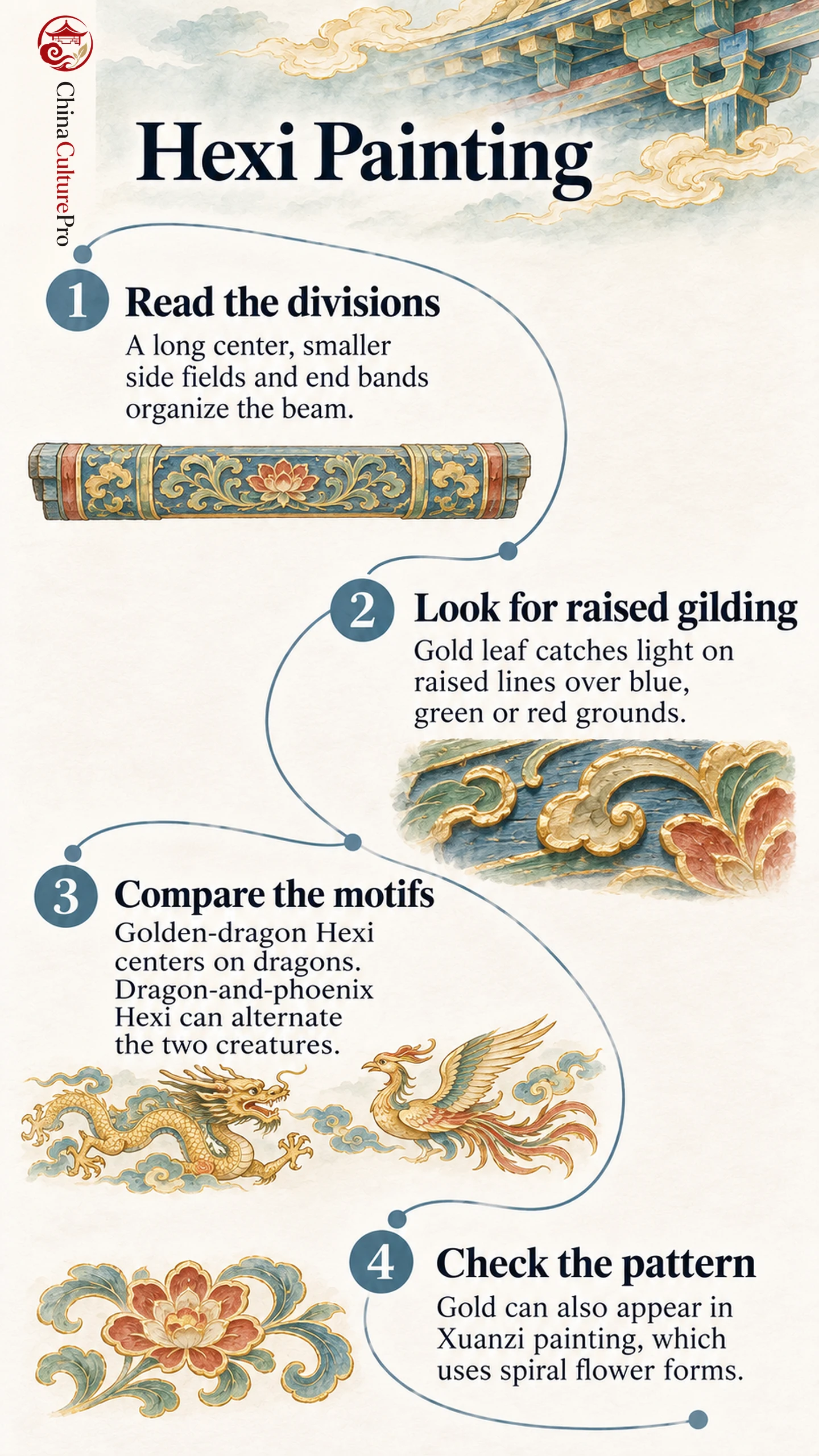
Stand far enough back to see the full length of a beam. The long center and the smaller fields at either side become easier to pick out before you look for individual animals.[1][2]
The Three Parts of a Painted Beam
Find the central field (枋心, fāngxīn), which usually carries an extended composition. Toward its ends are the side sections (找头, zhǎotóu). The end bands (箍头, gūtóu) close the design nearer the ends of the timber. Curving lines mark the divisions. On repeated beams, this arrangement helps the eye recognize which motifs occupy comparable positions.[1][2]
Raised gilding is another clue. The Palace Museum describes a technique in which a painter traces the pattern with a raised paste and applies gold leaf over the relief. Raised outlines contrast with blue, green or red backgrounds. Viewed at an angle, the relief catches light even when individual details are too far away to see.[1][2]
Golden Dragons and Dragon-Phoenix Designs
In gold-dragon Hexi (金龙和玺, jīnlóng héxǐ), dragon figures dominate the beam. The Palace Museum describes a common arrangement of two dragons and a pearl in the central field. It records this category on both the inner and outer eaves at Baohe Hall in the Forbidden City.[2]
In dragon-and-phoenix Hexi (龙凤和玺, lóngfèng héxǐ), the two creatures can alternate across parts of the design. The Palace Museum records this style on the beams of Jiaotai Hall, where the Qing court kept its twenty-five imperial seals. The central field can carry two dragons, two phoenixes or one of each.[3]
How to Tell Hexi from Other Palace Painting
Xuanzi painting (旋子彩画, xuánzǐ cǎihuà) uses spiral flower forms as a major organizing motif. It can also use gold. At Jingyang Palace, the Palace Museum records dragon Hexi beneath the outer eaves of the main hall and Xuanzi painting in its interior eaves. Comparing the fields and motifs helps distinguish these neighboring forms of Chinese architectural decoration.[1][4]
For a closer reading, compare the contours around the painted fields. A Palace Museum study of the Yangxin Hall precinct used differences in the straightness of those lines and in the shading beside them to compare painting periods. In the examples discussed there, straight main lines with shading on the outside helped distinguish some later Qianlong-period work from curved outlines on earlier painted surfaces. That is a comparison of documented surfaces, and the same dating test needs evidence from the building at hand.[5]
FAQs About Hexi Painting
Is Hexi the highest-ranking Qing architectural painting?
The Palace Museum places Hexi at the top of the Qing architectural painting hierarchy. Golden-dragon Hexi is its highest-ranking form.[1][2]
Where on a building should I look for it?
Look under the eaves at the faces of the horizontal timbers. Some halls also have related painting on the inner eaves.[2][3]
Does the age of the hall tell you when a beam was painted?
Conservation studies distinguish painting campaigns within buildings. Use research on the particular surface to date its design.[5]
Sumber
[1] The Palace Museum. Hexi Architectural Painting
[2] The Palace Museum. Baohe Hall, Golden-Dragon Hexi and Raised Gilding
[3] The Palace Museum. Jiaotai Hall and Dragon-and-Phoenix Hexi
[4] The Palace Museum. Jingyang Palace and Xuanzi Painting
[5] The Palace Museum. Research on Historic Architectural Painting in the Yangxin Hall Precinct