


Quick Answer: Who Was Fang Xiaoru?
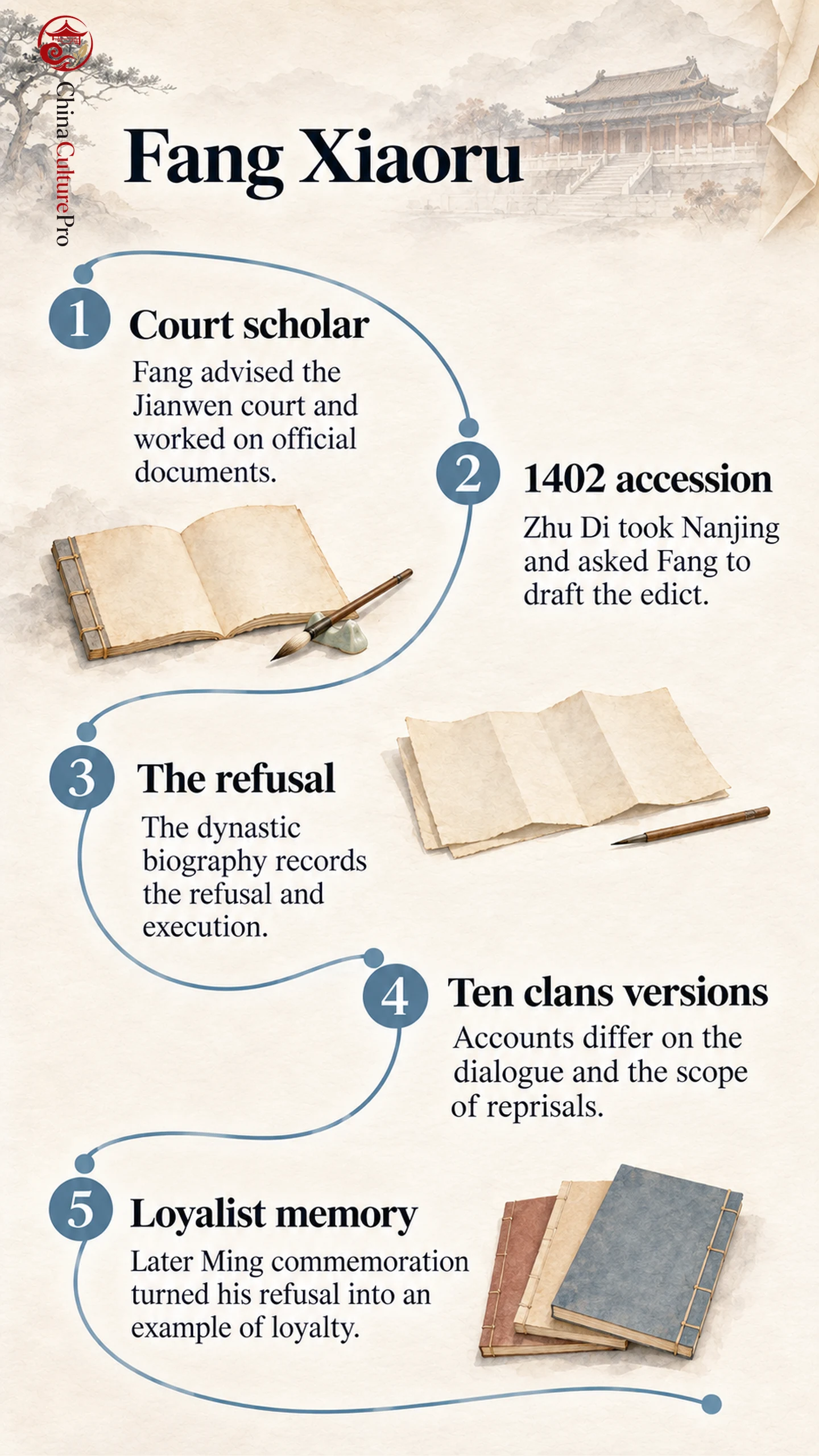
Fang Xiaoru (方孝孺, Fāng Xiàorú, 1357–1402) was a Ming scholar, court lecturer and adviser to the Jianwen Emperor. After Zhu Di seized the throne, the official biography says Fang refused to draft the new emperor’s accession edict. He was executed, and relatives and associates were also punished.[1][2]
- Court role: He helped prepare records and documents for the Jianwen government.[1]
- Point of refusal: The new ruler asked him to put the accession into the language of a public imperial edict.[1]
- Later story: Some accounts describe punishment extending to “ten clans,” with accounts differing over the wording and scope.[1][2][3][4]
The sources give a clear core of his story: service to Jianwen, execution in 1402 and reprisals that reached beyond Fang himself. The exact conversation and punishment categories deserve closer reading.[1][2][3]
When Zhu Di took Nanjing in 1402, he needed to announce his accession. A court scholar who had drafted documents for the previous emperor was asked to supply the words. His refusal became a story about the risks of refusing to recognise a new ruler.
What Fang Did for the Jianwen Court
Before joining the central court, Fang taught and studied in the Confucian scholarly tradition. The official History of the Ming describes him serving as a lecturer in the Hanlin Academy, explaining books to Jianwen and receiving requests for advice. He also took part in compiling records and drafting official documents.[1]
Those duties mattered when Zhu Di, the Prince of Yan, challenged Jianwen. Fang had already put the court’s position into written orders. The overview of the Ming dynasty places the dispute within the succession of the early reigns.[1][2]
What an Accession Edict Meant in 1402
The Jingnan campaign (靖难之役, Jìngnàn Zhī Yì) ended with Zhu Di’s forces entering Nanjing. The official biography presents the new court asking Fang to draft an edict announcing the succession. An accession edict spoke in the ruler’s name and publicly announced the new reign. The choice of a prominent writer from the defeated court gave the request particular political force.[1][2]
The same source describes Fang refusing and Zhu Di ordering his execution. The Yongle Emperor thus enters Fang’s biography at the moment when military victory had to be expressed as a claim to rule.[1][2]
Where the “Ten Clans” Story Comes From
The dynastic biography names relatives and associates who suffered and describes hundreds of executions over time. A separate account of Jianwen’s reign gives Fang a defiant reference to ten clans in the dialogue while describing nine clans in its account of the ensuing punishment. A familiar retelling adds students and peers as the tenth group. The texts therefore attach different meanings and scopes to the number.[1][3][4]
Later Ming commemoration cast Fang as a loyal official who accepted death in the service of his ruler. Historian Peter Ditmanson follows changing versions of Fang’s image through the mid- and late Ming. The later accounts show how his refusal became an example of loyalty, even when details of the punishment differ.[1][2]
FAQs About Fang Xiaoru
Why did Fang Xiaoru refuse to write the edict?
The official biography presents his refusal in the context of his service to Jianwen and his unwillingness to draft a proclamation for the ruler who displaced him.[1][2]
Was the execution of ten clans a settled legal fact?
The sources describe broad reprisals against relatives and associates. The ten-clans label comes through versions that differ in how they present the punishment and who they count.[1][3][4]
Sumber
[1] History of the Ming. Volume 141: Biography of Fang Xiaoru
[2] Peter Ditmanson. Death in Fidelity: Mid- and Late-Ming Reconstructions of Fang Xiaoru
[3] Wikisource transcription. Traces of the Jianwen Emperor
[4] ChinaCulture.org. A Familiar Retelling of Fang Xiaoru’s Story