


Quick Answer: Who Are Da Qiao and Xiao Qiao?
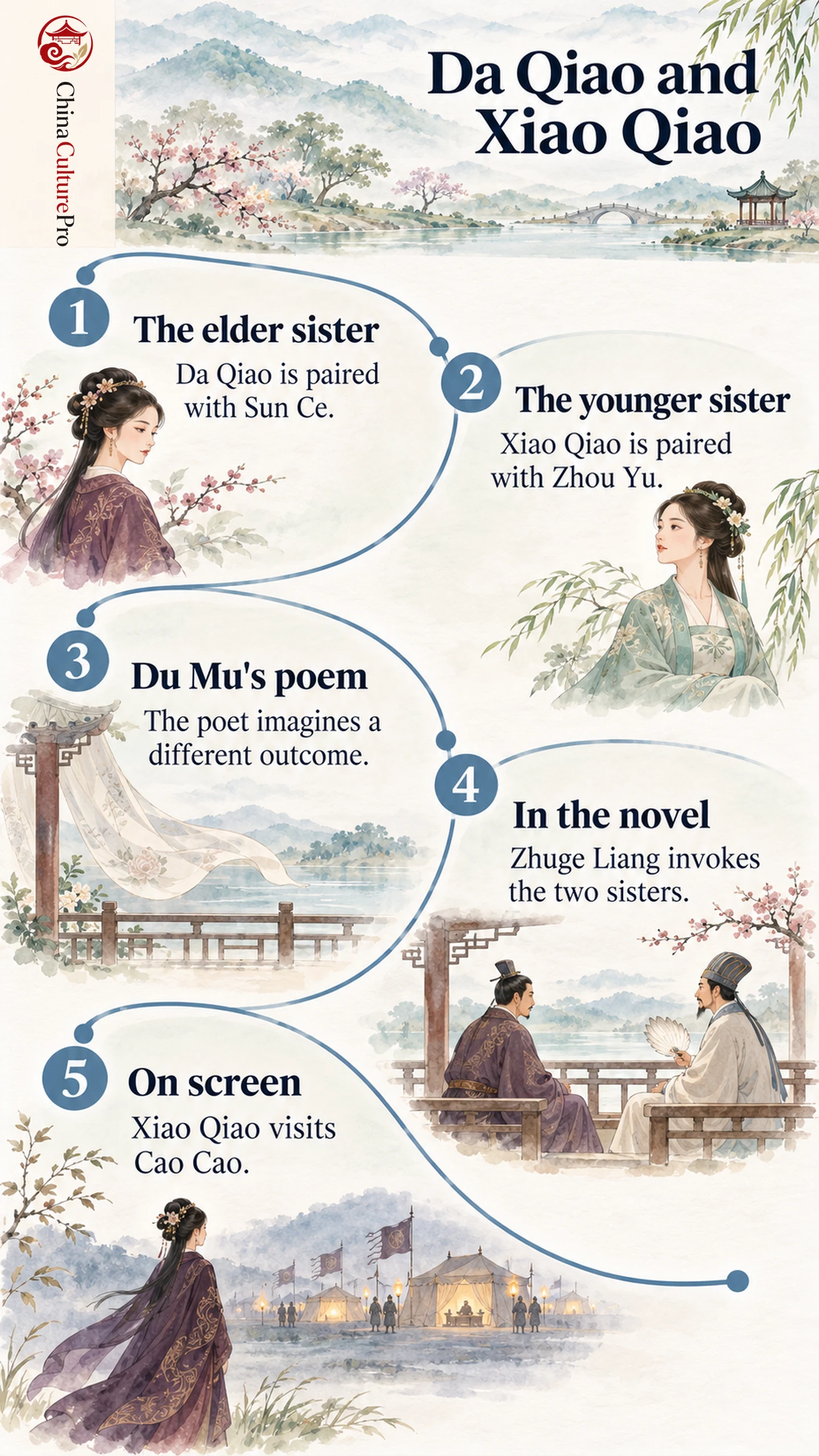
Da Qiao (大乔, Dà Qiáo) and Xiao Qiao (小乔, Xiǎo Qiáo) were sisters known through the late Han figures Sun Ce and Zhou Yu. The Records of the Three Kingdoms (三国志, Sānguó Zhì) pairs the elder sister with Sun Ce and the younger with Zhou Yu. In the later Romance of the Three Kingdoms (三国演义, Sānguó Yǎnyì), their names are drawn into the debate over whether to resist Cao Cao before the Battle of Red Cliffs.[1][3]
- Names: Da and Xiao distinguish the elder and younger sisters. The historical passage preserves the family name in the form 橋.[1][2]
- Red Cliffs: The Tang poet Du Mu imagined the sisters being held captive if Zhou Yu had lost. The novel turns that possibility into a provocation spoken aloud.[2][3]
- Film: Xiao Qiao has an active part in John Woo’s two-part Red Cliff. In the 2009 second part, she visits Cao Cao in person.[4]
The historical passage, poem, novel and film give the sisters different roles. The 2009 film scene is discussed below.
The sisters are easy to identify and hard to know. Later writers could adopt two familiar names without inheriting much of a life story. The way each writer uses that freedom tells us what kind of story they are telling about Red Cliffs.
What the historical record says about the Qiao sisters
The encounter appears in Zhou Yu’s biography in Chen Shou’s Records of the Three Kingdoms. It comes after a passage about Sun Ce and Zhou Yu campaigning together and taking Wan. The biography introduces the women as the two daughters of a man referred to as Lord Qiao. It remarks on their beauty and records which sister became each man’s partner. The biography records the two pairings in a few words and leaves the sisters’ own perspectives unrecorded.[1]
The shared Qiao name explains why English accounts often call them “the Qiao sisters.” In the historical edition cited here, 橋 is the form of the name. Later sources use 喬, which is written 乔 in simplified Chinese. The sound of the surname stays the same. The biography later describes the alliance that resisted Cao Cao, but in its account of the battle the sisters have no recorded military role.[1][2]
How Red Cliff turned the sisters into a literary motif
In his short poem Red Cliff, Du Mu imagines what would have happened if an east wind had failed to favor Zhou Yu. The poet’s image of defeat is the two women shut inside the Bronze Bird Terrace (铜雀台, Tóngquè Tái), associated with Cao Cao. A battle that could be measured in lost ships and territory is imagined instead through the fate of two named people. The wind is the hinge of the poem. It changes whose household will bear the cost of defeat.[2]
In chapter 44 of Romance of the Three Kingdoms, Zhuge Liang tells Zhou Yu that Cao Cao covets the sisters. He recites a version of a rhapsody attributed to Cao Cao’s son Cao Zhi, with a pun that turns two bridges into two women whose surname sounds like the word for bridge. Zhou Yu, who has been talking as though he favors surrender, immediately points out that one woman is his wife and the other was Sun Ce’s. Zhuge Liang pretends to have learned this only now.[3][5]
The chapter gives one more turn to the exchange. Zhou Yu says he was testing his listeners and had already decided to fight. The scene shows two alert negotiators trying to discover each other’s real intentions. The sisters’ names make the test personal, and the apparent offer of a settlement becomes a way for each man to gauge the other.[3][5]
How John Woo’s Red Cliff changes Xiao Qiao’s role
The Hong Kong Film Archive draws attention to a scene the filmmakers created for the 2009 second part. Xiao Qiao, played by Lin Chi-ling, visits Cao Cao alone at night. In Du Mu’s poem the imagined defeat would put her under his control. On screen she has chosen to enter his camp before the outcome is settled. The novel’s parley is an argument among men about what could be done to the sisters. The film asks viewers to watch what the younger sister does herself.[2][3][4]
FAQs About Da Qiao and Xiao Qiao
Who were the Qiao sisters’ husbands?
The historical record pairs the elder Da Qiao with Sun Ce and the younger Xiao Qiao with Zhou Yu. The novel also identifies the partners in chapter 44.[1][3]
Are Da Qiao and Xiao Qiao their given names?
The two labels mean elder Qiao and younger Qiao. Zhou Yu’s biography does not preserve separate given names for the sisters.[1][2]
Did the Qiao sisters cause the Battle of Red Cliffs?
The historical account describes an alliance formed to face Cao Cao’s southern advance. A threat involving the sisters appears in poetry and fiction, where it serves different purposes.[1][2][3]
Sumber
[1] Chen Shou. Records of the Three Kingdoms, Zhou Yu’s biography and the Battle of Red Cliffs
[2] Kementerian Pendidikan Taiwan. The two Qiaos and the closing lines of Du Mu’s Red Cliff
[3] Romance of the Three Kingdoms. Chapter 44, Zhuge Liang and Zhou Yu
[4] Hong Kong Film Archive. Programme for the second part of John Woo’s Red Cliff
[5] Nanhua University Institutional Repository. A study discussing the provocation in chapter 44