


Quick Answer: How Do You Read a Chinese Reign Year?
An era name (年号, niánhào) identifies a period. The number that follows counts from the first year (元年, yuánnián) of that era. The fifth year of Kangxi (康熙, Kāngxī), for example, began in 1666 and ran into January 1667. [1][2][3][4][7]
- Identify the era: Use the dynasty or ruler if the era name appears more than once in history. [1][5]
- Count the year: Start with year one of the named era. The ruler’s accession may fall in an earlier year. [1][2]
- Convert the date: For a specific day, preserve the Chinese month, day and any leap-month marker (闰, rùn). [4][5]
The era and year identify a range. A complete date includes the month and day.
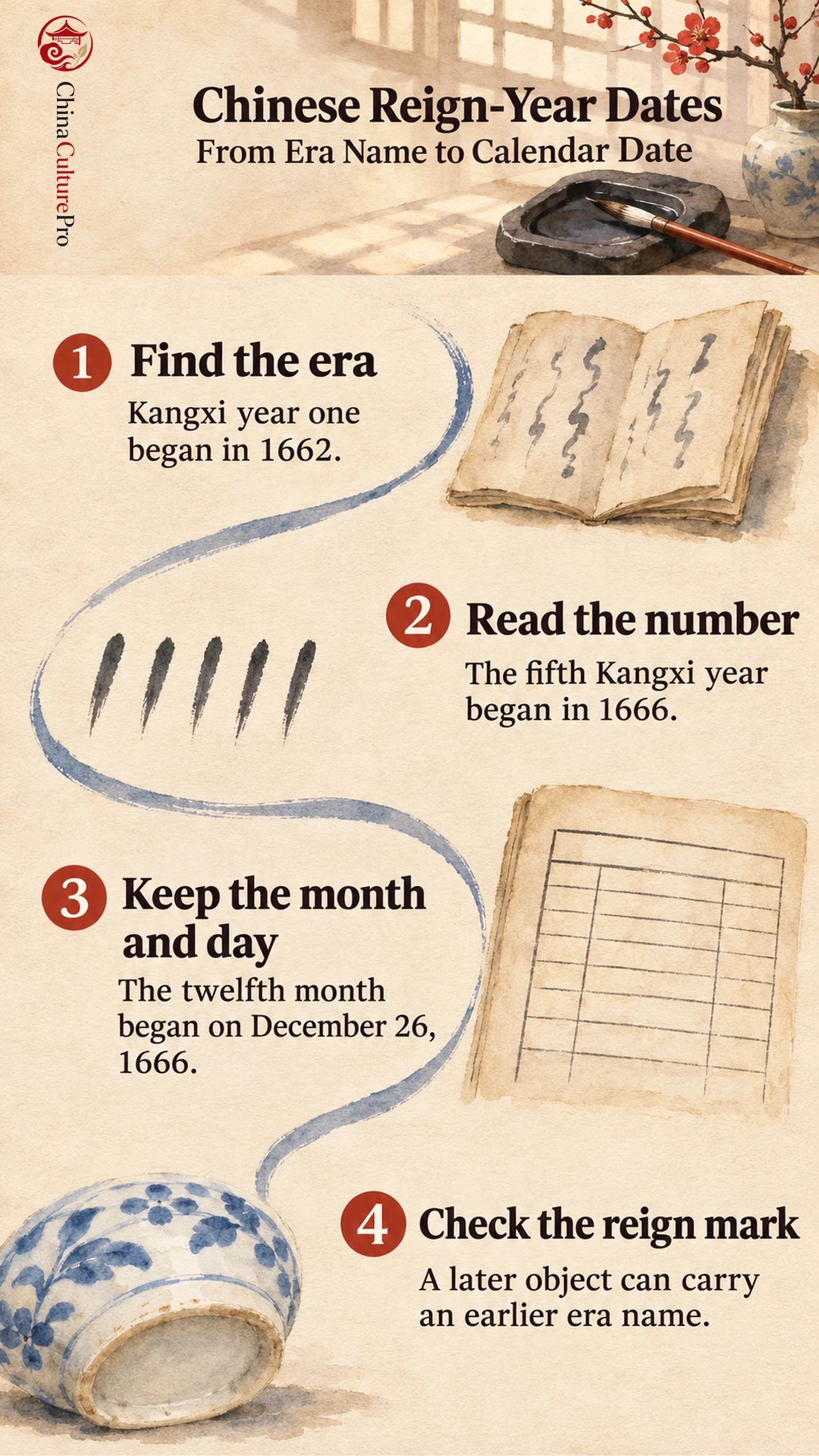
The Kangxi emperor took the throne in 1661, during the last year of the Shunzhi era. Kangxi year one began at the next Chinese New Year, in 1662. Use 1662 as the starting point when a source numbers a year in the Kangxi era. [1][2]
Era Name, Year, Month and Day
In a date such as Kangxi fifth year, twelfth month, first day, Kangxi identifies the Qing era. The fifth year counts four years forward from 1662. The following words give the month and day in the historical Kalender Tionghoa. Keep the leap-month marker with the month number. In Kangxi year six, the ordinary fourth month and the leap fourth month started a month apart. [1][4][5]
A ruler could use several era names over one reign, a practice common before the Ming and Qing dynasties. A new name might start partway through a year. A calendar table supplies the date on which the era began. Academia Sinica’s converter can use the dynasty and ruler along with an era name that has been used more than once. [2][3][5]
A Worked Conversion From the Kangxi Era
Add four to the year in which Kangxi year one began. The result, 1666, is the Gregorian year in which year five started. The Qing calendar table gives February 4, 1666 as the first day of year five. It places the first day of the twelfth month on December 26, 1666. Year six starts on January 24, 1667, so January 23 still falls in Kangxi year five. [2][3][4]
Read across the table from the era year to the start of the specified month. For a day other than the first, move forward by one day less than its number. If the source contains a leap-month marker, locate that column or use the explicit leap-month field in a converter. Keep the original date alongside the result so another reader can reproduce it. [4][5]
How to Read a Reign Mark on Porcelain
On porcelain, a reign mark may give only the era and a phrase meaning made during that era. The National Gallery of Art identifies a Kangxi-period blue-and-white vase whose mark names the earlier Xuande reign (宣德, Xuāndé). The catalogue dates the vessel to the Qing dynasty and identifies the mark as a later use of a Ming era name. The two entries answer different questions about the same object. [6]
FAQs About Chinese Era Dates
Can the same Chinese reign year fall in two Gregorian years?
Yes. Kangxi year five began in February 1666 and ended in January 1667. A year heading such as 1666 is a convenient label for the year in which it began. [3][4]
Why do historical sources give different Western dates?
Check whether they use the Gregorian calendar or the older Julian calendar. Academia Sinica’s tool documents its default changeover and allows a different convention when a historical source requires it. [5]
Sumber
[1] Taiwan Ministry of Education. Index of Chinese Era Names
[2] Tristan G. Brown, Princeton University Press. Dates of Qing Era Names
[3] Oxford University Press. Chronologies in Languages, Scripts, and Chinese Texts in East Asia
[4] Yuk Tung Liu. Chinese-Western Calendar Tables for the Qing
[5] Academia Sinica. Chinese and Western Calendar Conversion
[6] National Gallery of Art. Decorative Arts, Part II
[7] Taiwan Ministry of Education. First Year