

Quick Answer: How Do Chinese Fan Communities Work?
Chinese fan communities form around performers, fictional works, games or other interests. Fans may share interpretations, make art, organize meetups or help a performer reach a wider audience. Fanquan (饭圈, fànquān) often refers to organized idol fandom. Its activities can involve coordinated teams and shared expectations, while other fan groups may organize around creative work or informal discussion. [1][2][3][4]
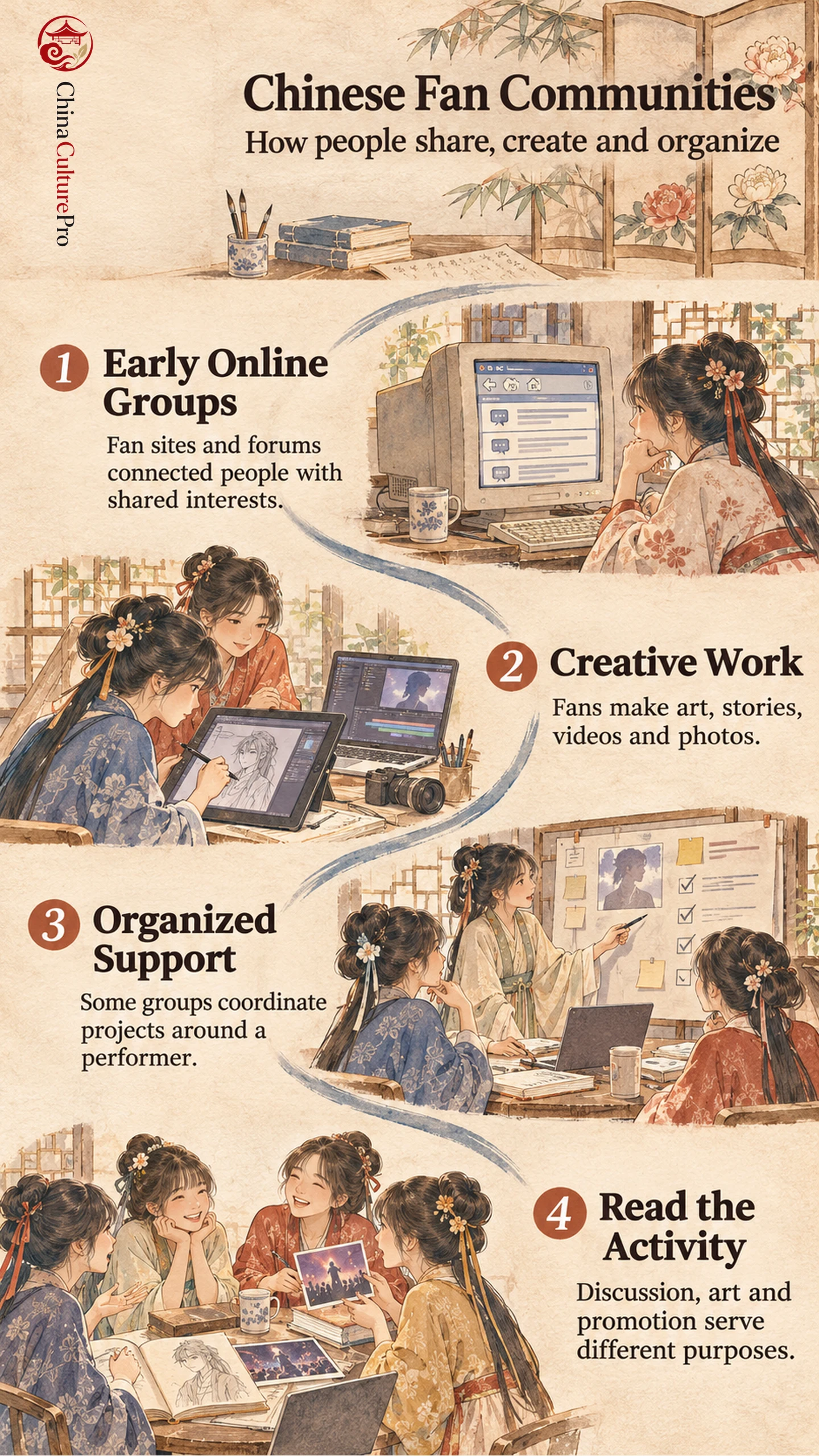
- Discussion: People share reactions, interpretations and references. [1][3][5]
- Creative work: Groups may make fiction, videos, photos or costumes. [3][4][5]
- Organized support: Some idol groups coordinate updates, fan projects and promotional work. [2][4][6]
The group’s purpose and activities tell you more than the fact that its members are fans.
One group might write stories around a television show. Another might edit videos or run an account that posts updates about a singer. Both are forms of fandom, but they create different things and give members different reasons to participate. [1][3][4][5]
From Fan Websites to Large Social Platforms
Weiyu Zhang’s history of Chinese online fandom follows early websites devoted to stars from Hong Kong and Taiwan and the later spread of fan activity across platforms. Message boards and later social networks gave fans different ways to find one another and share their work. [1]
Hunan Satellite TV’s Super Girl became a prominent case in the mid-2000s. The 2005 season helped bring organized audience support into wider view. A study of an online community around the 2006 season records fans writing and discussing fiction based on contestants. Viewers could organize around contestants or write stories that used the show as a starting point. [2][3]
How Creative Fandom Works
Fans may write fiction, draw art, edit videos or stage photographs. A new work can pick up a scene, character or relationship and give it another interpretation. The work can then become the center of a discussion among people who share the reference. The guide to ACG culture in China describes a setting where animation, comics and games intersect. [3][4][5]
A photo set can involve someone who makes a costume, a person who performs in it and another who takes or edits the pictures. See Chinese cosplay culture for that kind of collaboration. The guide to Chinese fan translation history explains another way groups work together to make media more accessible to fellow viewers. [4][5]
What an Organized Idol Group Can Do
Researchers use fanquan in work on organized idol fans, including groups that set expectations and assign tasks. A support club, or houyuanhui (后援会, hòuyuánhuì), can run accounts, publish schedules or organize teams for projects. Studies of different groups describe different levels of formality. [2][4]
Researchers also use the phrase data fandom for organized work focused on measurable online attention. One study of eight Weibo groups examined how a core group directed reporting activities. The findings apply to the eight groups examined. The study found that the fans directing the work and those carrying it out could have different levels of visibility and authority. [4][6]
How to Read What a Group Is Doing
| Aktivitas | What the Group Is Working On |
|---|---|
| Discussion and interpretation | A shared reading of a story, performance or character. [3][5] |
| Creative production | A work such as fiction, a photo series or an edited video. [3][4][5] |
| Organized idol support | Updates, promotions or another coordinated project around a performer. [2][4][6] |
People can move between these activities. When reading a post or an account profile, look for the group’s subject, the work it asks members to do and whether its rules apply to everyone who follows it. Those details make it easier to understand what participation means in that setting. [1][2][4]
FAQs About Chinese Fan Communities
Does fanquan mean every kind of fandom?
It can be used broadly, but research on organized idol groups often uses it for fan circles with shared expectations and coordinated activities. A casual group discussing a novel may work differently. [1][2][3]
What is a houyuanhui?
It is a support club. Some manage accounts, coordinate projects and organize teams around a performer. Its structure and activities depend on the group. [2][4]
Do Chinese fan communities only meet online?
Online platforms make it easier to share work and find other fans. Some groups also take part in in-person performances, photo shoots or other gatherings. [4][5]
Sumber
[1] Weiyu Zhang, Global Media and China. The Thirty Years of China’s Online Fandom
[2] Mao Dan, Wang Jingya and Chen Jiajun, The Journal of Chinese Sociology. Observations of Chinese Fandom
[3] Ling Yang and Hongwei Bao, Cultural Studies. Queerly Intimate: A Super Girl Fan Fiction Community
[4] International Journal of Cultural Studies. East Asian Pop Music Idol Production and the Emergence of Data Fandom in China
[5] The Journal of Chinese Sociology. The Art Worlds of Gender Performance
[6] Haoyang Zhai and Wilfred Yang Wang, International Journal of Communication. Fans’ Practice of Reporting