


Quick Answer: What Can Represent Courage in Chinese Culture?
Yong (勇, yǒng) is a Chinese character associated with courage and daring. In Chinese art a tiger can suggest bravery, but the object’s use matters. A tiger on a Qing officer’s badge had a formal meaning. A tiger on a child’s garment could express a family’s wish for protection.[1][4][5]
- A written word: The character can appear on its own or in compounds that specify the kind of courage.[1]
- A military emblem: The tiger design identified a rank within the dress system of its dynasty.[4]
- A protective animal: A fierce tiger face on a bib belonged to a set of images intended to guard the child in folk belief.[5]
The character carries a word’s meaning. A tiger image draws part of its meaning from where it appears.
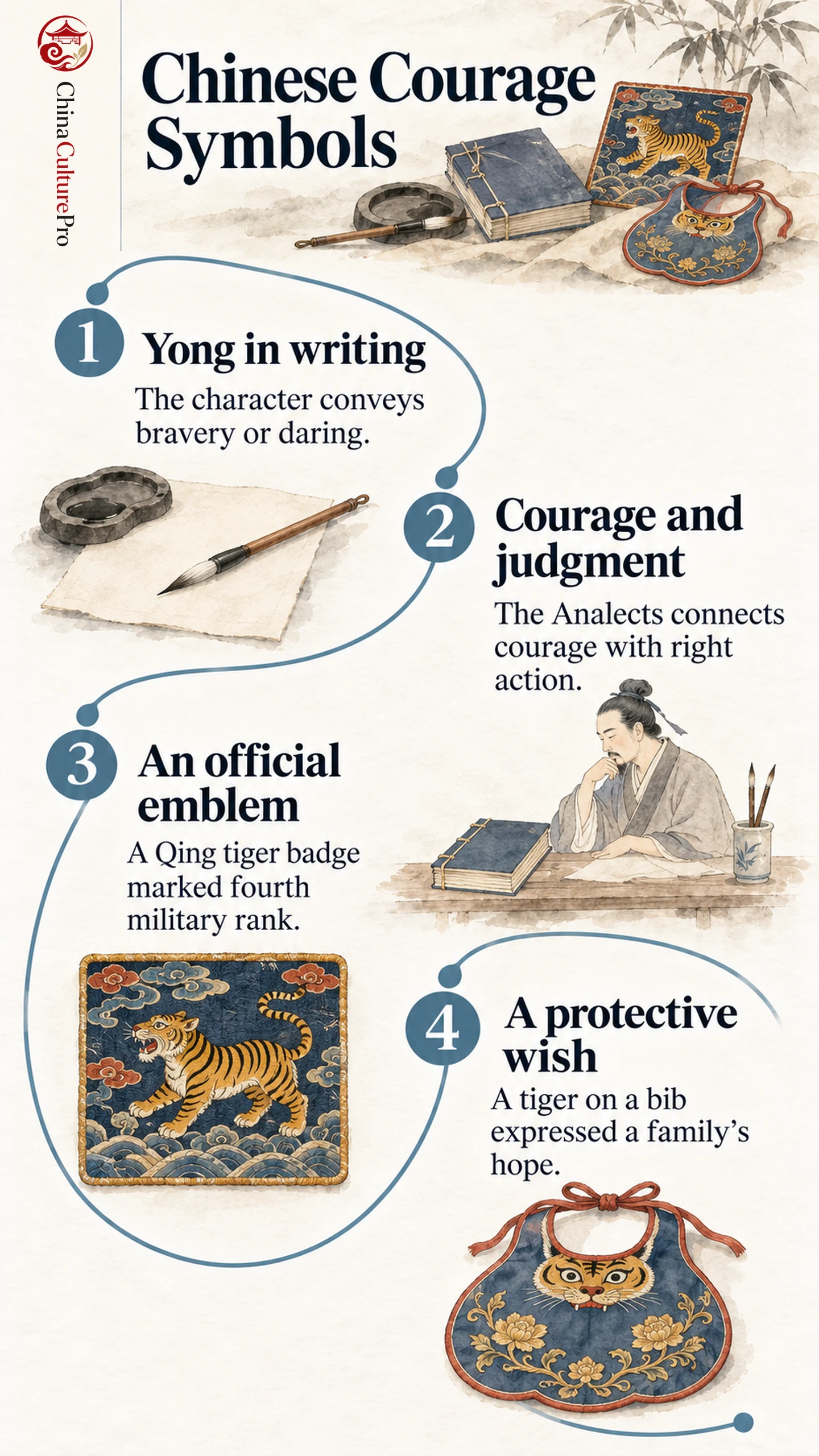
A motto spells out a quality. On a robe or bib, the tiger image takes on meaning from the person and garment it was made for.[1][4][5]
Yong in Writing and Everyday Speech
The common word for courage (勇气, yǒngqì) gives a direct, recognizable expression of the quality. Yong by itself can be read as brave or daring. It is also used in expressions about taking responsibility or having the nerve to correct a fault. Those uses show why the word can fit a moral decision as well as a physical challenge.[1]
For a short written motto, yong can stand alone as a character. For ordinary prose about finding the courage to do something, yongqi may express the noun more directly. The broader guide to Chinese symbols for strength covers a separate set of meanings such as resilience and endurance. Yongqi suits a message about daring to act; endurance may call for a different word.[1]
How the Analects Connects Courage With Right Action
The Analects describes the failure to act when one sees what is right as a lack of courage. Here the test is whether someone acts on a judgment. The term rightness (义, yì) concerns what one ought to do, so the passage links courage with a decision, without needing a battle or a display of physical strength.[2]
In another passage, the disciple Zilu asks whether the cultivated person prizes courage. Confucius puts rightness first and warns that courage without it can produce disorder or theft. The two passages address opposite errors. A person can fail by seeing what ought to be done and doing nothing, or by acting boldly with little regard for whether the action is right.[2][3]
The Tiger on a Military Rank Badge
A rank badge (补子, bǔzi) carried the sign of an official’s grade on a robe. An eighteenth-century Qing tiger badge uses silk and metallic thread. In the Qing system, a tiger could mark the fourth military rank. The same animal denoted the third military rank in the Ming system.[4]
The link between the tiger and bravery gives the emblem a cultural context, but the badge was part of a dress code. Its wearer held a particular grade under a specific system. The dynasty and the type of garment determine which rank the animal identifies.[4][5]
The Tiger on a Child’s Clothing
A Qing tiger-shaped bib uses blue silk damask, a face with paws and whiskers, and a gold-thread character for king on the forehead. The animal’s face sits at the opening around the neck, and other auspicious signs are arranged across the body of the bib. In this setting the tiger could be understood as a guard against harmful forces in traditional belief.[5]
The bib also contains figures linked with the Five Poisons (五毒, wǔdú). These images belong to a protective setting that differs from the insignia of an official robe. A similar attention to the face of the tiger appears in tiger-head shoes. The wearer’s age, the part of the body covered and the companion motifs help distinguish the intended use.[5]
FAQs About Chinese Courage Symbols
Which Chinese word directly means courage?
Yongqi is a common noun for courage. The single character yong conveys bravery or daring and can be used on its own in a short motto.[1]
Does every tiger image represent bravery?
The tiger has several associations. A court badge can identify military rank, while a child’s bib can express a family’s protective wish.[4][5]
Sumber
[1] Ministry of Education, Taiwan. Revised Mandarin Chinese Dictionary: Yong
[2] Chinese Text Project. The Analects: Wei Zheng
[3] Ruism. The Analects: Yang Huo 17.23
[4] The Metropolitan Museum of Art. Rank Badge with Tiger, 36.65.11
[5] University of Alberta Museums. Ferocity and the Five Poisons: Symbolism on Qing Dynasty Children’s Clothing