


Quick Answer: What Were the Main Chinese Ceramic Kiln Types?
Chinese ceramic kilns included elongated hillside kilns, rounded chambers and forms developed for particular production centers. The chamber shaped the path of hot gases and affected where different wares could be fired.[1][2]
- A dragon kiln (龙窑, lóngyáo) stretches uphill along a slope.[2]
- A mantou kiln (馒头窑, mántouyáo) has a rounded chamber named for a steamed bun.[1]
- Jingdezhen used waisted gourd-shaped kilns and later the egg-shaped kiln (蛋形窑, dànxíngyáo), among other forms.[4][6]
A ground plan helps identify the kiln. Fragments and firing equipment help identify the work done inside.
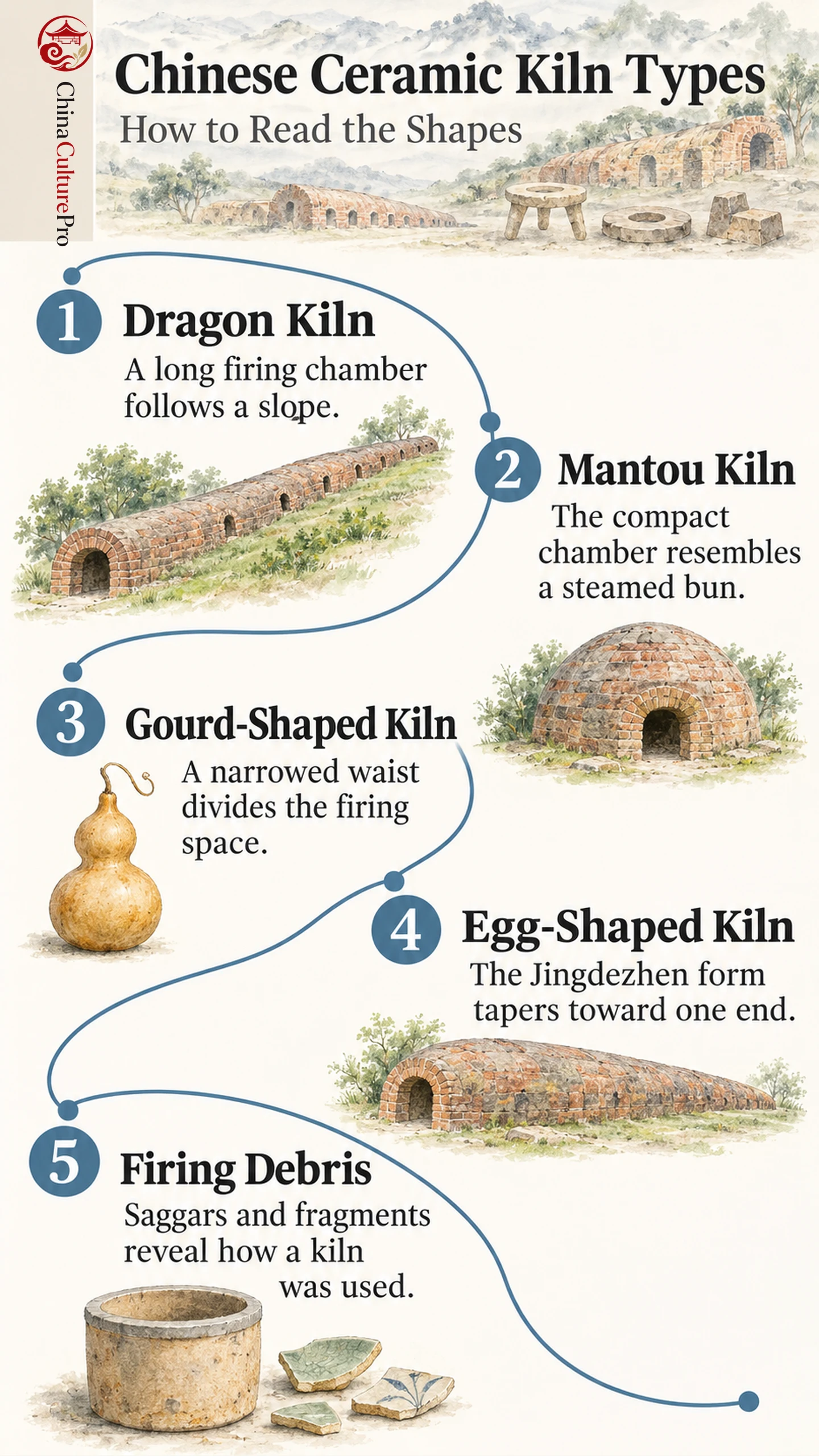
A dragon kiln takes its name from the length of its body. A mantou kiln takes its name from the shape of its chamber. These names are practical descriptions that can help you read a photograph or an excavation plan.
Dragon Kilns and the Hillside
A dragon kiln is long and narrow. Heat moves through the body from the lower end toward the upper end. Its size allowed southern Chinese potters to fire large batches. The conditions could vary along the length, so the positions of wares within the kiln mattered.[1][2]
Longquan celadon gives a concrete example of how closely a ware can depend on firing. The documented tradition calls for close attention to heating and cooling. The kiln is part of that history, alongside the clay body and glaze.[5]
Mantou Kilns and the Rounded Chamber
The mantou kiln concentrates the firing space in a rounded chamber. It was characteristic of many northern workshops, where its compact shape helped potters maintain steadier conditions. Excavated mantou forms at Jingdezhen show that the broad association with northern China has exceptions.[2][3]
Compare the outline from above first. Archaeologists also distinguish a pottery kiln from an iron blast furnace, which made metal from ore. A long chamber following a slope and a compact rounded chamber give you different clues, even if neither roof survives in full.
Gourd and Egg-Shaped Kilns at Jingdezhen
A gourd-shaped kiln has a narrowed middle separating front and rear spaces. An egg-shaped kiln has a broad chamber that narrows toward one end. Read together, the forms show changes in the design of firing spaces at Jingdezhen porcelain workshops.[1][6]
The Ancient Kiln Folk Customs Exhibition Area preserves a Qing kiln as well as newer reconstructions of earlier forms. Read the label to distinguish a surviving structure from a modern example built to demonstrate a design.[4]
What Firing Debris Reveals
A saggar (匣钵, xiábō) is a ceramic container that protects a piece from ash and debris during firing. Saggar fragments and failed wares can survive around a kiln. Together they help establish how workers loaded it and which ceramics they produced there.[1]
The firing traditions behind iron glazes, copper-red glazes and cobalt decoration involve different relationships between materials and heat. Some lead-glazed ceramics used a lower-temperature glaze firing.[7] These differences explain why kiln form alone cannot tell the whole story of Chinese porcelain and other wares.
FAQs About Chinese Ceramic Kiln Types
Was a dragon kiln always built on a slope?
The name refers to a long kiln traditionally laid out along a slope. Its elongated profile is a primary clue.[2]
What is the difference between a ceramic kiln and a blast furnace?
A ceramic kiln fires clay objects and any applied glaze. An iron blast furnace smelts ore to produce iron.
Are all kilns at Jingdezhen’s heritage park historic?
The park has a surviving Qing kiln and modern reconstructions of historical forms.[4]
Sumber
[1] Peking University Arthur M. Sackler Museum. Exhibition on ancient Chinese porcelain manufacture
[2] Asian Civilisations Museum. Ceramics Gallery large-print guide
[3] Chinese Social Sciences Net. Jingdezhen mantou kilns and their technological origins
[4] Jingdezhen Municipal Government. Ancient Kiln Folk Customs Exhibition Area
[5] UNESCO Intangible Cultural Heritage. Traditional firing technology of Longquan celadon
[6] Nanjing Museum. Exhibition on Jingdezhen imperial porcelain
[7] The Metropolitan Museum of Art. Tang tray with three-color glaze