

Quick Answer: What Are Earthly Branch Interactions in BaZi?
Earthly Branch interactions are named relationships among the lower characters in a BaZi (八字, bāzì) chart. Each of the four pillars has a Heavenly Stem above and an Earthly Branch (地支, dìzhī) below. You can check the lower characters against a list of established pairs and groups. [1][2]
- Pairs: The Six Combinations (六合, liùhé), Six Clashes (六冲, liùchōng) and Six Harms (六害, liùhài) each use two branches.
- Trios: A full Three Harmony set (三合, sānhé), also called a trine, has three named branches.
- Punishment patterns: Punishments (刑, xíng) include designated pairs or groups and certain repeated branches. [1][3]
A match identifies a relationship within the traditional system. Its interpretation depends on the other chart positions and the method being used. [2][3]
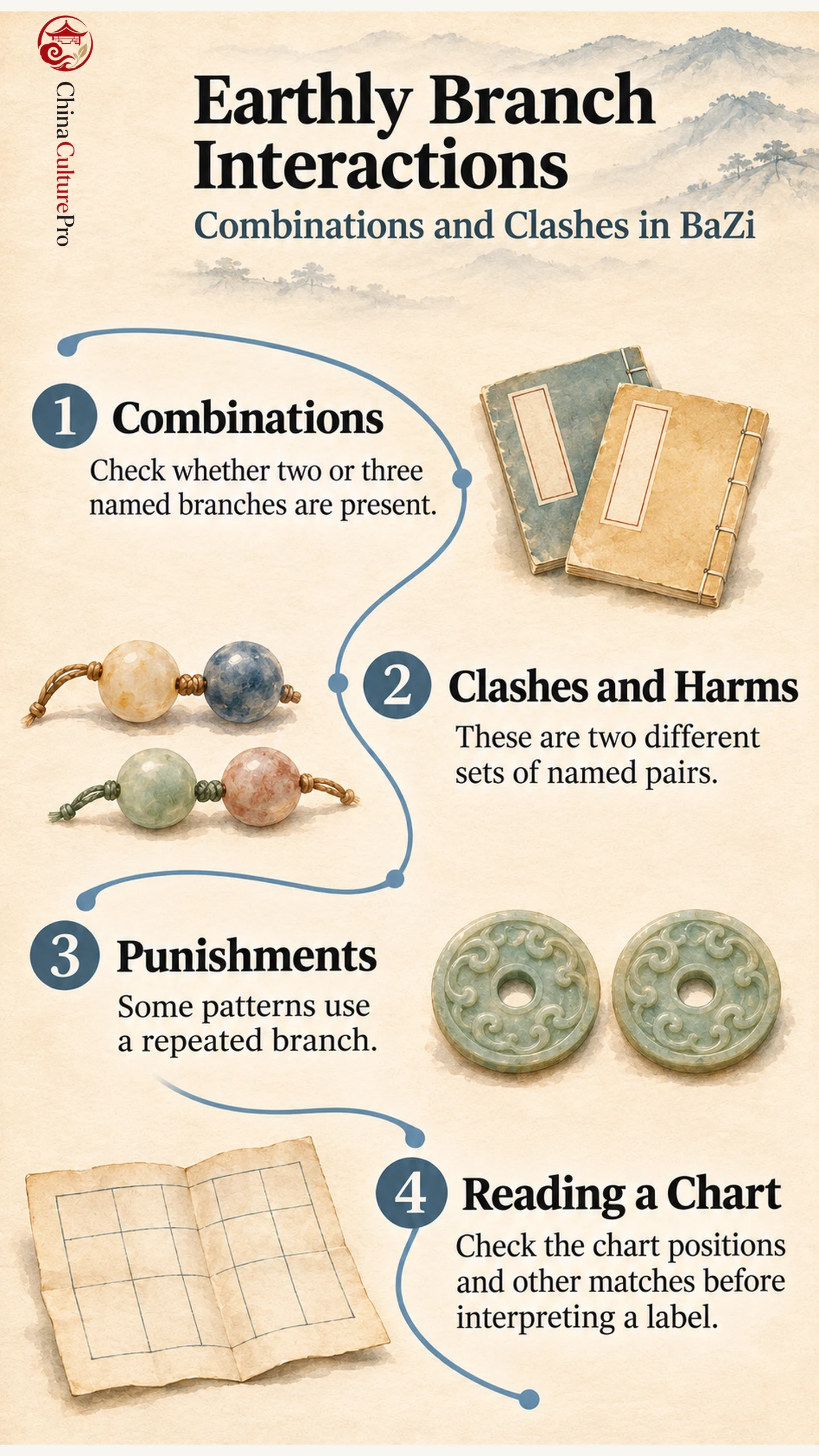
A printout can flag both a combination and a clash without making a mistake. One branch may have a named relationship with two other branches in separate pillars. The tables below let you check which branches are involved, then two short examples show what the same labels can and cannot tell you. [1][2]
Where to Find the Branches on a Four Pillars Chart
Read across the lower row of the year, month, day and hour pillars. If the chart prints both characters together, use the second character in each pillar. The upper characters follow separate stem rules. Our BaZi birth chart guide shows their positions and explains what the four columns represent. [1][2]
Use the branch characters to compare like with like. The twelve Earthly Branches also have animal names, so a teaching chart may say Tiger for Yín or Pig for Hài. For this lookup, the chart position matters too. Two people’s year animals give you a year-branch comparison. A single chart lets you compare branches across four different positions. [1][2]
Five Earthly Branch Relationships at a Glance
The following table uses a familiar set of traditional classifications. The pairings in each row stand on their own. Treat the English words as lookup labels when you read an interpretation. [1][2][3]
| Hubungan | Which branches match |
|---|---|
| Six Combinations | 子丑 Zǐ–Chǒu, 寅亥 Yín–Hài, 卯戌 Mǎo–Xū, 辰酉 Chén–Yǒu, 巳申 Sì–Shēn, 午未 Wǔ–Wèi |
| Three Harmonies | Water 申子辰 Shēn–Zǐ–Chén, Wood 亥卯未 Hài–Mǎo–Wèi, Fire 寅午戌 Yín–Wǔ–Xū, Metal 巳酉丑 Sì–Yǒu–Chǒu |
| Six Clashes | 子午 Zǐ–Wǔ, 丑未 Chǒu–Wèi, 寅申 Yín–Shēn, 卯酉 Mǎo–Yǒu, 辰戌 Chén–Xū, 巳亥 Sì–Hài |
| Six Harms | 子未 Zǐ–Wèi, 丑午 Chǒu–Wǔ, 寅巳 Yín–Sì, 卯辰 Mǎo–Chén, 申亥 Shēn–Hài, 酉戌 Yǒu–Xū |
| Punishments | 子卯 Zǐ–Mǎo, 寅巳申 Yín–Sì–Shēn, and 丑戌未 Chǒu–Xū–Wèi. Self-punishment is traditionally associated with repeated Chén, Wǔ, Yǒu or Hài. |
You may also see Seasonal Meetings (三会, sānhuì). These use consecutive branches of one season, such as Yín–Mǎo–Chén for spring Wood. The Wood trine instead uses Hài–Mǎo–Wèi. The two share Mǎo and differ in their other members. Some expanded references also list Breaks (破, pò) as a separate pair category. [2][3]
Two Worked Examples from Partial Charts
Example 1. Imagine the year branch is Yín, the month branch is Hài and the day branch is Shēn. Mark Yín–Hài as a combination, Yín–Shēn as a clash and Shēn–Hài as a harm. Keep all three labels on the worksheet. This lets you check which positions a report is comparing before it makes a separate argument about the strength of a relationship. [1][2]
Example 2. Imagine the lower row has Hài in the year and Mǎo in the month. The Wood trine also needs Wèi. If the remaining natal branches include Wèi, the three named branches are present in that birth chart. If Wèi appears only in a later year being compared, mark it in a separate column so no reader mistakes it for one of the four birth branches. Traditional methods can discuss partial sets, but the distinction between two named members and three still matters. [1][2]
Why Schools Can Interpret the Same Match Differently
A lookup table names the structure before any interpretation. Some schools check the season represented by the month branch, how close the branches are and whether other stems or branches support the same phase. For example, three Wood-trine members identify the group. An interpretation that says the chart transforms toward Wood makes a further claim under a particular method. The Five Elements guide explains the phase vocabulary used in such explanations. [1][2][3]
A Chinese zodiac compatibility chart gives a shorthand comparison of the animals linked with year branches. A Four Pillars reading can place those same two symbols in other positions or alongside conflicting matches. The traditional labels are useful for reading the system’s notation. They offer no reliable prediction of a couple’s outcome. [1][2]
FAQs About Earthly Branch Interactions
Can the same Earthly Branch take part in several relationships?
Yes. Check each pair or group separately first. Some methods then weigh the position, season and other branches to decide which relationship matters most in their interpretation. [2][3]
Is two out of three branches enough for a full Three Harmony set?
A full set has all three named members. Some traditions discuss partial sets, and a chart reader should identify which member is missing and whether it comes from a later time period. [1][2]
Sumber
[1] Wan Minying. Sanming Tonghui, volume 2
[2] Clarify. Earthly Branch combinations and clashes
[3] BaZi.uz. Branch Combinations and Other Interactions in BaZi